





Xmx in Java: JVM Heap Memory, Configuration &
Learn how to configure xmx java parameters to optimize JVM heap memory, prevent OutOfMemoryError, and pass your Java
Stop being a basic IT support cog. Get the globally non-negotiable CCNA credential that proves you can build, secure, and troubleshoot modern enterprise-level networks.
If you're stuck handling tier-1 help desk tickets, provisioning basic network access, or passively monitoring systems, your career is limited. You understand that the network infrastructure is the nervous system of any business - especially in the high-demand, 24/7 IT environments of Seattle, WA - but without validated skills, you can't confidently configure routers, switches, or enforce network security. Cisco Certified Network Associate (CCNA) engineers, on the other hand, are the first line of defense, designing QoS policies, configuring routing protocols, and earning 20-35% higher starting salaries. This is not another passive video tutorial that makes you memorize the OSI layers. Our Cisco Certified Network Associate course is designed by Cisco Certified experts, including CCIEs, who have architected and secured large-scale enterprise networks in telecommunications, banking, and IT service firms across Seattle, WA . You'll gain practical hands-on experience with IOS command lines, advanced subnetting, VLAN configuration, ACL security, and troubleshooting techniques essential for isolating and resolving network issues under real-world pressure. Generic IT resumes are filtered out by HR systems searching for "Cisco", "OSPF", and "ACLs". The CCNA 200-301 credential ensures you stand out. It is the globally recognized standard for entry- to mid-level network engineers, validating your ability to configure, maintain, and secure enterprise wired and wireless networks. Our program focuses on the real skills demanded by recruiters: IPv4/IPv6 subnetting speed, routing protocol configuration, VLAN setup, and Access Control List management. You'll get access to dedicated lab environments, complex real-world case studies modeled on Seattle, WA enterprise scenarios, and 24/7 expert support to debug your most challenging network issues. Completing this Cisco Certified Network Associate course positions you as a vital, job-ready asset from day one.
The entire curriculum is meticulously engineered to cover 100% of the single CCNA exam blueprint, focusing your time on the most heavily weighted domains.
Gain technical fluency through dedicated practice configuring IOS routers and switches using Packet Tracer and real-world simulation environments.
Master the practical configuration and troubleshooting of modern routing protocols, including OSPF (Single-Area) and EIGRP, for efficient Layer 3 connectivity.
Learn high-speed, military-grade subnetting methods that ensure you can calculate VLSM and IPv6 addressing accurately under exam and production pressure.
Gain exposure to modern network necessities: Wireless LAN (WLAN) configuration basics and introductory Network Automation/Programmability.
Be worry-free as certified CCIE/CCNP level engineers are available 24/7 to solve your complex routing errors and challenging configuration issues.
Network infrastructure design is critical for ensuring reliable data communication, and the Cisco Certified Network Associate (CCNA 200-301) Training Program provides in-depth training on network protocols, routing, and switching. Designing network architectures requires knowledge of Layer 2 switching protocols, such as Spanning Tree Protocol (STP), and Layer 3 routing protocols, including Open Shortest Path First (OSPF) and Enhanced Interior Gateway Routing Protocol (EIGRP). Cisco's Inter-VLAN Routing (IVR) solution relies on routers to extend network segmentation while maintaining connectivity between VLANs.
This requires proficiency in router configuration, including understanding how to configure router on a stick (ROAS) and virtual router redundancy protocols (VRRP). In Seattle, WA, network infrastructure design plays a crucial role in supporting large-scale data centers and enterprise networks. A well-designed network architecture ensures optimal performance, reliability, and scalability, which is critical for businesses that rely on network connectivity to operate efficiently.

Get a custom quote for your organization's training needs.
As a network administrator, it is essential to have a solid understanding of network security, including perimeter defend mechanisms, like firewalls, and access control lists (ACLs), that define access to network resources based on IP addresses, protocols, and ports. Implementing secure network architectures requires knowledge of Cisco's Network Admission Control (NAC) framework and 802.1x port-based authentication. These technologies provide the foundation for creating secured networks.
Network security also involves understanding how to configure intrusion detection and prevention systems (IDPS) to identify and block malicious traffic. This includes configuring signatures for common attack types, such as buffer overflows and SQL injection attacks. Knowledge of Cisco's Network-Based Application Recognition (NBAR) protocol helps network administrators identify and control traffic based on application protocols.
In Seattle, WA's tech-heavy industry, network security plays a critical role in protecting against sophisticated cyber threats. Effective network security requires a combination of technical expertise and strategic planning to ensure network resources are properly safeguarded. _
Learn to calculate IPv4/IPv6 addressing and VLSM in seconds, a non-negotiable skill for both the exam and efficient real-world network design.
Master setting up VLANs, configuring Trunks (802.1Q), and securing the Layer 2 domain using protocols like Spanning Tree Protocol (STP).
Gain hands-on fluency in configuring, verifying, and troubleshooting OSPF (Single-Area) and EIGRP to ensure dynamic, optimal packet delivery across complex WANs.
Master designing, implementing, and verifying standard and extended ACLs to enforce granular network security policies and traffic filtering at the router.
Learn to configure Static and Dynamic NAT/PAT to efficiently manage public and private IP address space - a mandatory skill for almost every Seattle, WA enterprise network accessing the Internet.
Gain the foundational skills to configure a WLAN using a WLC (Controller) and understand the basic principles of network programmability (Python, JSON) for future automation tasks.
If your career trajectory demands command over infrastructure and you are tired of being filtered out, this program is engineered to make you the certified Cisco Network Associate that businesses need.
The CCNA 200-301 Training Program identifies specific skill gaps in network administration, including a lack of understanding of WAN technologies, such as point-to-point protocol (PPP) and multi-protocol label switching (MPLS). Additionally, there is a need for knowledge of network management protocols, like Simple Network Management Protocol (SNMP), and traffic analysis using tools like Wireshark.
These skill gaps were identified through a comprehensive review of industry requirements and workforce assessments. By addressing these gaps, network administrators can improve network performance, increase security, and ensure compliance with organizational policies and regulatory requirements.
Network administrators in Seattle, WA can benefit from addressing these skill gaps to enhance their professional development and improve their contributions to their organizations.


Secure more interview calls by meeting the CCNA keyword requirement in networking job screenings.
Prove your ability to configure, secure, and troubleshoot real enterprise networking environments.
Build the technical credibility needed to influence network stability, design, and architecture decisions.
The CCNA 200-301 certification is the foundational, yet comprehensive, networking certification. It requires no formal degree but demands technical rigor.
Experience (Recommended): One or more years working with Cisco products is helpful, though many successful learners succeed through focused lab-based training alone.
Prior Certification: None required - CCNA 200-301 is the foundational exam that leads into CCNP and CCIE tracks.
Technical Focus: Requires hands-on fluency in IOS command line, Layer 2/Layer 3 protocols, IP addressing & subnetting, and basic security & wireless configuration.
The CCNA 200-301 Training Program provides comprehensive training in networking fundamentals, including network architecture, protocols, and routing and switching. This training covers Cisco's Internetwork Operating System (IOS) and provides hands-on experience with network simulation tools, such as GNS3 and VIRL.
Through a combination of lectures, hands-on labs, and simulated scenarios, network professionals gain the practical skills required to design, implement, and manage networks. Topics covered include network segmentation, routing protocols, and network security, providing a solid foundation for network administration.
In Seattle, WA's dynamic tech industry, network professionals who complete this program gain the skills and knowledge required to support the needs of organizations operating complex networks.
Master the purpose and operation of STP to prevent Layer 2 loops and ensure network stability. Learn to configure port priorities and root bridge elections, a key skill for any Cisco Certified Network Associate.
Master configuring Router-on-a-Stick and Layer 3 Switching for Inter-VLAN communication. Introduction to First Hop Redundancy Protocols (FHRP) (HSRP/VRRP).
Learn to bundle multiple physical links into a single logical connection using EtherChannel. Understand link aggregation techniques to increase bandwidth and provide redundancy in core switch connections, essential for progressing toward Cisco Certified Network Professional and Cisco Certified Specialist credentials.
Master the configuration and verification of Static and Default Routes - the simple, reliable method for basic Layer 3 forwarding and internet access.
Deep dive into the OSPF link-state routing protocol. Master single-area configuration, neighbor relationships, and troubleshooting common OSPF adjacency issues.
Master the configuration and verification of the EIGRP advanced distance-vector protocol, focusing on neighbor formation, DUAL fundamentals, and metric calculation.
Master designing, implementing, and verifying Standard and Extended ACLs on routers to filter traffic based on IP addresses, ports, and protocols for security enforcement.
Learn to configure Static, Dynamic, and PAT (Port Address Translation) to enable private internal networks to communicate securely with the external Internet. This is a core topic in the Cisco Certified Network Associate course and a critical step toward Cisco Certified Network Professional certification.
Understand WAN technologies like MPLS and Leased Lines. Gain hands-on knowledge to configure point-to-point connections and grasp the fundamentals of site-to-site VPNs. These concepts are vital for Cisco Certified Specialists and Cisco Certified CyberOps Associate aspirants focusing on network security.
Master basic concepts of RF, SSID, and channels. Learn to configure a simple WLAN using a Wireless LAN Controller (WLC) and understand security protocols (WPA3).
Get introduced to automation tools such as Python, JSON, and APIs. Learn how network engineers use these tools to monitor and manage network configurations programmatically. This is a key focus area in the Cisco Certified Network Associate course and prepares candidates for Cisco Certified CyberOps Associate and Cisco Certified Network Professional roles.
Consolidate all your knowledge across lessons. Master Cisco's troubleshooting methodology, including top-down and bottom-up approaches. Practice full-length simulations to ensure first-attempt success for the Cisco Certified Specialist and other certification exams.
The CCNA 200-301 Training Program offers a career-advancing opportunity for network professionals, providing training in the skills required for modern networking careers. By mastering the topics covered in this program, network professionals can increase their value to their organizations, improve their job prospects, and pursue higher-level certifications, such as the CCNP or CCIE.
This program provides essential training in networking fundamentals, with a focus on Cisco's network architecture and operation system. It also prepares network professionals for the 200-301 CCNA certification exam, providing a recognized credential in the industry.
Network professionals in Seattle, WA who pursue this training experience improved job opportunities and higher salaries, reflecting the value of their enhanced networking skills and knowledge.
Great class, very informative.

Great PMP<sup>®</sup> Bootcamp. I had a great time taking this course. I took the course to prepare to sit for the CAPM<sup>®</sup> but may be able to sit for the PMP<sup>®</sup>. I learnt a lot was challenging. Great course. We need one more day. Content was very detailed.

it was a great class. Lots of energy. And I enjoyed.

Fantastic course to prepare for PMP<sup>®</sup> exam.

As a participant it was smooth sailing for me.

Trainer was excellent. Shared good resources and good experiences.

Good content and training.
I wanted to let you know that I took and passed the PMP exam. Thanks to iCertGlobal and especially my Cincinnati course instructor, who was an excellent teacher and helped me immensely.

Trainer was good. Trainer was very engaged and interacting. Very much satisfied with the training.

I was pleasantly surprised at the quality of this training. Yomi was awesome as a trainer and working to make sure that we understood the concepts. Controlling Cost and Controlling Risk are the most complicated, but Yomi spent time after class working through questions to help others understand. This class also helped to change my perception of the PMP being this MONSTER to something that I can I can successfully do.

Great class with a lot of information and tips to prepare for the exam

It was a great course, covered all the things that i ended up hitting road bumps on. I was the only one in the class, but the trainer was just as involved as if it had been a full class.

I was nervous about taking it online versus classroom; but I am actually glad I took it online. Instructor was very great and gave a good learning experience with his relevant project management experience.
The training was very intense but covered with course material. It was more than I expected.

I thought the class was very informative. The instructor did an excellent job breaking down each chapter to where it was easy to understand. I was also very impressed with his commitment to help us pass ever after the class is over.

Excellent training. Instructor was very knowledgeable and explained information in an understandable way
Quality Materials presented, Instructor very knowledgeable. Exceeded my expectations.
The training is a great introduction into the PMI mindset. Very informative and helpful

Explore CCNA Our PMP certification training is available in a city near you
Stay updated with the latest insights and trends in your field
Learn how to configure xmx java parameters to optimize JVM heap memory, prevent OutOfMemoryError, and pass your Java
Master JVM memory tuning. Learn the difference between XMX vs XMS, configure heap sizes, and optimize Java performance

Learn how to use the growth formula in Excel to calculate percentage and annual rates. Boost your data
Learn how corporate certification training builds your skills, validates your expertise, and drives measurable team performance.

Deciding between self paced vs live online training? Discover which learning format accelerates your career growth and fits
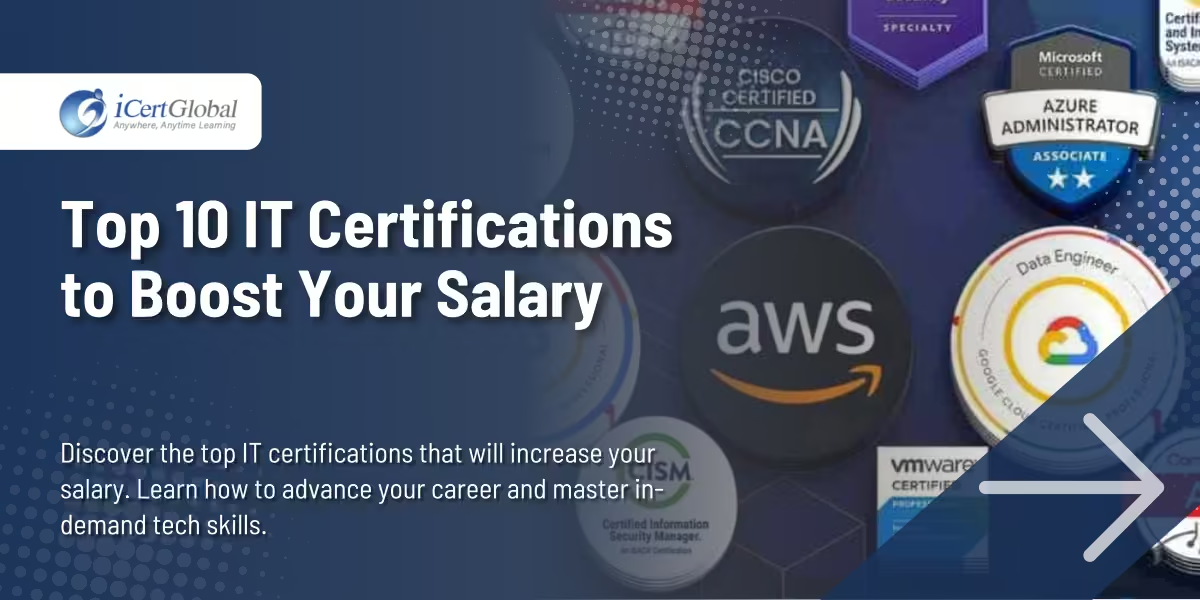
Discover the top IT certifications that will increase your salary in 2026. Learn how to advance your career
Advance your career by mastering Six Sigma belt levels. Learn the differences between Yellow, Green, and Black Belts

Learn how to calculate CAGR in Excel step-by-step. Master the RRI function, avoid common errors, and build high-value

Master the practical applications of ai in business and education. Learn how these in-demand skills can accelerate your
Understand the data encryption standard meaning, explore DES vs AES, and build the core cryptography skills you need
Our experts are ready to help you with any questions about courses, admissions, or career paths. Get personalized guidance from industry professionals.
Request a Call Back

"PMI®", "PMBOK®", "PMP®", "CAPM®" and "PMI-ACP®" are registered marks of the Project Management Institute, Inc. | "CSM", "CST" are Registered Trade Marks of The Scrum Alliance, USA. | COBIT® is a trademark of ISACA® registered in the United States and other countries.

