



ITIL 4 Foundation vs Practitioner: Certification Path Explained
Compare ITIL 4 Foundation vs Practitioner. Discover which certification aligns with your career goals, boosts your salary, and
Stop being a "ticket-closing machine." Get the credential that proves you can command major incidents, eliminate root causes, and run a high-performance Service Desk.
You are likely living in "Ticket Hell." Your queue is overflowing, your phone is ringing off the hook, and you are fixing the same printer issue for the 50th time this week. You are reacting, not managing. You are the "IT Guy" who reboots servers, not the "Operations Manager" who prevents them from crashing. To the business, you are a cost center. To your boss, you are a commodity. While others are drowning in volume, ITIL OSA Certification holders are analyzing trends. They aren't just closing tickets; they are opening Problem records to kill the root cause so the ticket never comes back. They are configuring Event Management systems to auto-heal servers before users even notice. Recruiters for Major Incident Manager roles in in St Louis, MO's massive NOCs and global support centers don't want "help desk agents"; they want ITIL Operational Support and Analysis experts who can command a bridge call during a P1 outage. This isn't a customer service soft-skills course. Our ITIL OSA training online and in-person is a technical operations bootcamp. We strip away the fluff and focus on the "Restore" and "Repair" workflows. You will learn how to execute a Major Incident Procedure without panicking, how to use Kepner-Tregoe or Ishikawa diagrams for ITIL Problem Management, and how to secure access without blocking productivity. We built this for the Service Desk Leads, Incident Commanders, and L2/L3 Support Engineers who are tired of the churn. Whether you are supporting a bank's trading floor or an e-commerce site's Black Friday sale, this training gives you the structural authority to take control of the chaos. You will learn to optimize the ITIL Service Desk function to deliver value, not just apologies.
We are an Authorized Training Organization (ATO).1 Your 4 credits are guaranteed to count toward the ITIL Intermediate OSA qualification.
We simulate P1/Critical outages. You will practice managing the communication, the technical teams, and the angry stakeholders in real-time.
Learn the difference between a "workaround" and a "permanent fix." We teach you the specific techniques to find the needle in the haystack.
The OSA exam is scenario-heavy. We provide specific tips on how to distinguish between "Incident" (Speed) and "Problem" (Quality) answers.
Learn how to structure your desk - Local, Centralized, Virtual, or Follow-the-Sun - for maximum efficiency and minimum cost.
Stuck on an Event Management correlation rule? Our experts are available around the clock to help you configure the logic.
ITIL Operational Support and Analysis (OSA) Training Program is often hindered by a skill gap that prevents teams from achieving efficient incident management, causing delays and impacting productivity. Inadequate process definition, knowledge of ITIL processes such as incident management, and organizational change control, and service level agreements are commonplace. Furthermore, inadequate IT asset management and software licensing practices hinder effective service desk performance. ITIL OSA Training Program focuses on building operational efficiency through effective service management principles. For instance, understanding ITIL's incident management process and developing an effective incident management strategy require thorough analysis of incident categories, roots cause analysis, and prioritization.
This also involves creating an incident management team structure, roles, and responsibilities. When done correctly, these processes lead to significant reductions in mean time to resolve (MTTR). In St Louis, MO, IT professionals have witnessed firsthand how poor service management can lead to lost revenue due to unnecessary service disruptions. ITIL OSA Training Program aims to bridge the skill gap and improve operational support and analysis capabilities to prevent such service disruptions, ultimately enhancing IT service quality and customer satisfaction. Work Responsibilities for the ITIL OSA Training Program involve ensuring that the service desk is adequately equipped to handle service requests and incidents, applying knowledge of IT service continuity management (ITSCM) and the IT service management (ITSM) framework.
Service desk analysts are expected to develop and implement effective service request management processes, as well as analyze incidents to identify the root cause and implement corrective actions to prevent future occurrences. Understanding the ITIL lifecycle model is crucial to effectively manage IT services. Developing effective service desk scripts, procedures, and playbooks to handle service requests and incidents requires knowledge of ITIL's service desk, incident management, and service request management processes. ITIL OSA Training Program focuses on developing a structured approach to service request management, aligning IT services with business objectives, and minimizing MTTR. Understanding ITIL's process for IT service continuity (ITSCM) supports effective risk management and business continuity planning.

Get a custom quote for your organization's training needs.
For service desk analysts in St Louis, MO, effective management of IT services and service requests is critical to ensuring smooth business operations. The ITIL OSA Training Program provides the necessary skills and knowledge to develop and implement effective service desk processes, ensuring that service requests and incidents are properly managed, and IT services are aligned with business objectives. ITIL OSA Training Program enhances professional credibility by equipping IT professionals with expert-level knowledge of ITIL best practices for operational support and analysis. This includes understanding incident management processes, developing effective service level agreements, and managing service desk performance metrics, such as MTTR and resolution rates.
Understanding the IT Service Management (ITSM) framework is crucial for effective IT service management. ITIL OSA Training Program provides a comprehensive understanding of ITIL's service management lifecycle, incorporating IT service continuity, capacity management, and availability management. IT professionals can demonstrate their expertise by applying ITIL best practices for service management, ensuring better IT service quality and customer satisfaction. In St Louis, MO, ITIL OSA Training Program certified professionals can leverage their enhanced credibility to influence IT service management strategy, improve IT service quality, and enhance customer satisfaction.
Skill Development through the ITIL OSA Training Program prepares IT professionals to develop and implement effective operational support and analysis processes that minimize MTTR and maximize IT service quality. This involves understanding the ITIL lifecycle model, developing an effective incident management strategy, and applying ITIL best practices for service management.
You will learn to manage the lifecycle of all incidents, focusing on rapid restoration of service to minimize business impact. You will master "Incident Models" to automate routine fixes.
You will learn to identify the root cause of recurring incidents. You will master reactive and proactive problem management to permanently remove errors from the infrastructure.
You will learn to filter and categorize events (Informational, Warning, Exception) to make sense of the noise generated by monitoring tools.
You will learn to handle Service Requests (password resets, new laptops) separately from Incidents, improving user satisfaction and team efficiency.
You will learn to grant authorized users the right to use a service while preventing access to non-authorized users (Executing the policies of Information Security).
You will learn to manage the Single Point of Contact (SPOC) between the Service Provider and the Users, managing expectations and communications.
If you are responsible for the daily operation, support, and restoration of IT services, this Capability module is your mandatory professional standard.
Developing an effective service desk structure, roles, and responsibilities is critical for efficient IT service management. ITIL OSA Training Program provides knowledge of ITIL's incident management process, covering incident category, root cause analysis, and prioritization, as well as creating an incident management team structure. For IT professionals in St Louis, MO, skill development through the ITIL OSA Training Program can lead to improved IT service quality, customer satisfaction, and enhanced professional credibility.
Practical Application of the ITIL OSA Training Program is demonstrated through real-world application of ITIL best practices for operational support and analysis. This involves developing and implementing effective service request management processes, incident management processes, and applying ITIL's service management framework. Effective service desk performance is influenced by the application of ITIL best practices for service level agreements, IT service continuity management, and capacity management.
ITIL OSA Training Program prepares IT professionals to apply ITIL best practices in a practical setting, aligning IT services with business objectives and minimizing MTTR. In St Louis, MO, practical application of the ITIL OSA Training Program can lead to sustained IT service quality, improved customer satisfaction, and enhanced business performance.
Use OSA to prove you have the analytical skills for Problem Management and Operations leadership.
Implement Event Management and proactive Problem Management so systems don't crash while you sleep.
Qualify for high-paying "Major Incident Manager" and "Operations Bridge Lead" positions in top MNCs.
This is an advanced Capability module. It assumes you know the basics.
Mandatory Prerequisite: You must hold a valid ITIL Foundation certificate (v3, 2011, or ITIL 4 Foundation). You cannot sit for OSA without it.
Training Requirement: You must complete an accredited training course (like ours) to get the "Candidate Number" required for the exam.
Recommended Experience: We strongly advise candidates to have 2+ years of experience in a Service Desk or Operations environment to understand the pressure of the scenarios.
The ITIL Operational Support and Analysis (OSA) Training Program is designed to address service desk performance issues such as MTTR, service level agreements, and knowledge of ITIL processes including incident management, problem management, and service level management. However, it often requires additional training and real-world application to gain practical experience. ITIL OSA Training Program graduates face challenges in aligning IT services with business objectives and in identifying root causes of recurring incidents. Understanding ITIL's continuous service improvement (CSI) approach can help address these challenges by providing a structured method for identifying and implementing improvements to IT services.
ITIL OSA Training Program provides knowledge of service desk performance metrics, including resolution rates, first call resolution (FCR), and mean time to resolve (MTTR), which can be used to measure service desk effectiveness. In St Louis, MO, IT professionals can apply their understanding of ITIL best practices and CSI approach to develop and implement effective improvements to IT services and improve overall IT service quality. ITIL OSA Training Program provides a comprehensive understanding of ITIL's service desk processes, including incident management, problem management, and service request management. ITIL service management framework, which includes IT service continuity management, capacity management, and availability management, also forms part of the program.
ITIL lifecycle model, which incorporates service strategy, service design, transition, and operation, is integral to the program. Understanding the IT service management lifecycle and the ITIL lifecycle model helps IT professionals to develop a structured approach to IT service management. ITIL OSA Training Program equips IT professionals with the necessary knowledge and skills to develop effective service level agreements, manage service desk performance, and improve overall IT service quality.
Master the flow: Detect, Log, Categorize, Prioritize, Diagnose, Resolve, Close. Learn the difference between Functional Escalation (Technical) and Hierarchical Escalation (Management).
When the house is on fire. Learn the specific procedure for handling high-impact incidents: The Bridge Call, The Communication Plan, and The Post-Implementation Review.
Separate the noise. Learn to build a Request Catalog for standard changes (password resets, software installs).
Drive efficiency. Learn how to use Request Fulfillment to reduce the burden on the Service Desk and lower the cost per ticket.
Stop the recurrence. Learn to investigate the underlying cause of incidents. Master techniques like Kepner-Tregoe, Ishikawa (Fishbone), and Pareto Analysis.
Manage the workarounds. Learn to document temporary fixes and share them with the Service Desk to speed up restoration times.
Execute the policy. Learn to verify identity (Authentication) and grant rights (Authorization).
Manage the user journey. Learn to handle Access Requests, Change of Status (Promotion/Transfer), and Revocation (Termination).
Design the team. Compare Local (Face-to-Face), Centralized (Cost-Effective), Virtual (Follow-the-Sun), and Specialized Service Desk structures.
Measure success. Learn to track First Call Resolution (FCR), Average Handling Time (AHT), and Customer Satisfaction (CSAT). Learn how to staff for peak volumes.
Review ITIL OSA exam tips. Learn to handle the "Gradient Scoring" questions and manage your time during the 90-minute test.
In St Louis, MO, ITIL OSA Training Program certified professionals can leverage their knowledge of ITIL service management framework to drive IT service management strategy and improve IT service quality. Practical implementation of ITIL best practices for operational support and analysis often requires significant changes to existing IT service management processes.
ITIL OSA Training Program provides a structured approach to process improvement, helping IT professionals to identify and prioritize process improvements. ITIL CSI approach provides a framework for ongoing process improvement, enabling IT professionals to develop and implement improvements to IT services.
ITIL service management framework and
Great class, very informative.

Great PMP<sup>®</sup> Bootcamp. I had a great time taking this course. I took the course to prepare to sit for the CAPM<sup>®</sup> but may be able to sit for the PMP<sup>®</sup>. I learnt a lot was challenging. Great course. We need one more day. Content was very detailed.

it was a great class. Lots of energy. And I enjoyed.

Fantastic course to prepare for PMP<sup>®</sup> exam.

As a participant it was smooth sailing for me.

Trainer was excellent. Shared good resources and good experiences.

Good content and training.
I wanted to let you know that I took and passed the PMP exam. Thanks to iCertGlobal and especially my Cincinnati course instructor, who was an excellent teacher and helped me immensely.

Trainer was good. Trainer was very engaged and interacting. Very much satisfied with the training.

I was pleasantly surprised at the quality of this training. Yomi was awesome as a trainer and working to make sure that we understood the concepts. Controlling Cost and Controlling Risk are the most complicated, but Yomi spent time after class working through questions to help others understand. This class also helped to change my perception of the PMP being this MONSTER to something that I can I can successfully do.

Great class with a lot of information and tips to prepare for the exam

It was a great course, covered all the things that i ended up hitting road bumps on. I was the only one in the class, but the trainer was just as involved as if it had been a full class.

I was nervous about taking it online versus classroom; but I am actually glad I took it online. Instructor was very great and gave a good learning experience with his relevant project management experience.
The training was very intense but covered with course material. It was more than I expected.

I thought the class was very informative. The instructor did an excellent job breaking down each chapter to where it was easy to understand. I was also very impressed with his commitment to help us pass ever after the class is over.

Excellent training. Instructor was very knowledgeable and explained information in an understandable way
Quality Materials presented, Instructor very knowledgeable. Exceeded my expectations.
The training is a great introduction into the PMI mindset. Very informative and helpful

Explore our instructor-led ITIL Operational Support and Analysis training to learn about the course duration, cost, eligibility, and certification process. You get practical learning, exam-focused preparation, and expert guidance. Ready to get started? Compare ITIL Operational Support and Analysis certification training options and choose a classroom or live online format that fits your schedule.
Explore Our ITIL Operational Support and Analysis certification training is available in a city near you
Stay updated with the latest insights and trends in your field
Compare ITIL 4 Foundation vs Practitioner. Discover which certification aligns with your career goals, boosts your salary, and
Explore the top 10 IT service management best practices for modern business, from ITIL 5 and AI automation
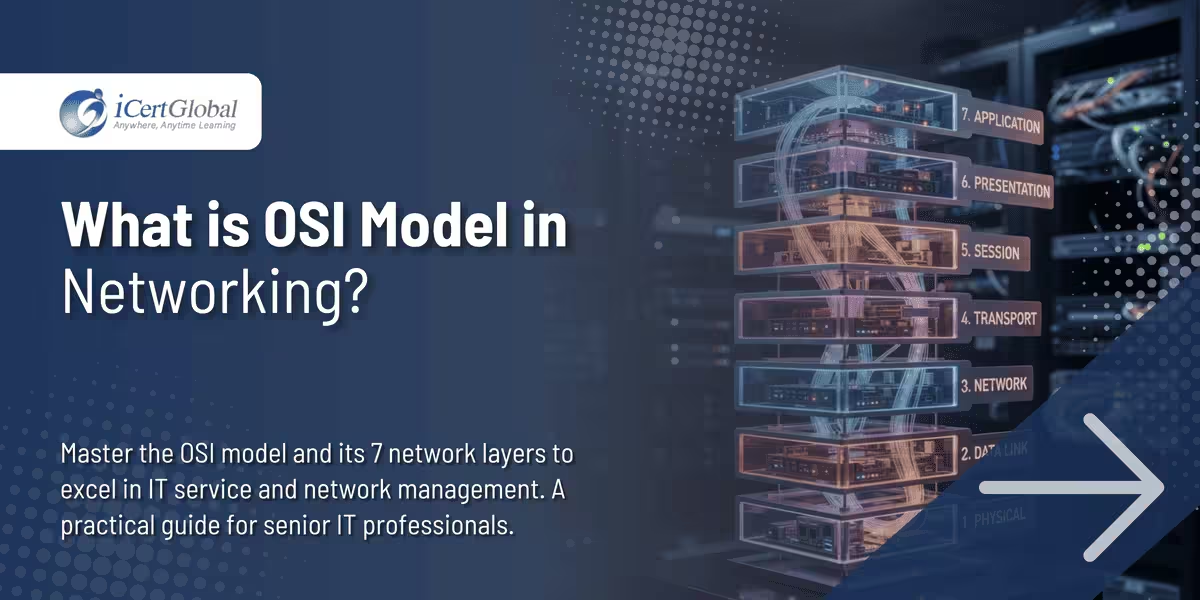
Master the OSI model and its 7 network layers to excel in IT service and network management. A
Learn the top benefits of ITIL certification and how it boosts your IT career and organizational value.
Learn how businesses keep their technology like computers and internet running well with ITSM and ITIL.
Learn what COBIT is and why it matters for managing technology in businesses.
Learn about the key responsibilities, skills, and career path of a Service Desk Manager.

Explore the top high-paying programming languages for 2026 and gain in-demand skills to boost your career, stay competitive,

Master frontend frameworks to accelerate your career. Compare React, Angular, Vue, Svelte, and Next.js to build modern web
Harness the power of Data Science in IT Process Management to streamline operations, improve decision-making, and maximize efficiency
Our experts are ready to help you with any questions about courses, admissions, or career paths. Get personalized guidance from industry professionals.
Request a Call Back

"PMI®", "PMBOK®", "PMP®", "CAPM®" and "PMI-ACP®" are registered marks of the Project Management Institute, Inc. | "CSM", "CST" are Registered Trade Marks of The Scrum Alliance, USA. | COBIT® is a trademark of ISACA® registered in the United States and other countries.

