You are familiar with the scenario: A programmer deploys a "small" update late on a weekend. By the next morning, the service is non-operational, the database is damaged, and you are participating in an emergency call explaining the failure of the rollback procedure. You are battling against unsanctioned modifications, assets lacking proper documentation, and a release method that relies on sheer fortune instead of structured reasoning. You are suffering from disorganization. RCV-certified professionals, however, are the architects of stability. While others are simply approving Change Requests (RFCs) or bypassing the Change Advisory Board (CAB) to achieve "rapid movement," ITIL RCV experts implement a strict framework of testing, validation, and regulated deployment. They don't just "execute code deployment"; they meticulously manage the entire release orchestration. Hiring managers for fast-paced environments (FinTech, SaaS providers, large Enterprise IT) require control; they seek Release Management ITIL specialists who can guarantee that increased speed does not compromise system stability. This is not a theoretical session focused on basic definitions. Our ITIL Release Control and Validation training offers a detailed examination of the practical workings of the "Service Transition" phase. You will acquire the skills necessary to run a Change Advisory Board (CAB) that genuinely adds value, how to construct a Configuration Management System (CMS) that is accurate and reliable, and how to validate newly deployed services to ensure end-users receive the functionality they genuinely requested. We developed this course for the Release Managers, Change Managers, and Build Engineers who are weary of being blamed for faulty deployments. Whether you operate within the startup community in your region or the financial services industry in the local area, this training equips you with the authority to halt an inadequate release immediately. You will learn how to standardize the "Build, Test, Deploy" cycle to guarantee that every transition represents forward progress, rather than a regression.
ITIL RCV Training Program Overview
Your ITIL RCV Certification Isn't Just a Paper. It's Your Insurance Policy Against Outages.
Why Obtain ITIL RCV Certification?
The Credential That Establishes Control
Stop being viewed as a delay.
Demonstrate clearly that your "administrative process" is, in reality, crucial risk mitigation that ultimately generates financial savings for the organization.
Bridge the gap between Development and Operations.
RCV furnishes the shared terminology and standardized process structure that enables DevOps to function effectively within major corporations.
Unlock specialized career opportunities.
Qualify for sought-after, highly compensated roles such as "Release Manager" and "Change Authority" that necessitate proven, certified expertise.
ITIL RCV Training Course Highlights
More Than a Course - It is Your Deployment Defence
PeopleCert Authorized
We operate as an Authorized Training Organization (ATO). Your earned credits are guaranteed to be applicable toward your total requirement for the ITIL Capability Stream.
Hands-on "Change" Labs
Our instruction goes beyond simple discussion of Request for Changes (RFCs). We actively simulate urgent CAB meetings and standard change models to evaluate your decision-making abilities under stress.
Configuration Management Deep Dive
Master the most challenging component of ITIL?Service Asset and Configuration Management (SACM)?and gain practical knowledge on how to accurately map Configuration Item (CI) relationships in real-world environments.
Exam-Focused Strategy
The RCV exam relies heavily on scenarios. We deliver specialized ITIL RCV exam tips to assist you in analyzing intricate transition scenarios and correctly identifying the "most accurate" response.
24/7 Expert Assistance
Having trouble grasping a concept such as the difference between the CMS vs. CMDB? Our specialists are available at all times to explain the technical details.
Skills You Will Gain In Our ITIL RCV Training Program
From Knowledge to Actionable Intelligence
Who This Program Is For
Ideal Candidates for ITIL RCV Certification
This certification training is ideal for:
If your duties involve transitioning software, equipment, or service offerings from a development environment ("Dev") into a live production setting ("Production"), this ITIL Intermediate RCV course stands as your essential professional benchmark.
ITIL RCV Certification Training Program Roadmap
The Step-by-Step System for First-Attempt Success
Eligibility and Pre-requisites
ITIL RCV Requirements
This is an advanced Capability module that assumes you are familiar with the fundamental concepts of the service lifecycle.
Course Modules
Comprehensive curriculum covering all exam domains
Change Management
Lesson 1: The Change Lifecycle
Master the end-to-end process. Learn to record, assess, authorize, and coordinate changes. Understand the critical difference between "Change" and "Release."
Lesson 2: Change Models
Stop treating every change the same. Learn to build Standard Change models (pre-authorized), Normal Change workflows, and Emergency Change procedures that actually work.
Lesson 3: The CAB and ECAB
Learn how to run a Change Advisory Board (CAB) that isn't a waste of time. Understand the specific role of the Emergency CAB (ECAB) during crises.
Service Asset & Configuration Management (SACM)
Lesson 1: The Configuration Model
Understand the logical model of the IT infrastructure. Learn the difference between an Asset and a Configuration Item (CI).
Lesson 2: The CMS and CMDB
Master the structure. Learn how the Configuration Management System (CMS) aggregates data from various Configuration Management Databases (CMDBs).
Lesson 3: Verification and Audit
Data rots. Learn the procedures for verification and audit to ensure your CMDB matches the physical reality of the data center.
Release & Deployment Management
Lesson 1: Release Policies & Planning
Define the rules of the road. Learn to create a Release Policy that dictates how and when software moves to production. Master the "Big Bang" vs. "Phased" deployment strategies.
Lesson 2: Build, Test, and Deploy
Manage the pipeline. Learn the mechanics of building the release package, testing it in a staging environment, and deploying it to live.
Lesson 3: Early Life Support (ELS)
The job isn't done at deployment. Learn how to structure Early Life Support to handle the immediate issues post-go-live.
Service Validation & Testing
Lesson 1: The V-Model
Validate quality. Learn the V-Model concept, mapping requirements to testing levels (Unit, Integration, System, Acceptance).
Lesson 2: Validation Strategy
Don't just test for bugs; test for value. Learn to validate that the service will deliver the required utility (fitness for purpose) and warranty (fitness for use).
Request Fulfillment
Lesson 1: Managing Requests
Stop clogging the Incident queue. Learn to separate Service Requests (standard, low risk) from Incidents (unplanned interruptions).
Lesson 2: Self-Help and Automation
Learn how to design request catalogs and self-help portals that empower users and reduce the load on the Service Desk.
Knowledge & Evaluation
Lesson 1: Knowledge Management (KM)
Capture the wisdom. Learn to manage the Service Knowledge Management System (SKMS) and the Data-Information-Knowledge-Wisdom (DIKW) structure.
Lesson 2: Change Evaluation
The final check. Learn the formal process for evaluating major changes to determine if the actual performance matches the predicted performance.
Lesson 3: Exam Strategy
Review ITIL RCV exam tips. Learn to handle the "Gradient Scoring" questions and manage your time during the 90-minute test.
Corporate Training
Tailored programs for teams with enterprise support

Ready to transform your team?
Get a custom quote for your organization's training needs.
Upcoming Schedule
Join the next batch that fits your timezone
Course & Support
Everything you need to know about our training options and support
Customer Testimonials
Hear from our successful graduates
"Exceptional PMP Training Experience with iCertGlobal I recently completed the PMP training by iCertGlobal, and I must say it was an outstanding experience. The instructor demonstrated a deep understanding of project management principles and brought real-world experience to the table. The training material's provided were comprehensive and well-organized, offering valuable insights and practical tips. I would highly recommend iCertGlobal to anyone looking for professional PMP Training.. "

John Anderson
"iCertGlobal provided a great learning experience with clear, well organised courses. The trainers were knowledgeable, and the support team was responsive to all my questions. The study material was comprehensive, which helped me pass my certification exam with ease. Highly recommended for anyone looking to get certified. "
James Walsh
"iCertGlobal is the best Certificate Training Organization. you will get good instructor and they will improve leaning sills and give the real time experience examples due to that you will get pass in first try. "
Andy Moran
"The course content, exam prep questions, interactive Q&A, and real-life examples made attending this PMP Project Management training class worth my time and money. The support from iCertGlobal was exceptional and I would like to thank them for accepting my request of meeting the trainer post the session for clearing my doubts."
Tim Malone
"I had a good learning experience with icertGlobal and it had been an amazing development journey. Actually, I accidentally bumped into iCertGlobal while searching for an online course for preparing my PMP examination. With positive reviews all over the internet and quick responses to my questions, I was flabbergasted enough to sign-up immediately. The instructor-led PMP preparatory course helped me both offline and online preparations. All the high-quality materials written in simple layman language was enough to grasp the gist of various topics. The instructors were very knowledgeable as they imparted not only their wealth of experiences but also real life examples. Thanks a lot iCertGlobal for imbibing this great learning experience. "
Jason Walter
"Thank you for your great course, great support, rapid response and excellent service."
Hoda Alavi
"My trainer made the materials relatable and easy to understand. It was fun being in class everyday. "
Cassandra Corn
"Amazing trainer who was very supportive. "

Shanna Pilgrim
"Trainer was well versed in the subject matter and got the impression the gentleman was professional and educated within standards and procedures for PMI. "
Anthony Zamora
"The Training was good and customer service was perfect. "
Maka Diakhate
"Trainer was knowledgeable and lesson's pace was just right."

Roger Gonzales
"Trainer (Bruce) was very excellent in delivery and presentation. He provided me with all the tools required to be successful in the PMP exams with lots of quiz questions on all topics reviewed. "
Bashiru Ojibara
"The trainer, Emad was top notch and very knowledgeable. He is up to date with all current versions and is great in 1:1 Training. "

Jonathan Obien
"Thank you for your great course, great support, rapid response and excellent service"

Hoda Alavi
"Marc had very good knowledge and he was able to explain the material and provide guidance to get ready for the test. "

Roque Montesino
"Excellent Course. Zahn was a great instructor and the course material definitely will help me pass the PMP Exam "

Jared Nelson
"Great teacher, went out of his way in every possible aspect. "
Radiah Sims
"Customer service provided by Robin was great as he was very responsive and the trainer, John, was very good at relating the content to my industry. "

Jason D Niebauer
ITIL Release Control and Validation Training in Other Cities
Our ITIL Release Control and Validation certification training is available in major cities worldwide
Related Blogs
Stay updated with the latest insights and trends in project management
ITIL 4 Foundation vs Practitioner: Certification Path Explained
Compare ITIL 4 Foundation vs Practitioner. Discover which certification aligns with your career goals, boosts your salary, and...
Top 10 IT Service Management Best Practices for
Master the top 10 ITSM best practices for modern businesses. Transform your service desk with proven frameworks to...
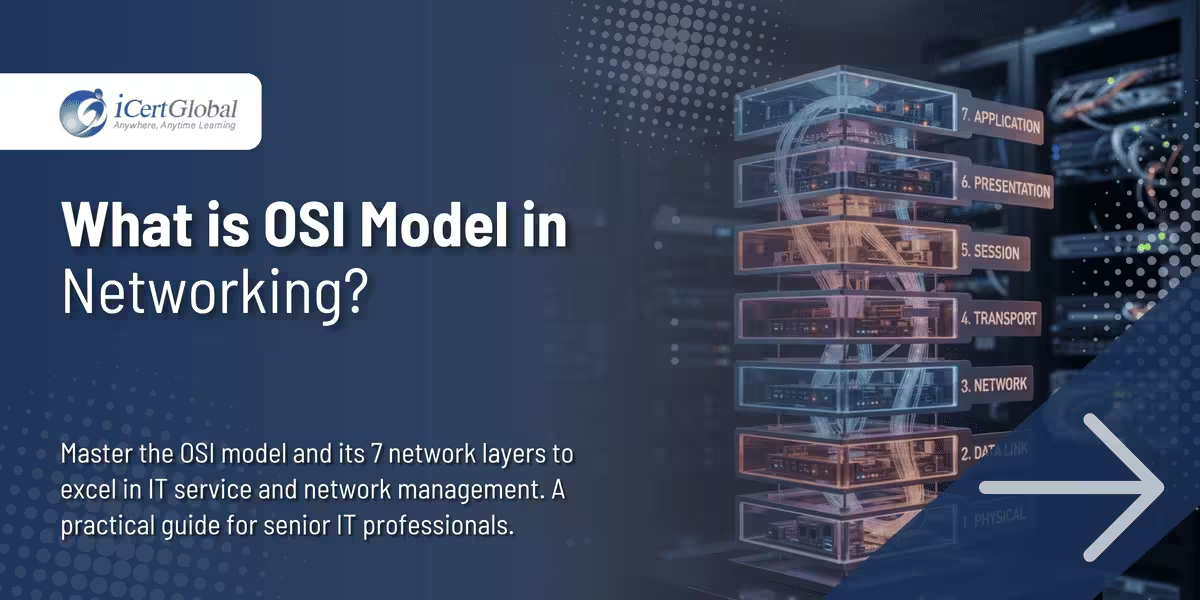
What is OSI Model in Networking
Master the OSI model and its 7 network layers to excel in IT service and network management. A...
7 Strong Advantages of ITIL Certification
Learn the top benefits of ITIL certification and how it boosts your IT career and organizational value....
Ensuring Tech Support Functions in Businesses
Learn how businesses keep their technology like computers and internet running well with ITSM and ITIL....
The Importance of COBIT in IT Management
Learn what COBIT is and why it matters for managing technology in businesses. ...



