



ITIL 4 Foundation vs Practitioner: Certification Path Explained
Compare ITIL 4 Foundation vs Practitioner. Discover which certification aligns with your career goals, boosts your salary, and
Stop the "Release and Pray" cycle. Get the credential that proves you can manage changes, deployments, and assets without crashing production.
You know the drill. A developer pushes a "minor" patch on Friday night. By Saturday morning, the service is down, the database is corrupted, and you are on a bridge call explaining why the rollback failed. You are fighting a war against unauthorized changes, undocumented assets, and a release process that relies on luck rather than logic. You are a victim of chaos. RCV-certified professionals are the masters of control. While others are rubber-stamping Change Requests (RFCs) or bypassing the CAB to "move fast," ITIL RCV professionals are enforcing a rigorous regime of testing, validation, and controlled deployment. They don't just "push code"; they orchestrate releases. Recruiters for high-velocity environments (FinTech, SaaS, Enterprise IT) don't want cowboys; they want Release Management ITIL experts who can ensure that speed doesn't kill stability. This isn't a theory class on definitions. Our ITIL Release Control and Validation training is a deep-dive into the mechanics of the "Transition" phase. You will learn how to run a Change Advisory Board (CAB) that actually creates value, how to build a Configuration Management System (CMS) that isn't a lie, and how to validate services so that users get what they actually asked for. We built this for the Release Managers, Change Managers, and Build Engineers who are tired of being the scapegoat for bad releases. Whether you are in New York, NY's startup ecosystem or Mumbai's banking sector, this training gives you the authority to stop a bad release in its tracks. You will learn to standardize the "Build, Test, Deploy" cycle to ensure that every change is a step forward, not a stumble backward.
We are an Authorized Training Organization (ATO). Your credits are guaranteed to count toward your ITIL Capability Stream total.
We don't just talk about RFCs. We simulate Emergency CAB meetings and standard change models to test your decision-making under pressure.
Learn the hardest part of ITIL - Service Asset and Configuration Management (SACM) and how to actually map CI relationships in the real world.
The RCV exam is scenario-heavy. We provide specific ITIL RCV exam tips to help you deconstruct complex transition scenarios and find the "most correct" answer.
Move beyond "Unit Testing." Learn the V-Model and how to validate service utility and warranty before go-live.
Stuck on a concept like the "CMS vs. CMDB"? Our experts are available around the clock to clarify the technical nuances.
Releasing controlled versions of services and products is a critical aspect of IT service management, particularly in the context of ITIL Release, Control, and Validation (RCV) Training Program. This program focuses on the processes and procedures necessary to ensure that releases are well-planned, executed, and validated.
The ITIL RCV framework provides a structured approach to managing releases, which involves identifying and mitigating risks, ensuring compliance with organizational and regulatory requirements, and verifying the quality of released services and products. The use of Release Control and Validation processes helps to minimize disruptions to service quality and delivery, reducing the likelihood of defects and errors.
In the New York, NY metropolitan area, organizations must adhere to strict regulatory standards to ensure the confidentiality, integrity, and availability of sensitive information. As such, the ITIL RCV Training Program is essential for professionals working in industries like finance and healthcare, where service quality and reliability are paramount.

Get a custom quote for your organization's training needs.
The ITIL RCV Training Program aims to equip professionals with the skills and knowledge necessary to implement and manage effective Release Control and Validation processes. This involves understanding the core principles of release management, including release planning, building and testing, and deployment.
In addition to developing knowledge of release management best practices, the program also focuses on the importance of clear communication and collaboration among stakeholders, including developers, testers, and operational teams. ITIL RCV best practices emphasize the need for a structured approach to release management, using tools and techniques such as release calendars and testing plans.
By mastering the skills and knowledge outlined in the ITIL RCV Training Program, professionals in New York, NY can improve their ability to manage complex releases, reduce the risk of errors and delays, and ensure that released services and products meet organizational and regulatory requirements.
Become the gatekeeper. You will learn to manage the lifecycle of all changes, enabling beneficial updates while minimizing disruption. You will master standard, normal, and emergency change models.
Master the rollout. You will learn to plan, schedule, and control the movement of releases to test and live environments, ensuring the integrity of the live environment is protected.
Own the data. You will learn to identify, control, record, audit, and verify service assets and configuration items (CIs), creating a "Source of Truth" for the IT estate.
Trust but verify. You will learn to ensure that deployed releases and resulting services meet customer expectations and verify that IT operations can support the new service.
Streamline the routine. You will learn to handle service requests (password resets, software installs) professionally and efficiently, separating them from Incidents.
Stop the brain drain. You will learn to gather, analyze, store, and share knowledge, ensuring the right information is available to the right person at the right time (DIKW hierarchy).
Release Managers / Deployment Leads
Software Build Engineers
Service Desk Managers (handling Requests)
If you are responsible for moving code, hardware, or services from "Dev" to "Production," this ITIL Intermediate RCV module is your mandatory professional standard.
ITIL RCV Training Program participants will learn about the key roles and responsibilities involved in Release Control and Validation, including the Service Portfolio Manager, Release Manager, and Change Manager. These professionals are responsible for planning, coordinating, and executing releases, as well as ensuring that changes to services and products are properly validated.
The program also covers the importance of stakeholder management, including identifying and engaging with stakeholders who will be impacted by releases. ITIL RCV best practices emphasize the need for clear communication, transparency, and collaboration among stakeholders to ensure a successful release.
In New York, NY, professionals working in industries such as technology and finance must be able to demonstrate a clear understanding of their roles and responsibilities in Release Control and Validation. The ITIL RCV Training Program provides participants with the knowledge and skills necessary to perform these responsibilities effectively.
Stop being viewed as a bottleneck. Prove that your "bureaucracy" is actually risk management that saves the company money.
Bridge the gap between Dev and Ops. RCV provides the common language and process structure that makes DevOps actually work in large enterprises.
Unlock specialized roles. Qualify for high-paying "Release Manager" and "Change Authority" positions that require certified expertise.
This is an advanced Capability module. It assumes you understand the basics of the service lifecycle.
Mandatory Prerequisite: You must hold a valid ITIL Foundation certificate (v3, 2011, or ITIL 4 Foundation). You cannot sit for RCV without it.
Training Requirement: You must complete an accredited training course (like ours) to get the "Candidate Number" required for the exam.
Recommended Experience: We strongly advise candidates to have 2+ years of experience in Release, Change, or Testing environments to understand the complex scenarios.
The ITIL RCV Training Program is relevant to professionals working in a variety of industries and roles, including service desk, incident management, problem management, and service level management. By completing this program, participants can demonstrate their expertise and knowledge of Release Control and Validation best practices.
The ITIL RCV framework is widely recognized and adopted in organizations across the globe, including those in the New York, NY metropolitan area. As such, professionals who have completed the ITIL RCV Training Program can expect to have a competitive edge in the job market, particularly in industries where IT service management is critical to success.
In addition, the ITIL RCV Training Program is part of a larger certification pathway, which can provide professionals with a comprehensive understanding of IT service management best practices.
Understand the logical model of the IT infrastructure. Learn the difference between an Asset and a Configuration Item (CI).
Master the structure. Learn how the Configuration Management System (CMS) aggregates data from various Configuration Management Databases (CMDBs).
Data rots. Learn the procedures for verification and audit to ensure your CMDB matches the physical reality of the data center.
Define the rules of the road. Learn to create a Release Policy that dictates how and when software moves to production. Master the "Big Bang" vs. "Phased" deployment strategies.
Manage the pipeline. Learn the mechanics of building the release package, testing it in a staging environment, and deploying it to live.
The job isn't done at deployment. Learn how to structure Early Life Support to handle the immediate issues post-go-live.
Validate quality. Learn the V-Model concept, mapping requirements to testing levels (Unit, Integration, System, Acceptance).
Don't just test for bugs; test for value. Learn to validate that the service will deliver the required utility (fitness for purpose) and warranty (fitness for use).
Stop clogging the Incident queue. Learn to separate Service Requests (standard, low risk) from Incidents (unplanned interruptions).
Learn how to design request catalogs and self-help portals that empower users and reduce the load on the Service Desk.
Capture the wisdom. Learn to manage the Service Knowledge Management System (SKMS) and the Data-Information-Knowledge-Wisdom (DIKW) structure.
The final check. Learn the formal process for evaluating major changes to determine if the actual performance matches the predicted performance.
Review ITIL RCV exam tips. Learn to handle the "Gradient Scoring" questions and manage your time during the 90-minute test.
The ITIL RCV Training Program is designed to establish a common language and understanding of Release Control and Validation best practices among IT service management professionals. By completing this program, participants can demonstrate their knowledge and expertise in this critical area of IT service management.
The ITIL RCV framework provides a structured approach to managing releases, which helps to ensure that services and products are delivered on time, within budget, and to the required quality standards. In New York, NY, organizations that have implemented the ITIL RCV framework have seen significant improvements in service quality and reliability.
By incorporating the ITIL RCV framework into their service management practices, organizations can improve their reputation, reduce the risk of errors and delays, and demonstrate their commitment to delivering high-quality services to their customers.
Great class, very informative.

Great PMP<sup>®</sup> Bootcamp. I had a great time taking this course. I took the course to prepare to sit for the CAPM<sup>®</sup> but may be able to sit for the PMP<sup>®</sup>. I learnt a lot was challenging. Great course. We need one more day. Content was very detailed.

it was a great class. Lots of energy. And I enjoyed.

Fantastic course to prepare for PMP<sup>®</sup> exam.

As a participant it was smooth sailing for me.

Trainer was excellent. Shared good resources and good experiences.

Good content and training.
I wanted to let you know that I took and passed the PMP exam. Thanks to iCertGlobal and especially my Cincinnati course instructor, who was an excellent teacher and helped me immensely.

Trainer was good. Trainer was very engaged and interacting. Very much satisfied with the training.

I was pleasantly surprised at the quality of this training. Yomi was awesome as a trainer and working to make sure that we understood the concepts. Controlling Cost and Controlling Risk are the most complicated, but Yomi spent time after class working through questions to help others understand. This class also helped to change my perception of the PMP being this MONSTER to something that I can I can successfully do.

Great class with a lot of information and tips to prepare for the exam

It was a great course, covered all the things that i ended up hitting road bumps on. I was the only one in the class, but the trainer was just as involved as if it had been a full class.

I was nervous about taking it online versus classroom; but I am actually glad I took it online. Instructor was very great and gave a good learning experience with his relevant project management experience.
The training was very intense but covered with course material. It was more than I expected.

I thought the class was very informative. The instructor did an excellent job breaking down each chapter to where it was easy to understand. I was also very impressed with his commitment to help us pass ever after the class is over.

Excellent training. Instructor was very knowledgeable and explained information in an understandable way
Quality Materials presented, Instructor very knowledgeable. Exceeded my expectations.
The training is a great introduction into the PMI mindset. Very informative and helpful

Explore our instructor-led ITIL Release Control and Validation training to learn about the course duration, cost, eligibility, and certification process. You get practical learning, exam-focused preparation, and expert guidance. Ready to get started? Compare ITIL Release Control and Validation certification training options and choose a classroom or live online format that fits your schedule.
Explore Our ITIL Release Control and Validation certification training is available in a city near you
Stay updated with the latest insights and trends in your field
Compare ITIL 4 Foundation vs Practitioner. Discover which certification aligns with your career goals, boosts your salary, and
Master the top 10 ITSM best practices for modern businesses. Transform your service desk with proven frameworks to
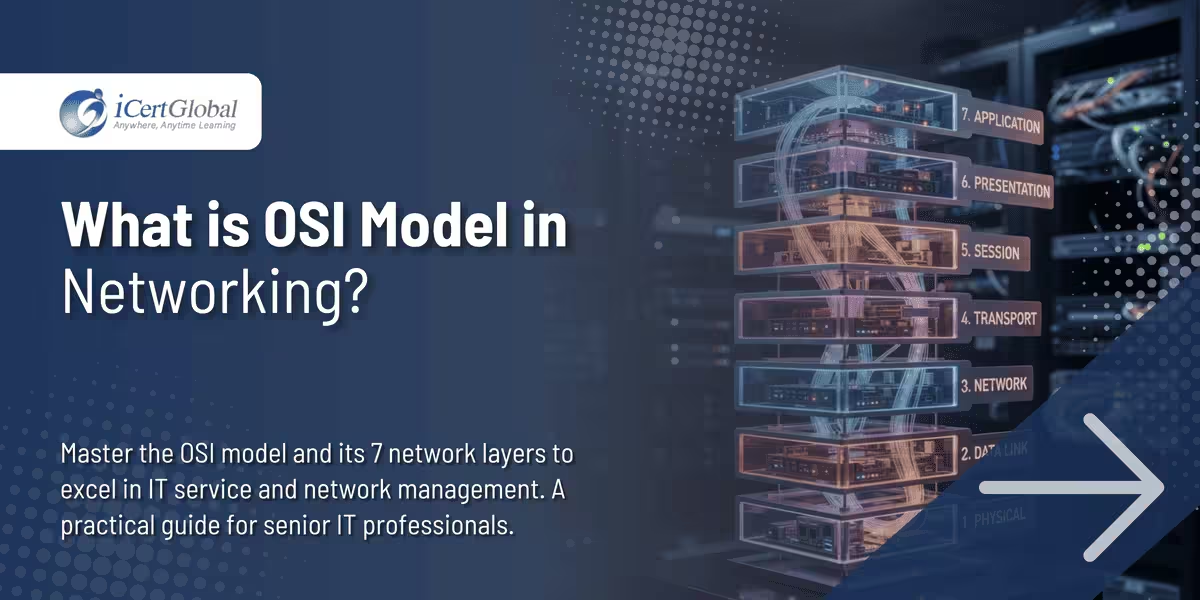
Master the OSI model and its 7 network layers to excel in IT service and network management. A
Learn the top benefits of ITIL certification and how it boosts your IT career and organizational value.
Learn how businesses keep their technology like computers and internet running well with ITSM and ITIL.
Learn what COBIT is and why it matters for managing technology in businesses.
Learn about the key responsibilities, skills, and career path of a Service Desk Manager.

Explore the top high-paying programming languages for 2026 and gain in-demand skills to boost your career, stay competitive,
Master frontend frameworks to accelerate your career. Compare React, Angular, Vue, Svelte, and Next.js to build modern web

Harness the power of Data Science in IT Process Management to streamline operations, improve decision-making, and maximize efficiency
Our experts are ready to help you with any questions about courses, admissions, or career paths. Get personalized guidance from industry professionals.
Request a Call Back

"PMI®", "PMBOK®", "PMP®", "CAPM®" and "PMI-ACP®" are registered marks of the Project Management Institute, Inc. | "CSM", "CST" are Registered Trade Marks of The Scrum Alliance, USA. | COBIT® is a trademark of ISACA® registered in the United States and other countries.

