





Is PfMP certification worth it?Complete Guide
Evaluate if the PfMP certification is worth it. Explore real career ROI, salary potential, and executive skill value
Accelerate your project management career with our expert-led PMP prep course. Master the PMBOK® Guide, access realistic mock exams, and gain the confidence to pass your PMI exam on the first attempt.
Achieving your PMP Certification in San Jose CA is a definitive step toward mastering advanced project management principles and leading high-impact initiatives in Silicon Valley's dynamic business ecosystem. This comprehensive PMP certification training in San Jose program aligns meticulously with the Project Management Institute (PMI) standards, covering predictive, Agile, and hybrid methodologies as detailed in the latest PMBOK Guide 8th Edition. Designed for aspiring and seasoned project managers, this elite PMP Course in San Jose equips you with the strategic skills needed to handle project complexity, manage cross-functional teams, and deliver business value. By blending theoretical frameworks with practical applications, our premium PMP Training in San Jose prepares you to pass the rigorous pmp exam on your first attempt. Register today for this PMP certification Exam in San Jose preparation course and drive corporate innovation.
Satisfy the strict PMI educational requirement with a 35-hour certificate, a core milestone of our PMP certification training in San Jose.
Master predictive, agile, and hybrid methodologies defined by the modern PMBOK Guide 8th Edition and official agile practices.
Learn from veteran trainers who deliver our premier PMP Course in San Jose using real-world enterprise project delivery scenarios.
Gain access to thousands of practice questions to master your PMP certification Exam in San Jose on your very first try.
Receive comprehensive study guides and reference tools when you register for this high-impact PMP Training in San Jose.
Secure your eligibility for the PMP Certification in San Jose CA with your step-by-step guidance and audit-proof application reviews.
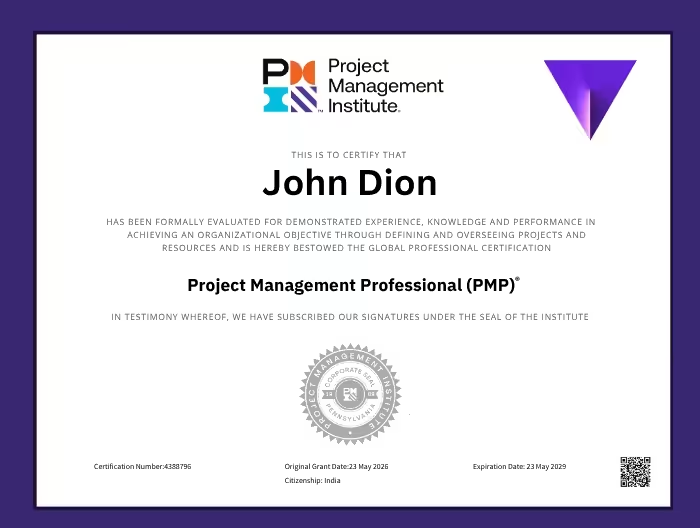
Upon successful completion of our PMP course, you will receive an official PMI-authorized certificate that is globally recognized. This certificate validates your expertise in project management and is highly valued by employers worldwide.
The PMP Certification Training Program is designed for professionals seeking to demonstrate their expertise in project management. Earning a Project Management Professional (PMP) certification can significantly enhance job prospects and career advancement opportunities. San Jose, CA's thriving technology industry demands skilled project managers who can navigate complex projects and ensure timely delivery.
Achieving PMP certification requires professionals to have a deep understanding of project management concepts, including project scope, schedule, budget, and resource management. The Program Evaluation and Review Technique (PERT) and Critical Path Method (CPM) are fundamental tools for project management professionals. They enable effective planning, execution, and control of projects, ensuring that all stakeholders meet project requirements and objectives.
In San Jose, CA's fast-paced tech industry, project managers play a critical role in delivering projects on time, within budget, and to the satisfaction of customers. By mastering project management skills, professionals can enhance their career prospects and contribute to the success of their organizations, thereby boosting their professional credibility and reputation.

Get a custom quote for your organization's training needs.
The PMP Certification Training Program identifies knowledge gaps that hinder professionals from achieving PMP certification.
Many professionals struggle with project planning, monitoring, and control, which are essential skills for PMP certification.
San Jose, CA's professionals can learn to address these gaps by mastering earned value management (EVM) and using project management information systems (PMIS) to track project progress and performance.
Note: The training location may be subject to change depending on the number of participants registered for the session and participant convenience. Confirmed venue details will be shared by email after enrollment.
Master traditional waterfall project management methodologies, satisfying key topics tested in the PMP certification Exam in San Jose.
Learn to implement modern frameworks as highlighted in our comprehensive PMP certification training in San Jose program.
Build high-performing teams and manage diverse stakeholder expectations, crucial skills evaluated on the official pmp exam.
Proactively identify risks and enforce quality standards according to the recognized principles of the PMBOK Guide 8th Edition.
Align project objectives with corporate strategies, a primary learning pillar of our specialized PMP Course in San Jose.
Formulate robust communication plans as taught throughout this elite PMP Training in San Jose course.
Acquire skills to manage project budgets and oversee vendor contracts to support your PMP Certification in San Jose CA journey.
Enhance your career prospects with our comprehensive PMP Certification in San Jose CA. This training program is meticulously designed for experienced project management professionals who want to master the PMBOK Guide domains, including People, Process, and Business Environment. By enrollling in this course, you will acquire the critical skills needed to lead complex initiatives, drive organizational value, and successfully pass the PMI-PMP exam on your first attempt.
Professionals in San Jose, CA's industry can overcome the identified knowledge gaps by participating in the PMP Certification Training Program.
The program provides hands-on training and real-world examples to help professionals develop practical skills in project planning, monitoring, and control.
By mastering skills such as risk management and stakeholder engagement, professionals can achieve PMP certification and boost their career prospects in San Jose, CA's competitive job market.


Managers who achieve their PMP Certification in San Jose CA earn significantly higher average salaries than non-certified peers.
Showcase complete mastery over project frameworks, showing employers you are fully prepared to pass the upcoming pmp exam.
Unlock elite career paths in leading tech, biotech, IT, and engineering firms with your globally recognized certification.
Minimize project risks and maximize efficiency by applying global project leadership methodologies in your daily business organization.
Candidates must satisfy specific requirements combining education, project leadership experience, and formal training to qualify for the exam.
Four-Year Degree Pathway: A 4-year bachelor's degree or global equivalent, at least 36 months of unique, non-overlapping professional project management experience, and 35 hours of project management education, easily fulfilled via our high-impact PMP certification training in San Jose.
High School / Associate Degree Pathway: A high school diploma, associate’s degree, or global equivalent, at least 60 months of unique, non-overlapping professional project management experience, and 35 hours of project management education to support your journey toward the PMP Certification in San Jose CA.
Formal Project Management Training: Regardless of your unique educational background, you must document 35 hours of formal project management contact hours, which are fully satisfied upon completing this comprehensive PMP Certification in San Jose CA training program.
The PMP Certification Training Program provides professionals with practical knowledge of project management frameworks and methodologies. This includes the Agile framework, which emphasizes flexibility, collaboration, and rapid delivery.
San Jose, CA's professionals can learn to apply Agile principles and practices to manage projects that require adaptability and continuous improvement. Professionals in San Jose, CA's industry can apply project management knowledge from the PMP Certification Training Program to real-world situations.
They can learn to manage project scope, develop project schedules, and estimate project costs using tools such as the work breakdown structure (WBS) and the project schedule network diagram (PSND).
Effective leadership is crucial in project management. This lesson focuses on understanding various leadership styles, including directive and collaborative approaches, and applying them to diverse team settings. Learners will explore how to set clear goals, create a shared vision, and foster an environment of trust and collaboration to enhance team performance.
Conflict is inevitable in project teams, and managing it effectively is an essential skill for project managers. This lesson covers conflict resolution techniques, such as understanding the source and stage of conflict, analyzing the context, and implementing solutions. It also explores how to negotiate project agreements and build consensus in a variety of scenarios.
Project managers are responsible for empowering team members to reach their full potential. This lesson addresses the importance of appraising performance, offering constructive feedback, and fostering team member growth. Learners will also explore how to identify training needs and provide resources to support continued development.
Emotional intelligence (EQ) is key to managing team dynamics. This lesson teaches learners how to apply EQ to assess the emotional needs of team members and stakeholders. By adjusting communication and leadership approaches based on emotional awareness, project managers can engage teams more effectively and ensure smoother project execution.
Effective scope management ensures that a project stays on track and delivers the expected outcomes. This lesson covers methods for defining and controlling scope, including developing a work breakdown structure (WBS), monitoring progress, and preventing scope creep. Learners will also explore how to prioritize and validate requirements to ensure alignment with stakeholder expectations.
Scheduling and resource management are critical for delivering a project on time and within budget. This lesson covers how to estimate task durations, manage dependencies, and create realistic schedules. Learners will also explore resource allocation techniques and budgeting strategies to ensure that resources are utilized effectively throughout the project lifecycle.
Managing quality ensures that the project's deliverables meet the required standards. This lesson focuses on determining quality standards, monitoring performance, and recommending improvements. Additionally, it covers the risk management process, including risk identification, assessment, and mitigation strategies to minimize potential negative impacts on the project.
Procurement and communication are key to project success. This lesson explores how to manage procurement needs, select suppliers, negotiate contracts, and monitor supplier performance. It also emphasizes the importance of communication management, including how to define stakeholder communication needs, establish channels, and ensure timely and accurate information flow.
Change is inevitable in project management, and managing it effectively ensures project success. This lesson focuses on strategies for handling changes to scope, schedule, or resources. Learners will also explore how to integrate change management practices into project processes to maintain alignment with project goals and stakeholder expectations.
Compliance is a key consideration for any project. This lesson explores how to identify and understand the regulatory and compliance requirements that may affect a project. Learners will explore methods for addressing compliance issues and the potential consequences of noncompliance, ensuring that projects adhere to legal and organizational standards.
Ultimately, the success of a project is measured by the value it delivers. This lesson teaches learners how to define and measure project benefits and ensure that value is realized throughout the project lifecycle. Learners will explore how to communicate project value to stakeholders and demonstrate progress toward achieving organizational goals.
External factors, such as regulatory changes, technological advancements, and market shifts, can significantly impact project scope and execution. This lesson covers how to monitor these changes, assess their impact on the project, and adapt the project scope and deliverables to mitigate negative effects while capitalizing on new opportunities.
Organizational change can influence the outcomes of projects. This lesson focuses on how to assess organizational culture and determine how changes within the organization will impact the project. Learners will explore strategies for managing the impact of organizational change on projects and aligning project goals with the organization's evolving needs.
Agile project management emphasizes flexibility and collaboration, making it an ideal approach for certain projects. This lesson introduces the key principles and values of Agile methodologies and compares them with traditional project management approaches. Learners will explore specific Agile frameworks, such as Scrum and Kanban, and understand when and how to apply Agile practices in various project environments.
Many projects benefit from a combination of traditional (predictive) and Agile (adaptive) methods. This lesson delves into hybrid project management approaches, teaching learners how to blend the structure of traditional project management with the flexibility of Agile methodologies. By understanding how to integrate the two approaches, learners will be able to apply hybrid strategies to real-world projects effectively.
The project charter is the foundational document that outlines a project's goals, objectives, and deliverables. This lesson covers how to develop a project charter, as well as techniques for managing and defining project scope. Learners will explore how to break down scope using work breakdown structures (WBS) and ensure that all deliverables are clearly defined and achievable.
Risk and resource management are essential components of successful project planning. This lesson teaches how to identify and assess project risks, develop mitigation strategies, and allocate resources effectively. Learners will also explore how to plan and manage resources to ensure that the project remains on schedule and within budget.
Executing a project plan involves managing people, resources, and tasks to keep the project on track. This lesson covers how to implement the project plan, manage day-to-day activities, and ensure that all project objectives are met. Learners will also explore how to manage stakeholder expectations and handle project constraints such as scope, time, and cost.
Monitoring project performance is essential to ensure that the project stays aligned with its goals. This lesson covers how to track project performance using key metrics and performance indicators. Learners will learn how to take corrective actions when necessary to keep the project on track and how to manage deviations effectively.
Project closure ensures that all objectives are met and deliverables are handed over to the client or stakeholders. This lesson covers how to successfully close a project, including validating that all deliverables meet the required criteria and ensuring that the project is formally completed. Learners will also explore how to conduct a final review and document lessons learned.
Lessons learned and knowledge transfer are critical for future project success. This lesson focuses on capturing lessons learned during the project and sharing them with relevant stakeholders. Learners will also explore how to ensure knowledge transfer within the team to support future projects and continuous improvement in project management practices.
Work responsibilities for PMP-certified professionals in San Jose, CA's industry include project planning, execution, and control. They are responsible for ensuring that projects are completed on time, within budget, and to the satisfaction of stakeholders.
By participating in the PMP Certification Training Program, professionals can develop the skills and knowledge needed to excel in these responsibilities and contribute to the success of their organizations. Professionals with PMP certification in San Jose, CA's industry are expected to have excellent leadership and communication skills.
They must be able to motivate project team members, manage stakeholder expectations, and communicate project status and progress to all stakeholders. By mastering project management skills, professionals can develop these essential skills and contribute to the success of their organizations.
Great class, very informative.

Great PMP<sup>®</sup> Bootcamp. I had a great time taking this course. I took the course to prepare to sit for the CAPM<sup>®</sup> but may be able to sit for the PMP<sup>®</sup>. I learnt a lot was challenging. Great course. We need one more day. Content was very detailed.

it was a great class. Lots of energy. And I enjoyed.

Fantastic course to prepare for PMP<sup>®</sup> exam.

As a participant it was smooth sailing for me.

Trainer was excellent. Shared good resources and good experiences.

Good content and training.
I wanted to let you know that I took and passed the PMP exam. Thanks to iCertGlobal and especially my Cincinnati course instructor, who was an excellent teacher and helped me immensely.

Trainer was good. Trainer was very engaged and interacting. Very much satisfied with the training.

I was pleasantly surprised at the quality of this training. Yomi was awesome as a trainer and working to make sure that we understood the concepts. Controlling Cost and Controlling Risk are the most complicated, but Yomi spent time after class working through questions to help others understand. This class also helped to change my perception of the PMP being this MONSTER to something that I can I can successfully do.

Great class with a lot of information and tips to prepare for the exam

It was a great course, covered all the things that i ended up hitting road bumps on. I was the only one in the class, but the trainer was just as involved as if it had been a full class.

I was nervous about taking it online versus classroom; but I am actually glad I took it online. Instructor was very great and gave a good learning experience with his relevant project management experience.
The training was very intense but covered with course material. It was more than I expected.

I thought the class was very informative. The instructor did an excellent job breaking down each chapter to where it was easy to understand. I was also very impressed with his commitment to help us pass ever after the class is over.

Excellent training. Instructor was very knowledgeable and explained information in an understandable way
Quality Materials presented, Instructor very knowledgeable. Exceeded my expectations.
The training is a great introduction into the PMI mindset. Very informative and helpful

Explore our instructor-led PMP training to learn about the course duration, cost, eligibility, and certification process. You get practical learning, exam-focused preparation, and expert guidance. Ready to get started? Compare PMP certification training options and choose a classroom or live online format that fits your schedule.
Explore Our PMP certification training is available in a city near you
Stay updated with the latest insights and trends in your field
Evaluate if the PfMP certification is worth it. Explore real career ROI, salary potential, and executive skill value
Prepare for your project management job interview with essential CAPM interview questions and answers designed to showcase your
Discover top PgMP jobs in 2026. Explore key program manager roles, salary trends, core competencies, and strategic paths
Discover if the CAPM for graduates is right for you. Explore the career benefits, limitations, and real-world job
Failed your PMP exam? Learn the official PMP exam retake rules, fees, and waiting periods to plan your
Master the project manager skills employers demand in 2026. Boost your career, prep for key certifications, and lead
Discover the top trending tech jobs for 2026. Learn the high-income skills you need to advance your career,
Learn the common PMP application mistakes that trigger audits and delay your exam. Submit a flawless application and
Compare PMI-CPMAI vs AI certifications. Discover which path builds the practical project management skills you need to advance
.avif)
Deciding between the PMP online exam vs test center? Compare rules, technical risks, and exam day environments to
Our experts are ready to help you with any questions about courses, admissions, or career paths. Get personalized guidance from industry professionals.
Request a Call Back

"PMI®", "PMBOK®", "PMP®", "CAPM®" and "PMI-ACP®" are registered marks of the Project Management Institute, Inc. | "CSM", "CST" are Registered Trade Marks of The Scrum Alliance, USA. | COBIT® is a trademark of ISACA® registered in the United States and other countries.

