





GCP Certification Path 2026: Beginner to Professional Guide
Map your cloud career with the 2026 GCP certification path. Master in-demand skills, prepare for exams, and unlock
Move beyond managing projects. Get the credential to lead strategic programs and deliver enterprise-level business value.
If you're managing multiple, related projects, your organization may still see you as a senior project manager. You're juggling shared resources, inter-project dependencies, and conflicting stakeholder priorities - but without the formal authority and strategic platform of a Program Manager. Meanwhile, certified PgMP professionals report directly to the C-suite, manage strategic benefits instead of just project outputs, and command salaries of ₹35-50 lakhs for delivering enterprise-level change. That ceiling you've hit - It ends now. This PgMP Training Program is not just an advanced PMP course. Designed by seasoned Portfolio Management and program executives who have successfully managed enterprise-wide transformation initiatives - including mergers, product line launches, and digital transformations - this program equips you to transition from tactical execution to strategic leadership. Learn how to navigate organizational politics, secure multi-year funding, and align diverse business units toward a single strategic objective. Unlike traditional courses, we focus on building executive-level Project Management capability. You'll master the development of program roadmaps, establish program governance frameworks, and manage the financial lifecycle of programs to ensure benefits are delivered, realized, and measured. The PgMP certification is your entry ticket - but the real value is learning to speak the language of the C-suite, presenting business cases instead of project plans, and positioning yourself as a business leader who delivers strategic outcomes, not just completed projects.
Learn with full confidence that your training aligns with the official PMI standards and the latest PgMP Examination Content Outline (ECO).
Unlock your potential with expert instructors who are practicing program and portfolio directors, guiding you with real-world strategic insights.
Choose a training schedule that respects your time. We offer intensive weekend-only batches in Gainesville, FL designed for senior professionals.
Master complex concepts quickly through hands-on case studies and individualized feedback via our advanced PgMP exam simulators.
Target your weaknesses with 1500+ tailor-made practice questions and mock tests designed to mimic the difficulty and style of the PgMP exam.
Be worry-free. Our team of PgMP-certified experts is available 24x7 to solve your doubts and assist you at every turn, from application to certification.
Programs are a critical component of organizational strategy, encompassing multiple projects under a unified goal and objective. In projects, deliverables and outcomes are often focused on singular objectives; programs manage the overall portfolio, ensuring alignment with enterprise goals. Effective program management ensures that strategic objectives are met in a timely and cost-effective manner. Program management is a discipline that requires a structured approach to managing multiple projects with interdependent components. This involves understanding and applying various principles, including program life cycle management, benefit realization, and stakeholder management. Program managers must also be adept at dealing with uncertainty, ambiguity, and complexity, drawing on their expertise in risk management, issue resolution, and decision-making.
By managing these aspects effectively, programs optimize resource utilization and maximize value creation. In Gainesville, FL, program management is essential for organizations operating in the defense and aerospace sectors, where portfolios often involve large-scale, long-duration projects. Effective program management enables these organizations to deliver complex systems and technologies on time, within budget, and to the required quality standards. By adopting a structured approach to program management, organizations in this sector can capitalize on opportunities, mitigate risks, and achieve strategic objectives. Program stakeholders, including sponsors, team members, and external partners, require clarity on the program's objectives, scope, and expected outcomes. To address these needs, program managers must develop a comprehensive communication strategy, leveraging techniques such as stakeholder analysis, issue escalation, and performance reporting.
By communicating effectively, program managers can build trust, foster collaboration, and ensure that all stakeholders are aligned with the program's objectives. Program managers play a critical role in ensuring that programs deliver value to the organization and its stakeholders. To achieve this, they must develop and apply their skills in areas such as program scope definition, schedule development, and cost estimation. By focusing on these skills, program managers can create a clear vision for the program, set realistic expectations, and ensure that the program's objectives are met. In Gainesville, FL, organizations operating in the aerospace and defense sectors require skilled program managers who can deliver complex programs while minimizing costs and maximizing value.

Get a custom quote for your organization's training needs.
Program managers are responsible for developing and implementing program strategies, ensuring alignment with organizational objectives and stakeholder expectations. Effective program management involves managing program scope, schedule, and budget, as well as overseeing program teams, stakeholders, and external partners. Program managers must also identify and mitigate risks, address issues, and make informed decisions to ensure program success.
Program managers must apply various skills and techniques to manage program scope, including defining program objectives, identifying deliverables, and establishing program boundaries. They must also develop program schedules and resource plans, ensuring that resources are allocated effectively to meet program objectives. By managing program scope, schedule, and budget, program managers can deliver programs on time, within budget, and to the required quality standards.
In Gainesville, FL, program managers are responsible for delivering complex programs in the aerospace and defense sectors, where portfolios often involve long-duration projects and significant resource allocation. Effective program management enables these organizations to meet strategic objectives, capitalize on opportunities, and minimize risks. By focusing on program scope, schedule, and budget, program managers can ensure that programs deliver value to the organization and its stakeholders.
Go beyond basic project controls by designing and implementing robust governance frameworks, steering committees, and decision-making structures that ensure program success and stakeholder confidence. Develop advanced task management skills to oversee multiple projects seamlessly under a unified program structure.
Master the heart of program leadership by learning to identify, quantify, track, and deliver tangible business benefits that justify the program's existence. Move beyond outputs to real outcomes, leveraging effective change management practices to ensure benefits are realized across the organization.
Learn the language of the C-suite by developing skills that ensure your program remains perfectly aligned with organizational strategic objectives. Position yourself as an indispensable asset who drives measurable business value through alignment and execution.
Navigate the complex web of high-level stakeholders by developing sophisticated stakeholder management strategies. Handle competing interests from sponsors, executives, and partners to maintain momentum and secure lasting buy-in.
Take control of multi-million dollar budgets by creating comprehensive financial plans, managing program-level finances, and articulating the program's value in clear financial terms. Strengthen your ability to optimize resources and justify ROI at the strategic level.
Manage your program as a cohesive system by mastering techniques to coordinate multiple projects, manage interdependencies, and oversee aggregated risks that could threaten strategic goals. Strengthen your task management and risk mitigation capabilities for seamless, high-impact delivery.
If you are responsible for the coordinated management of multiple related projects to achieve strategic business objectives, this program is engineered to get you certified.
Program managers must communicate effectively with stakeholders, including sponsors, team members, and external partners. To achieve this, they must develop a comprehensive communication strategy, leveraging techniques such as stakeholder analysis, issue escalation, and performance reporting. By communicating effectively, program managers can build trust, foster collaboration, and ensure that all stakeholders are aligned with the program's objectives. In practice, program managers must balance competing demands, including stakeholder expectations, program constraints, and resource limitations.
To address these challenges, program managers must apply their skills in areas such as program governance, risk management, and issue resolution. By managing these aspects effectively, program managers can ensure program success and deliver value to the organization and its stakeholders.
Effective program management requires a structured approach to managing multiple projects with interdependent components. This involves understanding and applying various principles, including program life cycle management, benefit realization, and stakeholder management.
Program managers must also be adept at dealing with uncertainty, ambiguity, and complexity, drawing on their expertise in risk management, issue resolution, and decision-making. Program managers must develop a range of skills to manage program scope, including defining program objectives, identifying deliverables, and establishing program boundaries. They must also develop program schedules and resource plans, ensuring that resources are allocated effectively to meet program objectives. By mastering these skills, program managers can deliver programs on time, within budget, and to the required quality standards.


Move beyond project execution to become a recognized leader in strategic planning and enterprise-level program delivery.
Gain access to executive-level compensation and leadership roles that demand proven program management and strategic execution capabilities.
Shift from tactical management to strategic decision-making. Develop advanced analysis and task management skills to secure a permanent seat at the strategy table.
The PgMP certification is one of the most elite credentials in the field of program management because its prerequisites are among the most stringent in the industry. PMI requires extensive, proven experience in both project and program management, ensuring that only seasoned professionals can earn this certification. Here is the high-level breakdown of what you need to qualify.
Comprehensive Exam Preparation: While there are no mandatory training hours, the PgMP exam and application process are highly challenging. Our program provides structured preparation and practical guidance on the tools essential for success.
Experience (with a Degree): A four-year degree plus a minimum of 4 years (6,000 hours) of project management experience and 4 years (6,000 hours) of program management experience under the supervision of a Program Manager.
Experience (with a Diploma): A secondary degree or diploma plus a minimum of 4 years (6,000 hours) of project management experience and 7 years (10,500 hours) of program management experience.
Problem-Solving Skills: Successfully navigating the PgMP panel review requires strong analytical and problem-solving capabilities, along with the ability to document and communicate your unique program management experience effectively.
In Gainesville, FL, program managers must develop and apply their skills in areas such as program governance, risk management, and issue resolution. To achieve this, they must attend training programs, participate in workshops, and engage in professional development activities. By developing their skills and knowledge, program managers can ensure program success and deliver value to the organization and its stakeholders. Program managers must also develop a comprehensive communication strategy, leveraging techniques such as stakeholder analysis, issue escalation, and performance reporting.
By communicating effectively, program managers can build trust, foster collaboration, and ensure that all stakeholders are aligned with the program's objectives. In this context, program managers must develop their skills in areas such as stakeholder engagement, issue escalation, and performance reporting. Effective program managers must apply their skills and knowledge to manage program risks, including identifying potential risks, assessing risk likelihood and impact, and developing mitigation strategies. By managing these risks effectively, program managers can minimize program delays, cost overruns, and quality issues.
In practice, program managers must develop their skills in areas such as risk management, issue resolution, and decision-making.
Go beyond project outputs and focus on outcomes that deliver real business value. Learn to identify, map, and prioritize benefits that align with organizational strategy. Strengthen your analytical and strategic planning capabilities to ensure programs deliver meaningful and measurable results.
Build reliable systems that ensure benefits identified during planning are actually realized. Learn how to transition program deliverables into operational processes, embed accountability mechanisms, and sustain organizational value long after program completion.
Develop frameworks for continuous tracking and transparent reporting of benefits realization. Learn how to communicate ROI and long-term value to executive stakeholders while reinforcing your ability to apply data-driven strategic insights and problem-solving methodologies.
Master stakeholder management at the executive level. Learn to navigate complex power dynamics, manage expectations, and maintain stakeholder commitment throughout the program lifecycle. Apply advanced communication and influence strategies to build lasting executive trust.
Design and implement robust governance structures that drive accountability and transparency. Learn to establish steering committees, define roles and escalation paths, and manage governance mechanisms for large-scale strategic initiatives. Strengthen your task and program management skills to coordinate diverse project portfolios effectively.
Develop a strategic communications framework that informs, engages, and aligns stakeholders across all levels. Move beyond standard reporting to deliver targeted, value-driven communications that keep sponsors, teams, and leadership aligned toward program success.
Learn how to orchestrate multiple interdependent projects under a unified strategic framework. Master methods for managing dependencies, resolving conflicts, and maintaining synchronized progress across all program components. Strengthen your task management and leadership skills to achieve seamless program integration.
Elevate your risk management expertise by learning to identify and mitigate aggregated risks that affect strategic outcomes. Develop advanced analytical capabilities to evaluate complex risk interconnections and implement proactive mitigation strategies at the program level.
Ensure quality and fiscal accountability across the program lifecycle. Learn to implement program-wide quality assurance systems, manage multi-million-dollar budgets, and report financial performance in business terms that resonate with executives and sponsors.
Get expert-led guidance to write high-impact experience summaries that meet PMI's stringent panel review standards. Learn to articulate your accomplishments using domain-specific language and secure your application approval with audit-proof precision.
Develop precision test-taking strategies tailored for the 4-hour, 170-question PgMP exam. Learn how to approach complex, scenario-based questions and apply judgment under pressure. Strengthen your time management and analytical reasoning with proven exam success methodologies.
This capstone session brings everything together. Revisit all five PgMP domains, close knowledge gaps through intensive mock exams, and finalize your readiness plan. Leave fully prepared to pass the PgMP exam and elevate your career as a strategic program leader.
Program managers must apply their skills and knowledge to manage program scope, schedule, and budget. This involves developing program plans, allocating resources, and tracking program progress. Program managers must also communicate effectively with stakeholders, including sponsors, team members, and external partners. By applying these skills, program managers can deliver programs on time, within budget, and to the required quality standards.
Program managers must focus on program governance, including developing program charters, defining program roles and responsibilities, and establishing program decision-making processes. By managing these aspects effectively, program managers can ensure program success and deliver value to the organization and its stakeholders. In Gainesville, FL, program managers must apply their skills in areas such as program governance, risk management, and issue resolution. Program managers must also develop a comprehensive communication strategy, leveraging techniques such as stakeholder analysis, issue escalation, and performance reporting.
By communicating effectively, program managers can build trust, foster collaboration, and ensure that all stakeholders are aligned with the program's objectives. In practice, program managers must balance competing demands, including stakeholder expectations, program constraints, and resource limitations. Program managers must manage program risks, including identifying potential risks, assessing risk
Great class, very informative.

Great PMP<sup>®</sup> Bootcamp. I had a great time taking this course. I took the course to prepare to sit for the CAPM<sup>®</sup> but may be able to sit for the PMP<sup>®</sup>. I learnt a lot was challenging. Great course. We need one more day. Content was very detailed.

it was a great class. Lots of energy. And I enjoyed.

Fantastic course to prepare for PMP<sup>®</sup> exam.

As a participant it was smooth sailing for me.

Trainer was excellent. Shared good resources and good experiences.

Good content and training.
I wanted to let you know that I took and passed the PMP exam. Thanks to iCertGlobal and especially my Cincinnati course instructor, who was an excellent teacher and helped me immensely.

Trainer was good. Trainer was very engaged and interacting. Very much satisfied with the training.

I was pleasantly surprised at the quality of this training. Yomi was awesome as a trainer and working to make sure that we understood the concepts. Controlling Cost and Controlling Risk are the most complicated, but Yomi spent time after class working through questions to help others understand. This class also helped to change my perception of the PMP being this MONSTER to something that I can I can successfully do.

Great class with a lot of information and tips to prepare for the exam

It was a great course, covered all the things that i ended up hitting road bumps on. I was the only one in the class, but the trainer was just as involved as if it had been a full class.

I was nervous about taking it online versus classroom; but I am actually glad I took it online. Instructor was very great and gave a good learning experience with his relevant project management experience.
The training was very intense but covered with course material. It was more than I expected.

I thought the class was very informative. The instructor did an excellent job breaking down each chapter to where it was easy to understand. I was also very impressed with his commitment to help us pass ever after the class is over.

Excellent training. Instructor was very knowledgeable and explained information in an understandable way
Quality Materials presented, Instructor very knowledgeable. Exceeded my expectations.
The training is a great introduction into the PMI mindset. Very informative and helpful

Explore Program Management Professional Our PMP certification training is available in a city near you
Stay updated with the latest insights and trends in your field
Map your cloud career with the 2026 GCP certification path. Master in-demand skills, prepare for exams, and unlock
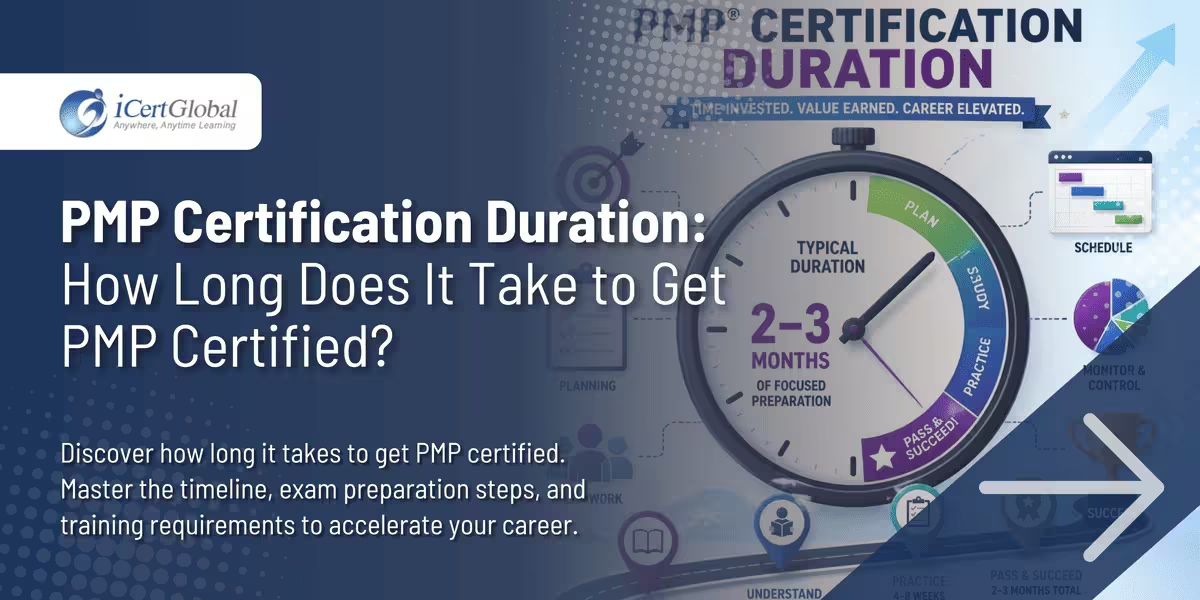
Discover how long it takes to get PMP certified. Master the timeline, exam preparation steps, and training requirements
Master product ownership. Find the complete CSPO certification cost in India, training fees, and career ROI to plan
Master the CEH exam on your first attempt. Use this practical 10-step study plan to build your ethical
Master 10 essential AI prompt engineering techniques to boost your career. Learn how to optimize LLM outputs and
Master risk management and pass your PMI-RMP Exam. Explore proven study strategies, eligibility requirements, and steps to boost
Master the CRISC certification syllabus. Learn the four domains, key exam topics, and proven prep strategies to advance
Master the critical machine learning skills you need to advance your career, pass top certifications, and land high-paying
Master enterprise risk. Learn the CRISC certification eligibility requirements, exam details, and how this credential boosts your salary
Compare CSM vs A-CSM to find the right Scrum certification for your career goals. Explore requirements, salary impact,
Our experts are ready to help you with any questions about courses, admissions, or career paths. Get personalized guidance from industry professionals.
Request a Call Back

"PMI®", "PMBOK®", "PMP®", "CAPM®" and "PMI-ACP®" are registered marks of the Project Management Institute, Inc. | "CSM", "CST" are Registered Trade Marks of The Scrum Alliance, USA. | COBIT® is a trademark of ISACA® registered in the United States and other countries.

