Your Lean Six Sigma Yellow Belt certification isn't just a certificate - it's how you get noticed by management. Working in operations, quality, or manufacturing without formal process improvement training can leave you stuck doing routine tasks while colleagues talk about DMAIC, control charts, and process capability. Meanwhile, professionals with Lean Six Sigma Yellow Belt certification online or in-person actively contribute to improvement projects, join cross-functional teams, and build resumes that qualify them for Green Belt training and higher-value roles. This Lean Six Sigma Yellow Belt course is designed by practicing Black Belts and Master Black Belts who lead improvement programs. Yellow Belts aren't passive observers - they are active contributors who need practical capability, not just awareness. Our program equips you to immediately participate in projects, collect data correctly, and understand the methodology driving your organization. Unlike introductory courses that provide superficial exposure, we build capable team members who can contribute meaningfully. You'll learn how to identify the eight wastes in your processes, use basic statistical tools to analyze data, participate effectively in kaizen events, and support Green Belts and Black Belts with data collection and process documentation. The certification validates your foundation - the real value is becoming the team member who understands improvement methodology and gets selected for high-visibility projects instead of being stuck in business-as-usual operations. We've built this for working professionals in manufacturing, services, healthcare, and IT who need foundational capability fast. Intensive 2-day bootcamp or flexible weekend format, fully interactive with real case studies from Wheeling, IL organizations. Every session recorded. Beyond the training, you get Lean and Six Sigma quick reference guides you can use on projects immediately, basic statistical templates, 24/7 expert support, and clear guidance on qualifying for Green Belt certification - the natural next step that most Yellow Belt programs mention but provide no roadmap for achieving.
Lean Six Sigma Yellow Belt Training Program in Wheeling, IL
LSSYB Training Course Highlights in Wheeling, IL
More Than a Course - It's Your Career Accelerator
Industry-Recognized Curriculum
Training aligned with the globally accepted Lean Six Sigma Yellow Belt Body of Knowledge.
Taught by Six Sigma Practitioners
Instructors are experienced Black Belts and Master Black Belts with real project expertise.
Flexible Schedule Options
Choose weekday evening, weekend, or intensive bootcamp formats suitable for working professionals.
Hands-On Project Work
Learn through real case studies and project simulations replicating real workplace improvement scenarios.
Comprehensive Practice Materials
Access 500+ practice questions, mock tests, and a project implementation toolkit.
Lifetime Expert Support
Get ongoing guidance and clarification from Six Sigma experts whenever needed.
Career Relevance
The Lean Six Sigma Yellow Belt (LSSYB) Certification Training Program is a significant step for professionals seeking to enhance their organizational performance through data-driven methodologies. Key performance indicators (KPIs) are often improved by the disciplined application of Six Sigma principles. Wheeling, IL companies benefit from this strategic approach, which fosters continuous improvement and quality control. Process optimization and defect reduction are fundamental objectives in the LSSYB curriculum.
Students learn how to analyze and solve problems using statistical process control (SPC), leading to a reduction in variability. This understanding of quality management is applied in various industries, from healthcare to finance. Effective project management is also a crucial aspect of the LSSYB program. By acquiring the skills and knowledge of the LSSYB program, professionals are better equipped to address complex business challenges.
This certification demonstrates a commitment to excellence in organizational performance and aligns with industry best practices. With this competitive edge, individuals can expand their career opportunities in Wheeling, IL and contribute to the success of their organization.
Corporate Training
Tailored programs for teams with enterprise support

Ready to transform your team?
Get a custom quote for your organization's training needs.
Skill Development
During the LSSYB Certification Training Program, students develop essential skills in statistical analysis and problem-solving techniques. This expertise enables professionals to drive process improvements and minimize waste. Root cause analysis (RCA) and the Ishikawa method are critical tools for identifying and addressing systematic flaws. Data visualization and effective communication are also emphasized in the LSSYB curriculum.
Using visual aids, such as histogram and Pareto charts, to present findings is a key skill for professionals. This skillset is highly valued by companies in Wheeling, IL seeking to make data-driven decisions. The program's focus on analytical thinking promotes decision-making supported by empirical evidence. Effective training on tools such as control charts and flowcharts is integrated within the LSSYB program.
This enables students to develop a comprehensive understanding of quality management principles and their practical application. By mastering these skills, professionals are empowered to implement impactful improvements in their organizations.
Upcoming Schedule


Skills You Will Gain In Our LSSYB Training Program - Wheeling, IL
Waste Identification
Stop accepting inefficiency as "normal". You will learn to identify the 8 wastes (DOWNTIME) in any process and quantify their impact on cost, quality, and delivery time.
Data Collection & Measurement
Cut through opinions and assumptions using facts. You will master measurement techniques, sampling methods, and data collection plans that provide reliable data for decision-making.
Process Mapping
Make the invisible visible before fixing it. You will create current-state process maps, swimlane diagrams, and value stream maps that expose bottlenecks and non-value-added steps.
Root Cause Analysis
Stop treating symptoms and solve real problems. You will use tools like 5 Whys, Fishbone Diagrams, and Pareto Analysis to identify the true underlying causes - not just quick fixes.
Basic Statistical Analysis
Understand what your data is actually saying. You will learn process capability calculations, control chart interpretation, and descriptive statistical analysis for performance evaluation.
DMAIC Methodology
Follow a proven framework instead of random trial-and-error. You will learn to structure improvement initiatives using Define, Measure, Analyze, Improve, and Control phases for sustainable results.
Who This Program Is For
This certification training is ideal for:
Operations Coordinators
Quality Analysts
Process Associates
Team Leaders
Junior Project Managers
Entry-Level Consultants
If you work in operations, quality, or process-related roles and want to contribute to improvement initiatives, this program gives you the foundational methodology and credential to do exactly that.
Practical Application
The LSSYB Certification Training Program focuses on transferring theoretical knowledge into practical application. Participants engage in case studies and simulations to develop a working understanding of Six Sigma methodologies. This hands-on experience prepares professionals to tackle real-world challenges.
By integrating DMAIC (Define, Measure, Analyze, Improve, Control) into the LSSYB curriculum, students learn how to structure their approach to process improvement. This framework guides professionals in designing and implementing effective solutions. Wheeling, IL companies appreciate the practical approach offered by the LSSYB program, which aligns with industry standards.
Using examples from various industries, instructors demonstrate the application of LSSYB principles in diverse business settings. This contextual learning experience enables students to relate the concepts to real-world scenarios. By equipping professionals with practical skills and knowledge, the LSSYB program enhances their ability to contribute to organizational success.
LSSYB Certification Training Program Roadmap in Wheeling, IL


Why get LSSYB-certified?
The Credential That Ends the Gatekeeping
Stop being overlooked for improvement teams
Get selected for high-visibility projects that demonstrate measurable business impact to leadership.
Position yourself for the Green Belt track
Yellow Belt is your launchpad - master the fundamentals and create a clear path to advanced roles and higher compensation.
Speak the language of operational excellence
Understand the tools, terminology, and mindset that quality and process improvement teams use every day.
Eligibility and Prerequisites
The Lean Six Sigma Yellow Belt is intentionally designed as the starting point for professionals entering the world of process improvement. Unlike advanced belts, it does not require prior project experience or technical background. It provides the foundational mindset, tools, and framework needed before progressing to Green Belt and beyond.
No Formal Education Requirements: There are no mandatory degree or diploma qualifications required to enroll in or earn a Yellow Belt certification.
No Prior Six Sigma Experience Needed: This certification is ideal for beginners and those newly stepping into operational excellence or continuous improvement environments.
Training Completion Recommended: While some certifying bodies allow direct exam attempts, completing a recognized training program (like ours) significantly improves exam success and real-world application capability.
Workplace Relevance: Most impactful for professionals in operations, quality, manufacturing, service delivery, business support, or anyone transitioning into process improvement roles.
Growth
Throughout the LSSYB Certification Training Program, students cultivate a comprehensive understanding of Six Sigma principles. This foundation enables them to pursue advanced certifications, such as the Green Belt or Black Belt. By expanding their skillset, professionals in Wheeling, IL can take on more senior roles or shift into specialized areas.
The LSSYB program's emphasis on process management and statistical analysis lays the groundwork for continued growth. Professionals develop a solid understanding of quality tools and techniques, which they can apply in various contexts. This versatility is highly valued by organizations, as it enables professionals to adapt to changing business requirements.
By leveraging the knowledge and skills gained from the LSSYB program, individuals can advance their careers and contribute to the growth of their organization. This upward trajectory is facilitated by the program's focus on continuous improvement and quality management best practices.
Course Modules & Curriculum
Six Sigma Foundations & Organizational Context
Lesson 1: Introduction to Lean Six Sigma Philosophy
Understand how Lean Six Sigma evolved and why it matters in modern business. Learn the core concepts of variation, defects, and process capability. Distinguish between Lean (waste elimination) and Six Sigma (variation reduction), and understand how the two approaches integrate to drive operational excellence.
Lesson 2: Organizational Roles & Deployment
Discover how Lean Six Sigma programs are structured within organizations. Understand the responsibilities of Champions, Black Belts, Green Belts, and Yellow Belts, and learn how improvement projects are selected, approved, and measured for financial and operational impact.
Lesson 3: Team Dynamics & Yellow Belt Responsibilities
Learn how to contribute effectively as a Yellow Belt team member in DMAIC projects. Understand team roles, collaboration expectations, and how to participate in problem-solving and data-driven discussions led by Green and Black Belts.
Define Phase - Framing the Problem
Lesson 1: Project Selection & Charter Development
Learn to identify high-impact improvement opportunities using prioritization tools. Develop clear and measurable project charters, including problem statements, goals, scope boundaries, and stakeholder identification - essential skills for launching aligned and achievable improvement initiatives.
Lesson 2: Voice of the Customer (VOC)
Master methods for gathering and analyzing customer feedback. Translate needs and expectations into Critical-to-Quality (CTQ) requirements, and learn how to differentiate explicit requests from deeper underlying needs that influence satisfaction.
Lesson 3: Process Identification & High-Level Mapping
Create SIPOC diagrams to clarify process boundaries and relationships. Build high-level process maps to visualize how work flows, identify bottlenecks, and uncover inefficiencies before diving deeper into analysis.
Measure Phase - Quantifying Performance
Lesson 1: Data Collection Fundamentals
Understand the difference between continuous and discrete data and when each is applicable. Develop reliable operational definitions, sampling strategies, and data collection plans that eliminate ambiguity and ensure trustworthy measurement.
Lesson 2: Process Performance Metrics
Learn key Six Sigma performance metrics, including DPU, DPMO, yield, cycle time, and process capability indices (Cp, Cpk). Understand what these metrics reveal about customer satisfaction and process stability.
Lesson 3: Basic Measurement System Analysis
Establish measurement reliability before analysis. Learn the concepts of accuracy, precision, bias, and stability, and perform basic Gage R&R studies to verify that data is valid and repeatable.
Analyze Phase - Identifying Root Causes
Lesson 1: Process Mapping & Value Stream Analysis
Create detailed process maps and swimlane diagrams to visualize workflows and handoffs. Use value stream mapping to classify activities as value-added or non-value-added and identify improvement opportunities.
Lesson 2: Root Cause Analysis Tools
Apply structured techniques such as the 5 Whys, Fishbone (Ishikawa) Diagrams, and Pareto Analysis to move beyond treating symptoms and uncover the true underlying causes of process problems.
Lesson 3: Basic Statistical Analysis
Learn to calculate and interpret descriptive statistics such as mean, standard deviation, and range. Create and analyze histograms, run charts, and basic control charts to understand process behavior and variation patterns over time.
Improve & Control - Implementing and Sustaining Solutions
Lesson 1: Solution Generation & Implementation
Use structured brainstorming and prioritization frameworks to identify effective improvement ideas. Develop implementation plans with defined ownership, timelines, and success criteria to drive meaningful results.
Lesson 2: Control Phase & Sustainability
Create control plans to maintain improvements over time. Learn monitoring methods, documentation practices, and standard work procedures to prevent regression and ensure long-term stability.
Lesson 3: Lean Principles & Waste Elimination
Master the 8 wastes (DOWNTIME) and learn how to identify and eliminate them. Apply 5S principles for workplace organization and explore pull systems, Kanban, and continuous flow as alternatives to traditional batch processing.
Course & Support
Everything you need to know about our training options and support
Work Responsibilities
Upon completing the LSSYB Certification Training Program, professionals are equipped to take on specific roles and responsibilities within their organizations. They can contribute to quality improvement initiatives and participate in project teams deploying Six Sigma methodologies.
In Wheeling, IL companies, LSSYB-certified professionals can assume responsibilities such as quality control manager or process improvement analyst. Their expertise in statistical process control and data analysis enables them to drive process enhancements and streamline operations.
By working collaboratively with cross-functional teams, LSSYB-certified professionals help organizations achieve operational efficiencies and improve customer satisfaction. Their contributions to quality management and process improvement have a direct impact on business outcomes, making them valuable assets to their organizations.
Customer Testimonials
Hear from our successful graduates
"Exceptional PMP Training Experience with iCertGlobal I recently completed the PMP training by iCertGlobal, and I must say it was an outstanding experience. The instructor demonstrated a deep understanding of project management principles and brought real-world experience to the table. The training material's provided were comprehensive and well-organized, offering valuable insights and practical tips. I would highly recommend iCertGlobal to anyone looking for professional PMP Training.. "

John Anderson
"iCertGlobal provided a great learning experience with clear, well organised courses. The trainers were knowledgeable, and the support team was responsive to all my questions. The study material was comprehensive, which helped me pass my certification exam with ease. Highly recommended for anyone looking to get certified. "
James Walsh
"iCertGlobal is the best Certificate Training Organization. you will get good instructor and they will improve leaning sills and give the real time experience examples due to that you will get pass in first try. "
Andy Moran
"The course content, exam prep questions, interactive Q&A, and real-life examples made attending this PMP Project Management training class worth my time and money. The support from iCertGlobal was exceptional and I would like to thank them for accepting my request of meeting the trainer post the session for clearing my doubts."
Tim Malone
"I had a good learning experience with icertGlobal and it had been an amazing development journey. Actually, I accidentally bumped into iCertGlobal while searching for an online course for preparing my PMP examination. With positive reviews all over the internet and quick responses to my questions, I was flabbergasted enough to sign-up immediately. The instructor-led PMP preparatory course helped me both offline and online preparations. All the high-quality materials written in simple layman language was enough to grasp the gist of various topics. The instructors were very knowledgeable as they imparted not only their wealth of experiences but also real life examples. Thanks a lot iCertGlobal for imbibing this great learning experience. "
Jason Walter
"Thank you for your great course, great support, rapid response and excellent service."
Hoda Alavi
"My trainer made the materials relatable and easy to understand. It was fun being in class everyday. "
Cassandra Corn
"Amazing trainer who was very supportive. "

Shanna Pilgrim
"Trainer was well versed in the subject matter and got the impression the gentleman was professional and educated within standards and procedures for PMI. "
Anthony Zamora
"The Training was good and customer service was perfect. "
Maka Diakhate
"Trainer was knowledgeable and lesson's pace was just right."

Roger Gonzales
"Trainer (Bruce) was very excellent in delivery and presentation. He provided me with all the tools required to be successful in the PMP exams with lots of quiz questions on all topics reviewed. "
Bashiru Ojibara
"The trainer, Emad was top notch and very knowledgeable. He is up to date with all current versions and is great in 1:1 Training. "

Jonathan Obien
"Thank you for your great course, great support, rapid response and excellent service"

Hoda Alavi
"Marc had very good knowledge and he was able to explain the material and provide guidance to get ready for the test. "

Roque Montesino
"Excellent Course. Zahn was a great instructor and the course material definitely will help me pass the PMP Exam "

Jared Nelson
"Great teacher, went out of his way in every possible aspect. "
Radiah Sims
"Customer service provided by Robin was great as he was very responsive and the trainer, John, was very good at relating the content to my industry. "

Jason D Niebauer
Build In-Demand Skills
Explore our instructor-led Lean Six Sigma Yellow Belt training to learn about the course duration, cost, eligibility, and certification process. You get practical learning, exam-focused preparation, and expert guidance. Ready to get started? Compare Lean Six Sigma Yellow Belt certification training options and choose a classroom or live online format that fits your schedule.
Lean Six Sigma Yellow Belt Training in Other Cities
Our Lean Six Sigma Yellow Belt certification training is available in major cities worldwide
Related Blogs
Stay updated with the latest insights and trends in your field
Lean Six Sigma Green Belt and Black Belt
Discover the true Lean Six Sigma certification cost for Green and Black Belts. Compare exam fees, career ROI,...
DMAIC Explained Through a Realistic Process Improvement Example
Master the DMAIC process with a practical, step-by-step example. Learn how to solve process issues, pass your exam,...
How to Select a Lean Six Sigma Project
Learn how to identify and execute high-impact projects. Master Lean Six Sigma project selection to drive business results...
Six Sigma Belt Levels Explained: Yellow, Green, and
Advance your career by mastering Six Sigma belt levels. Learn the differences between Yellow, Green, and Black Belts...
How to Prepare for the Six Sigma Green
Master the DMAIC methodology and pass your Six Sigma Green Belt Certification Exam. Learn proven study strategies to...
10 Industries Where Lean Six Sigma Green Belt
Advance your career with Lean Six Sigma Green Belt skills. Explore the top 10 industries actively hiring certified...
Understanding Key Lean Six Sigma Principles for Exam
Master essential lean six sigma principles to pass your certification exam, eliminate process waste, and advance your career....
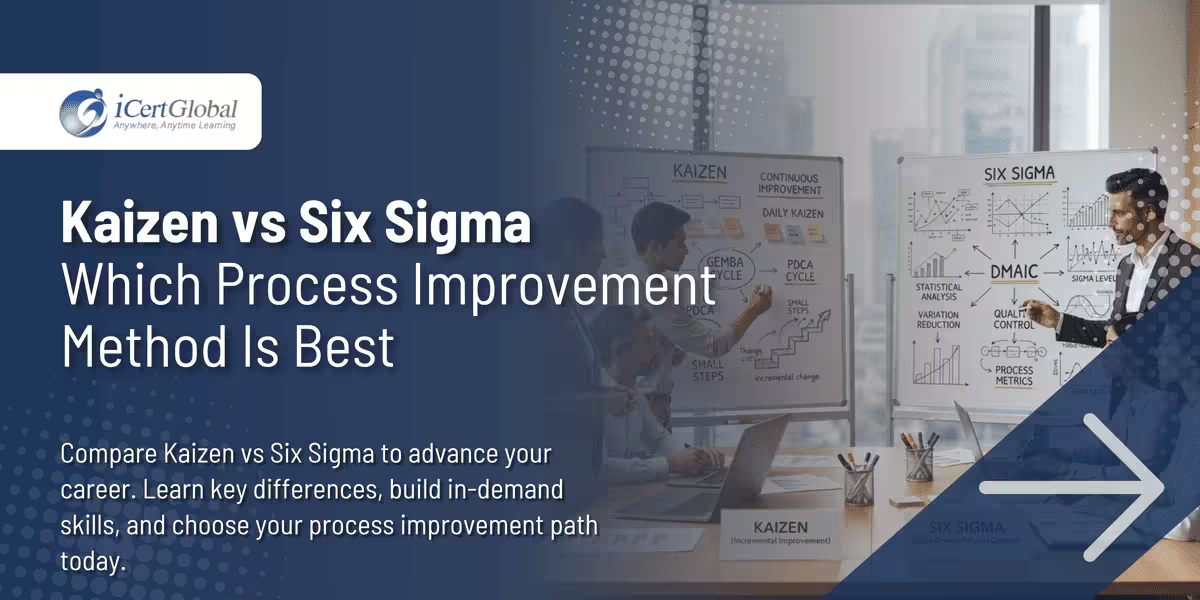
Kaizen vs Six Sigma Which Process Improvement Method
Compare Kaizen vs Six Sigma to advance your career. Learn key differences, build in-demand skills, and choose your...
Six Sigma vs TQM: Key Differences Explained
Advance your career by mastering quality management. Discover the key differences between Six Sigma and TQM to choose...
.avif)
How to Achieve Six Sigma Green Belt Certification?
Master the DMAIC framework and boost your career. Learn how to achieve Six Sigma Green Belt Certification with...

