






8 Best Practices for Successful Business Analysts
Learn 8 proven best practices for Business Analysts to master requirements, manage stakeholders, and drive project value. Expert
Stop just documenting requirements. Get the elite credential that gives you a seat at the table to shape business strategy.
You're a senior business analyst, but often treated like a scribe - brought into projects after major decisions are made and told to just "document the requirements." You have the strategic insight to help the business define problems and shape solutions, but lack the credential that gets you into high-level conversations. Our business analytics certification elevates you to a strategic partner. Certified Business Analysis Professionals (CBAPs) lead enterprise analysis, influence business strategy, and command salaries 50-70% higher than uncertified peers because they are recognized as value creators, not just requirement-takers. This isn't another course that just rehashes the BABOK-Guide. Our business analytics course is designed and led by practicing CBAPs working on large-scale transformation projects in Barrie, ON banking, telecom, and retail. They facilitate workshops with C-level executives, model complex enterprise architectures, and build business cases for multi-crore investments. You'll learn the BABOK framework while applying it to navigate ambiguity, influence powerful stakeholders, and drive business decisions - not just document them. Unlike programs focused on memorization, we build strategic leadership capability for BAs. Learn techniques for enterprise analysis, solution evaluation, and strategy definition that go beyond user stories and use cases. The business analytics certification proves your experience, but the real value is shifting your role from project-level order-taker to enterprise-level strategic advisor who is indispensable to the business. This program is built for experienced BAs, product owners, and systems analysts who have hit a professional ceiling. Structured for senior professionals, it includes interactive discussions, complex case studies, expert-led sessions on cracking the notoriously difficult scenario-based CBAP exam, and meticulous one-on-one support for the CBAP application process - ensuring your years of hard-earned experience meet IIBA's stringent requirements.
Learn with absolute confidence, knowing our curriculum is officially recognized and fully aligned with IIBA's stringent standards and the BABOK-Guide v3.
Unlock your potential with expert instructors who are practicing, CBAP-certified professionals guiding you through complex case studies and real-world scenarios.
Target your CBAP certification with a training schedule that respects your time. We offer weekday-evening, weekend-only, or a full 4-day bootcamp format.
Master complex concepts fast with 35 hours of hands-on training and individualized performance feedback through multiple exam simulators that mimic the real case-study format.
Demolish your weak areas with 1500+ tailor-made practice questions, mock tests, and detailed case studies that reflect the actual exam's complexity.
Be worry-free as industry experts are available 24x7 to solve your doubts and assist you at every turn - from application to certification.
In the field of business analysis, requirements elicitation is a critical component of the Certified Business Analysis Professional (CBAP) Certification Training Program. This involves identifying and documenting stakeholders' needs and expectations to inform project decisions. Requirements gathering typically begins with stakeholder analysis, which aims to identify, analyze, and prioritize stakeholders based on their interest and influence in the project.
By doing so, business analysts can develop a comprehensive understanding of stakeholders' requirements, including their needs, expectations, and constraints. In the context of business analysis, requirements documentation is essential to ensure that stakeholder needs are properly captured and communicated. In Barrie, ON, business analysts must be skilled in requirements elicitation to effectively communicate with stakeholders and deliver high-quality outcomes.
This requires developing strong stakeholder management skills, including active listening, negotiation, and conflict resolution.

Get a custom quote for your organization's training needs.
Business analysts working on projects must be well-versed in the requirements documentation process to ensure that stakeholder needs are properly captured and communicated. This involves creating and maintaining requirements documentation, including functional and non-functional requirements, use cases, and system specifications. Effective requirements documentation is critical to ensuring that stakeholders are aware of their needs and expectations and that the project deliverables meet their requirements.
Requirements documentation also involves identifying and documenting assumptions, dependencies, and risks associated with the project. By doing so, business analysts can develop a comprehensive understanding of the project scope and ensure that stakeholders are aware of the potential risks and challenges associated with the project. In the context of business analysis, requirements documentation is essential to ensuring that project deliverables meet stakeholder expectations and requirements.
In Barrie, ON, business analysts must be skilled in requirements documentation to effectively communicate with stakeholders and deliver high-quality outcomes. This requires developing strong documentation skills, including writing clear and concise requirements, creating and maintaining documentation templates, and using version control systems to manage document changes.
Move beyond project-level thinking. You will learn to analyze the current state, define the future state, assess risks, and craft a change strategy that delivers measurable business value.
Master advanced techniques to uncover implicit requirements from even the toughest stakeholders. You will learn to manage conflicts, drive engagement, and build lasting consensus across teams.
Stop treating requirements as static documents. You will learn to manage, trace, prioritize, and maintain requirements end-to-end, ensuring alignment with business goals. With tools like Power BI, you'll visualize dependencies and performance metrics that keep stakeholders on track.
Model, specify, and verify requirements with architectural precision. You will go beyond user stories to develop robust design options and solution recommendations that can actually be implemented.
Don't just recommend solutions - prove their value. You will master the techniques to measure solution performance, analyze results, and recommend data-backed actions that maximize business outcomes.
Plan your analysis effort from start to finish. You will learn to conduct stakeholder analysis, define governance structures, and track progress with analytics tools that provide real-time insights and keep your strategy on course.
If you have significant business analysis experience and meet IIBA's mandatory requirements, this program is engineered to get you certified.
To become a certified business analyst, professionals must develop a comprehensive understanding of stakeholder analysis and requirements elicitation. This involves identifying and analyzing stakeholders' needs and expectations to inform project decisions and ensure that project deliverables meet stakeholder requirements. By doing so, business analysts can develop strong stakeholder management skills, including active listening, negotiation, and conflict resolution.
Effective stakeholder analysis is critical to ensuring that business analysts understand stakeholder needs and expectations and that stakeholders are aware of their needs and expectations. In the context of business analysis, stakeholder analysis involves identifying, analyzing, and prioritizing stakeholders based on their interest and influence in the project. In Barrie, ON, business analysts must be skilled in stakeholder analysis to effectively communicate with stakeholders and deliver high-quality outcomes.
This requires developing strong stakeholder management skills, including understanding stakeholder interests, influencing stakeholders, and managing stakeholder expectations.


Get the strategic roles your experience already deserves.
Reserved for certified professionals who can link projects to business value.
Drive enterprise-wide change and demonstrate measurable business impact.
The CBAP is the gold standard for senior business analysis professionals. IIBA has established strict benchmarks to ensure every certified individual has a proven track record of leading complex analysis work. Here is what you need to qualify.
7,500 Hours of Business Analysis Work Experience: This must be logged within the last 10 years.
900 Hours in 4 of the 6 BABOK Knowledge Areas: You must demonstrate depth and breadth across the BA competency spectrum.
35 Hours of Professional Development (PD): This must be completed within the last 4 years. Our training program fully satisfies this requirement.
Two Professional References: You'll need references from a career manager, client, or another CBAP recipient.
Additional Guidance: For a comprehensive breakdown of how to document your hours, please refer to our detailed FAQ section.
The Certified Business Analysis Professional (CBAP) Certification Training Program focuses on developing professionals' skills in requirements elicitation, stakeholder analysis, and requirements documentation. By mastering these skills, business analysts can develop strong stakeholder management skills, including active listening, negotiation, and conflict resolution. This requires developing a comprehensive understanding of stakeholder analysis, requirements elicitation, and requirements documentation.
Effective requirements elicitation involves identifying and documenting stakeholders' needs and expectations to inform project decisions and ensure that project deliverables meet stakeholder requirements. By doing so, business analysts can develop a comprehensive understanding of stakeholder needs and expectations and ensure that stakeholders are aware of their needs and expectations. In Barrie, ON, business analysts must be skilled in requirements elicitation to effectively communicate with stakeholders and deliver high-quality outcomes.
This requires developing strong stakeholder management skills, including understanding stakeholder interests, influencing stakeholders, and managing stakeholder expectations.
Go beyond basic interviews. Master advanced elicitation techniques like workshops, prototyping, and observation to uncover hidden stakeholder needs. Learn to manage complex dynamics and foster productive collaboration throughout the project lifecycle.
Learn the discipline of tracing, maintaining, prioritizing, and approving requirements to ensure they remain aligned with the business case throughout the project. Build strong governance and change management mechanisms for long-term consistency.
Develop frameworks to manage competing interests, organizational politics, and difficult stakeholders. Master techniques to build consensus, handle resistance, and influence decision-making with credibility and data-backed insights.
Learn to use industry-standard modeling techniques such as UML and BPMN to create clear, verifiable, and traceable requirements. Develop artifacts that support both business understanding and technical implementation.
Build quality from the start. Learn to perform peer reviews, walkthroughs, and validation sessions to ensure requirements are correct, complete, and fully aligned with business objectives before moving to design and development.
Move from analysis to solutioning. Learn to develop, evaluate, and recommend multiple design options that balance business goals, user needs, and technical feasibility - ensuring the best possible solution design.
Your role doesn't end after deployment. Learn to define performance metrics and KPIs, collect data, and evaluate whether the solution is delivering the intended business value and ROI.
Cut through data complexity. Learn to interpret performance results, identify root causes of underperformance, and uncover hidden improvement opportunities using structured analytical methods.
Identify the factors holding back solution or organizational success. Apply data analytics, business data analysis, and predictive modeling techniques to recommend targeted improvements that enhance overall performance and value realization.
Master the soft skills and analytical abilities that the CBAP exam implicitly tests. Strengthen your critical thinking, problem-solving, communication, and business acumen to handle scenario-based questions with confidence.
Develop expert-level exam techniques to handle long, complex case studies. Learn how to extract key insights quickly, identify relevant information, and answer groups of scenario-based questions accurately under time pressure.
Consolidate your knowledge across all Knowledge Areas (KAs). Tackle full-length mock tests, review high-weighted topics, and prepare to enter your CBAP exam with unshakeable confidence and mastery of the BABOK Guide framework.
The Certified Business Analysis Professional (CBAP) Certification Training Program is designed to equip professionals with the skills and knowledge required to perform business analysis successfully. This involves developing a comprehensive understanding of requirements elicitation, stakeholder analysis, and requirements documentation.
By mastering these skills, business analysts can develop strong stakeholder management skills, including active listening, negotiation, and conflict resolution. Effective stakeholder analysis involves identifying, analyzing, and prioritizing stakeholders based on their interest and influence in the project.
By doing so, business analysts can develop a comprehensive understanding of stakeholder needs and expectations and ensure that stakeholders are aware of their needs and expectations. In Barrie, ON, business analysts must be able to communicate effectively with stakeholders, which requires developing strong stakeholder management skills, including understanding stakeholder interests, influencing stakeholders, and managing stakeholder expectations.
Great class, very informative.

Great PMP<sup>®</sup> Bootcamp. I had a great time taking this course. I took the course to prepare to sit for the CAPM<sup>®</sup> but may be able to sit for the PMP<sup>®</sup>. I learnt a lot was challenging. Great course. We need one more day. Content was very detailed.

it was a great class. Lots of energy. And I enjoyed.

Fantastic course to prepare for PMP<sup>®</sup> exam.

As a participant it was smooth sailing for me.

Trainer was excellent. Shared good resources and good experiences.

Good content and training.
I wanted to let you know that I took and passed the PMP exam. Thanks to iCertGlobal and especially my Cincinnati course instructor, who was an excellent teacher and helped me immensely.

Trainer was good. Trainer was very engaged and interacting. Very much satisfied with the training.

I was pleasantly surprised at the quality of this training. Yomi was awesome as a trainer and working to make sure that we understood the concepts. Controlling Cost and Controlling Risk are the most complicated, but Yomi spent time after class working through questions to help others understand. This class also helped to change my perception of the PMP being this MONSTER to something that I can I can successfully do.

Great class with a lot of information and tips to prepare for the exam

It was a great course, covered all the things that i ended up hitting road bumps on. I was the only one in the class, but the trainer was just as involved as if it had been a full class.

I was nervous about taking it online versus classroom; but I am actually glad I took it online. Instructor was very great and gave a good learning experience with his relevant project management experience.
The training was very intense but covered with course material. It was more than I expected.

I thought the class was very informative. The instructor did an excellent job breaking down each chapter to where it was easy to understand. I was also very impressed with his commitment to help us pass ever after the class is over.

Excellent training. Instructor was very knowledgeable and explained information in an understandable way
Quality Materials presented, Instructor very knowledgeable. Exceeded my expectations.
The training is a great introduction into the PMI mindset. Very informative and helpful

The training is a great introduction into the PMI mindset. Very informative and helpful

All positive - trainer has vast experience in different types of projects which helped with the examples he provided
Great! Lots of material and very helpful to not only learn the material but also prepare for the exam. Completely satisfied with the training.

Great Course. Dr. Ram was an awesome teacher. I could listen to him all day.
I completed the Online Training Session and thought it was well put together and satisfied everything I expected.

I really enjoyed how thorough trainer was with the course information and taking time to elaborate on areas that may have been somewhat confusing. He did a tremendous job in making sure that we knew what would possibly be on the exam and ensuring our confidence to take the exam within the next few months. Overall, I thought the course was great and trainer was exceptional in his teaching of the curriculum.

Great content. Teacher did an excellent job of presenting the material, knew the material well.
Explore our instructor-led CBAP training to learn about the course duration, cost, eligibility, and certification process. You get practical learning, exam-focused preparation, and expert guidance. Ready to get started? Compare CBAP certification training options and choose a classroom or live online format that fits your schedule.
Explore Our CBAP certification training is available in a city near you
Stay updated with the latest insights and trends in your field
Learn 8 proven best practices for Business Analysts to master requirements, manage stakeholders, and drive project value. Expert

Explore why the ECBA Certification is a must-have for new BAs. Learn about ECBA career benefits, salary hikes,

Kickstart your business analysis career. Master your ECBA Exam preparation with a structured study plan, mock benchmarks, and
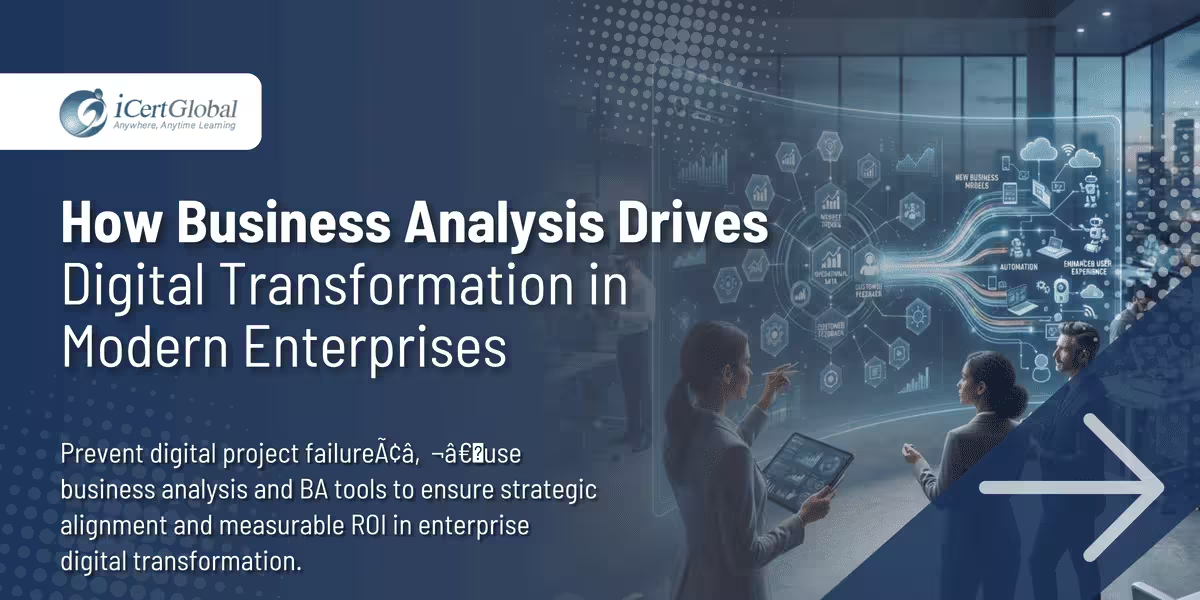
Prevent digital project failure—use business analysis and BA tools to ensure strategic alignment and measurable ROI in enterprise

Explore 7 key reasons a Business Analytics career boosts ROI and growth for senior professionals (10+ yrs). Gain
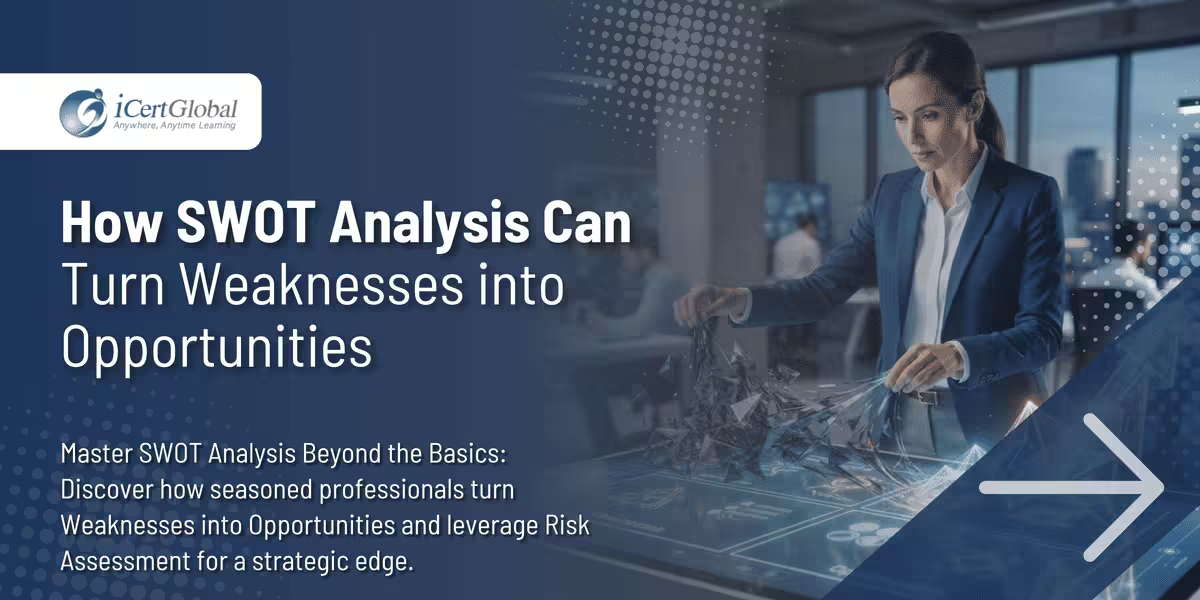
Learn how to perform a SWOT analysis. Master this essential strategic tool to advance your career and make

Master scalable and secure Business Analytics with cloud-native architecture. Learn how microservices, Kubernetes, and BI tools like Power

Learn how advanced ML algorithms, from deep learning to MLOps, are transforming Business Analytics. Gain expert insights to

Learn how quantum computing is revolutionizing business analytics and operation solving. Discover key use cases and prepare for

Explore how AR/VR is transforming business analytics. Master immersive data visualization to drive better decision making. A guide
Our experts are ready to help you with any questions about courses, admissions, or career paths. Get personalized guidance from industry professionals.
Request a Call Back

"PMI®", "PMBOK®", "PMP®", "CAPM®" and "PMI-ACP®" are registered marks of the Project Management Institute, Inc. | "CSM", "CST" are Registered Trade Marks of The Scrum Alliance, USA. | COBIT® is a trademark of ISACA® registered in the United States and other countries.

