






AI Driven Digital Marketing Certified Professional Salary in
Learn how earning your AI digital marketing certification impacts your 2026 salary potential. Find average pay, career paths,
Stop being blindsided by IT failures. Get the globally mandated credential that validates your expertise in managing enterprise IT risk and implementing solid controls, unlocking senior-level governance and audit roles.
Your CRISC isn't just a certificate; it's a career lever that can open doors to senior leadership in Governance, Risk, and Compliance (GRC). As a technical manager, compliance officer, or internal auditor, you may spot outdated systems, non-compliant processes, or neglected security controls every day. Yet, without the strategic framework that comes with CRISC certification, prioritizing these risks based on actual business impact and risk appetite remains a challenge. CRISC-certified professionals not only define risk culture and implement control frameworks but also command significantly higher salaries, often 30-50% more than their peers, reflecting their ability to safeguard enterprises from catastrophic losses. Our CRISC training program is meticulously designed by ISACA-certified IT Audit Directors and Chief Risk Officers who manage billion-dollar risk portfolios in Coventry, England leading financial and IT service organizations. Unlike conventional courses that focus on technical facts, this program teaches you the complete CRISC framework and shows you how to translate technical vulnerabilities into quantified business risks. You will learn how to design cost-effective control solutions that satisfy both boards and regulators, bridging the gap between IT risk and business strategy. Through this intensive CRISC training, you will gain mastery in establishing robust risk identification processes, applying advanced risk assessment methodologies to quantify impact, and crafting practical risk response strategies, including mitigation, transfer, and acceptance, aligned with executive decision-making. Passing the CRISC exam validates your expertise, but the true value is in walking into board meetings across Coventry, England, or beyond with the confidence to present clear, data-driven assessments of your organization's IT risk posture, demanding action and resources. This program is specifically tailored for working professionals who need verifiable expertise. Intensive weekday and weekend batches are fully interactive, offering live Q&A sessions, access to risk quantification templates, control assessment checklists, and 24/7 expert support. With our structured system, achieving this highly specialized ISACA credential becomes an attainable goal. Before enrolling, you can also explore the CRISC certification cost and understand how earning your CRISC certification can dramatically increase your career trajectory and CRISC certification salary potential. Enrolling in this CRISC training is more than preparing for an exam; it's about transforming your career, establishing yourself as a trusted authority in IT risk management, and unlocking leadership opportunities in the rapidly evolving world of enterprise governance, risk, and compliance.
Your curriculum is meticulously aligned with the latest four domains of the CRISC job practice for maximum exam relevance.
Learn directly from CRISC-certified professionals who design and implement risk governance and control frameworks for major Coventry, England enterprises.
Focus exclusively on complex, real-world scenarios to apply risk concepts - the core of the high-stakes ISACA exam methodology.
Master the CRISC concepts fast with 40+ hours of strategic, application-oriented learning and deep-dive domain reviews.
Strengthen your weak areas with 1500+ tailor-made, application-style practice questions focused on risk quantification and control design.
Be worry-free as certified risk leaders are available 24x7 to assist you with assessment, control, and governance-related queries.
The CRISC (Certified in Risk and Information Systems Control) certification is a globally recognized credential in the field of risk and information systems control. Coventry, England-based organizations rely on risk management to ensure business continuity and strategic alignment. CRISC certification holders possess expertise in risk management, control, and governance, which is highly valued by employers.
In the context of risk management, organizations need professionals who can identify and assess risks using techniques such as risk assessment frameworks and maturity models. CRISC certification holders have a solid understanding of enterprise risk management (ERM) principles and are well-versed in identifying, assessing, and mitigating risks. By applying these skills, professionals can ensure that organizations remain competitive and resilient.
In the Coventry area, businesses are constantly seeking professional guidance on risk management and strategic decision-making. CRISC certification holders bring value to organizations by providing actionable insights and recommendations that support informed decision-making. By leveraging their expertise, organizations can reduce their exposure to risks and achieve their strategic objectives.

Get a custom quote for your organization's training needs.
CRISC certification holders are responsible for identifying and assessing risks that threaten an organization's strategic objectives. Coventry-based professionals who have earned this certification work closely with stakeholders to develop and implement effective risk management strategies. This involves creating and maintaining risk assessments, recommending risk-mitigation controls, and monitoring risk exposure.
Professionals with CRISC certification possess a deep understanding of risk management frameworks and are skilled in applying these frameworks to real-world scenarios. They have expertise in risk assessment methodologies, such as the Committee of Sponsoring Organizations (COSO) framework, and are well-versed in identifying and mitigating risks that could impact business outcomes. In the Coventry area, these skills are highly valued by employers who seek professionals who can provide expert guidance on risk management.
In their role, CRISC-certified professionals must communicate complex risk management concepts to non-technical stakeholders, providing actionable recommendations to support strategic decision-making. This requires strong analytical and technical skills, as well as excellent communication and interpersonal skills. By providing expert guidance on risk management, professionals in this field play a critical role in supporting business success and resilience.
Master the methodology for identifying IT risk sources, events, and vulnerabilities across the enterprise and linking them to business objectives.
Learn to execute advanced risk assessment techniques (e.g., heat maps, probability/impact scoring) to accurately quantify and prioritize risk based on business criticality.
Command the design and selection of risk responses (mitigation, acceptance, transfer) and develop the business case for necessary control investments.
Master the principles of designing, implementing, and documenting effective control frameworks to manage specific, quantified risks to an acceptable level.
Implement a robust framework for continuous monitoring of key risk indicators (KRIs) and assessing control effectiveness to ensure ongoing risk compliance.
Learn to integrate the IT risk management framework with the overall Enterprise Risk Management (ERM) strategy, ensuring board-level reporting and accountability.
If you have 3 or more years of cumulative, paid experience managing IT risk and/or implementing information systems controls, this program is your mandatory path to strategic risk leadership and governance roles.
The CRISC certification training program aims to address a critical skill gap in the field of risk management. Coventry-based professionals who are pursuing this certification typically have a solid foundation in risk management principles, but lack the advanced skills and knowledge required to excel in this field. By completing the CRISC certification training program, professionals can acquire the expertise needed to identify and mitigate risks that impact business outcomes.
The training program covers advanced risk management concepts, including risk assessment methodologies, risk mitigation strategies, and risk monitoring controls. Professionals who complete the program will gain a deep understanding of risk management frameworks and be well-versed in applying these frameworks to real-world scenarios. In the Coventry area, employers are seeking professionals who possess these advanced skills and knowledge.
Professionals who have completed the CRISC certification training program will have the skills and knowledge required to excel in risk management roles. They will be able to provide expert guidance on risk management, communicate complex concepts to non-technical stakeholders, and support strategic decision-making. By addressing the skill gap in this field, professionals can provide significant value to their organizations and contribute to business success.


Meet the mandatory ISACA certification requirements for governance, risk, and compliance leadership positions.
Position yourself among professionals who quantify and manage enterprise IT risk at the strategic level.
Demonstrate proven expertise in implementing and monitoring controls that protect against regulatory fines and catastrophic loss.
The Certified in Risk and Information Systems Control (CRISC) certification is globally recognized for its rigor and relevance. It is designed exclusively for professionals with proven, hands-on experience in IT risk management and control implementation. Here is what you need to qualify.
Mandatory Experience: A minimum of 3 years of cumulative, paid, full-time work experience in at least three of the four current CRISC domains.
Experience Window: The required experience must be gained within the 10-year period preceding your application date, or within 5 years of passing the CRISC exam.
No Waivers: Unlike some ISACA certifications, CRISC does not allow educational waivers for the mandatory 3 years of work experience - practical exposure is essential.
The Reality: There are no shortcuts. This program equips you with the methodologies and exam knowledge required to validate your experience, but the actual certification demands verifiable professional practice in IT risk management.
Professionals who have earned the CRISC certification are well-positioned for career growth and advancement in the field of risk management. Coventry-based organizations are constantly seeking professionals who possess advanced risk management skills and knowledge. By completing the CRISC certification training program, professionals can accelerate their career growth and achieve their career objectives.
The CRISC certification is a highly valued credential in the field of risk management, and professionals who hold this certification are recognized as experts in their field. They have a deep understanding of risk management frameworks and are well-versed in applying these frameworks to real-world scenarios. In the Coventry area, employers recognize the value of CRISC-certified professionals and are willing to invest in their careers.
By earning the CRISC certification, professionals can demonstrate their expertise and commitment to risk management. This can lead to new career opportunities, increased responsibility, and higher earning potential. Professionals who have completed the CRISC certification training program will be well-positioned to take on leadership roles and contribute to the growth and success of their organizations.
Master the four primary risk response options - Accept, Mitigate, Transfer, and Avoid - and learn to select the most cost-effective strategy aligned with your organization's risk appetite.
Gain expertise in designing preventive, detective, and corrective controls. Learn to map these controls to specific risks and regulatory requirements, a critical aspect of CRISC certification preparation and practical CRISC training application.
Develop skills to document risk responses, define clear ownership of risks and controls, and build a strong business case for control investments. These competencies contribute directly to CRISC certification success and enhance your salary potential.
Master the methodology for continuous monitoring of controls, defining control test plans, and conducting Control Self-Assessment (CSA) programs.
Learn how to define and monitor Key Risk Indicators (KRIs), create effective risk reports for the board and senior management, and communicate risk status clearly and confidently.
Integrate the IT risk framework with governance structures such as the IT Steering Committee, and prepare the organization's risk management program for internal and external IT audits.
Master the alignment of IT risk strategy with the overall Enterprise Risk Management (ERM) framework and organizational strategy for sustainable governance.
Deep-dive into the regulatory landscape in Coventry, England (e.g., IT Act and industry-specific mandates) and learn how to map compliance requirements to your organization's risk and control framework.
Understand the role of IT risk management in driving and assessing the adequacy of Business Continuity Planning (BCP) and Disaster Recovery (DR) programs.
Review the ISACA Code of Professional Ethics and understand the ongoing requirements for maintaining your CRISC certification in good standing.
Develop targeted strategies for ISACA's scenario-based questions. Learn the "best answer" methodology - a critical skill for excelling in the CRISC exam and enhancing your overall exam performance.
Consolidate your knowledge across all domains, focus on high-weighted areas, and complete mock assessments. This ensures full readiness for your CRISC certification and positions you for higher-value strategic risk roles.
The CRISC certification training program provides professionals with the skills and knowledge needed to excel in risk management roles. Coventry-based professionals who complete the program will gain a deep understanding of risk management frameworks and be well-versed in applying these frameworks to real-world scenarios. They will possess the advanced skills and knowledge required to identify and mitigate risks that impact business outcomes.
The training program covers a range of topics, including risk assessment methodologies, risk mitigation strategies, and risk monitoring controls. Professionals who complete the program will have the ability to analyze complex risk management concepts, identify areas of risk, and recommend effective risk mitigation strategies. In the Coventry area, employers are seeking professionals who possess these advanced skills and knowledge.
By completing the CRISC certification training program, professionals can develop the skills and knowledge needed to support strategic decision-making. They will be able to communicate complex risk management concepts to non-technical stakeholders, provide actionable recommendations, and contribute to business success.
Great class, very informative.

Great PMP<sup>®</sup> Bootcamp. I had a great time taking this course. I took the course to prepare to sit for the CAPM<sup>®</sup> but may be able to sit for the PMP<sup>®</sup>. I learnt a lot was challenging. Great course. We need one more day. Content was very detailed.

it was a great class. Lots of energy. And I enjoyed.

Fantastic course to prepare for PMP<sup>®</sup> exam.

As a participant it was smooth sailing for me.

Explore CRISC Our PMP certification training is available in a city near you
Stay updated with the latest insights and trends in your field
Learn how earning your AI digital marketing certification impacts your 2026 salary potential. Find average pay, career paths,
Master high-value AI skills. Learn when to use prompt engineering vs fine tuning to optimize models, pass certifications,
Discover the highest-paying cybersecurity jobs in 2026. Learn which certifications and technical skills you need to advance your
Advance your Scrum Master career. Discover the truth about the A-CSM exam, meet the 2026 certification requirements, and
Master the ISACA domains and advance your cybersecurity career. Test your knowledge with realistic CISM exam questions and
Master the 6 phases of AI project management. Use this CPMAI Study Guide to pass your exam, build
Map your cloud career with the 2026 GCP certification path. Master in-demand skills, prepare for exams, and unlock
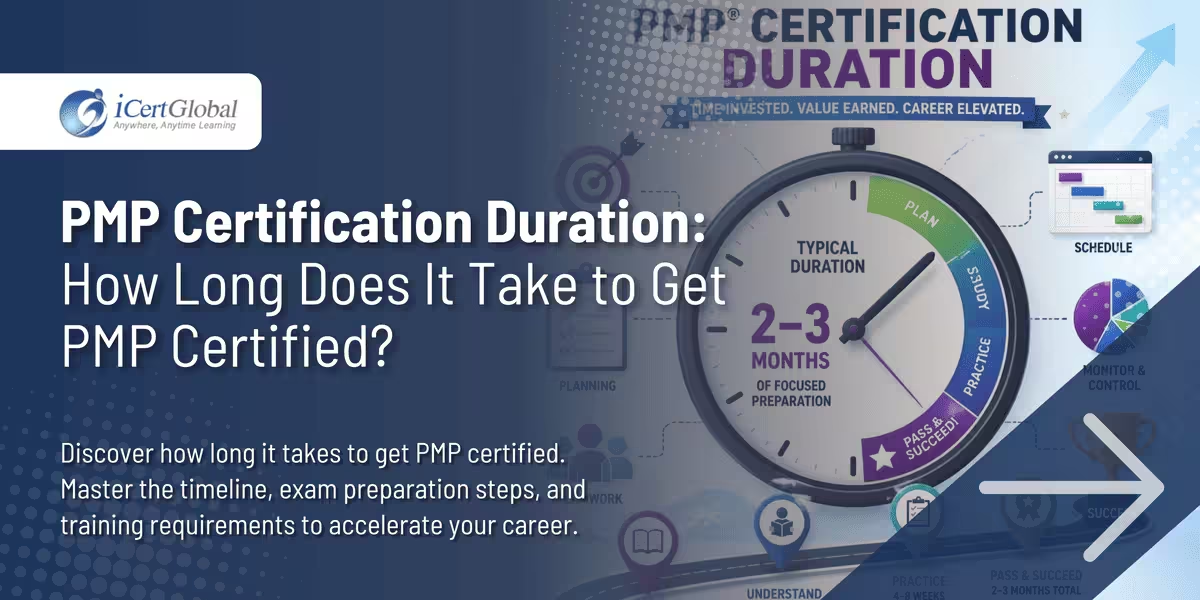
Discover how long it takes to get PMP certified. Master the timeline, exam preparation steps, and training requirements
Master product ownership. Find the complete CSPO certification cost in India, training fees, and career ROI to plan
Master the CEH exam on your first attempt. Use this practical 10-step study plan to build your ethical
Our experts are ready to help you with any questions about courses, admissions, or career paths. Get personalized guidance from industry professionals.
Request a Call Back

"PMI®", "PMBOK®", "PMP®", "CAPM®" and "PMI-ACP®" are registered marks of the Project Management Institute, Inc. | "CSM", "CST" are Registered Trade Marks of The Scrum Alliance, USA. | COBIT® is a trademark of ISACA® registered in the United States and other countries.

