
You've spent years in Excel or basic SQL, generating historical reports that tell management what they already knew last quarter. Your job is analysis, but your output is descriptive, not predictive. The industry has moved on: companies in San Marcos, TX are building predictive maintenance models, fraud detection systems, and customer churn scores. They're not looking for report writers; they're paying a 50%+ premium for certified Data Scientists who can code in Python and translate complex statistical outcomes into clear, scalable, and profitable business solutions through Data Science with Python Training. You're currently stuck because your resume lacks the keywords: Pandas, Scikit-learn, Hypothesis Testing, REST APIs, and Deployment Pipelines. HR filters are scanning for certified proof that you can handle the math and the code required to deliver actual business value through a recognized Data Science with Python certification. That stops now. This isn't another generalized Python course. This Data Science with Python course is designed by professional Data Scientists to bridge the massive gap between data analysis and rigorous predictive modeling and productionization. You will learn the why behind the how: understanding the assumptions of a model, dealing with messy real-world data issues (missing values, outliers), and critically, interpreting model coefficients to drive business strategy—not just getting a high R-squared. We built this for ambitious Analysts, BI Developers, and Statisticians in San Marcos, TX who need to rapidly upskill. You get direct, hands-on labs using Jupyter Notebooks, extensive case studies in finance and e-commerce, and personalized feedback on your model code. Beyond the exam, you leave with a portfolio of robust models—from market basket analysis to classification algorithms—ready to impress any senior Data Science Manager. Stop settling for low-impact reporting. Start building the models that dictate high-value business decisions.
Data Science with Python Training Program Overview San Marcos, TX
Data Science with Python Training Course Highlights
More Than a Course—It's Your Career Accelerator
Rigorous Statistical Modeling
Master the three pillars of enterprise analytics—Regression, Classification, and Clustering—through a comprehensive Data Science with Python program using Scikit-learn.
Live Python Coding Labs
Engage in 30+ hours of intensive, hands-on practice in Jupyter and Spyder for data manipulation, visualization, and complex model construction.
Exhaustive Practice Scenarios
Access over 2,000 questions focused on statistical assumptions, model interpretation, and practical Python coding output to cut through generic test banks.
Critical Library Mastery
Gain practical fluency in the packages that matter most in production environments: Pandas, Scikit-learn, NumPy, and Statsmodels.
Portfolio-Ready Final Project
Complete an end-to-end Data Science project, from data cleaning to basic deployment, designed to be showcased to employers in a highly competitive analytics market.
24x7 Expert Guidance
Receive immediate, high-quality support from certified Data Scientists throughout your training, covering Python code errors, statistical confusion, and model validation issues.
Upcoming Schedule
Where your classroom training takes place
Note: The training location may be subject to change depending on the number of participants registered for the session and participant convenience. Confirmed venue details will be shared by email after enrollment.
Why get Data Science certified?
The Credential That Ends the Gatekeeping
Command High-Level Attention
Stop getting filtered out by HR bots. Secure the senior Data Scientist and modeling interviews your statistical and technical experience already deserves.
Access Premium Compensation
Unlock the higher salary bands and specialized roles reserved for professionals who can build and deploy scalable, complex statistical models using Python.
Pivot to Strategic Leadership
Transition from descriptive reporting to strategic, predictive analytics, earning a mandatory seat at the core business decision-making table.
Who This Program Is For
This certification training is ideal for:
Individuals currently working as BI Analysts
Those in roles as Market Researchers
Professionals categorized as Software Engineers
Leaders holding the title of IT Professionals
Managers focused on Data Analysts
Professionals working as Statisticians & Economists
If you have a solid analytical mindset, basic programming exposure, and are tired of being overlooked for high-impact Python-based roles, this intensive training in Python and statistical modeling is your required path to a Data Scientist title.Opening doors to entry level data science jobs as well as advanced roles.
Industry Applicability
The Data Science with Python Certification Training Program is relevant to various industries in San Marcos, TX, including healthcare, finance, and marketing. Participants will learn how to apply machine learning and statistical modeling techniques to real-world problems in these industries.
In this course, participants will learn about the application of machine learning to healthcare data, including disease diagnosis and patient risk stratification. They will also learn about the application of statistical modeling to financial data, including credit risk assessment and portfolio optimization.
This training will enable participants to develop data-driven solutions that meet the needs of various industries. By applying machine learning and statistical modeling techniques to real-world problems, participants will gain a deeper understanding of the business needs and requirements of various industries in San Marcos, TX, where data analysis is critical to driving business outcomes.
Eligibility and prerequisites for Data Science with Python Certification
Objective: To certify your practical expertise in statistical modeling within the Python ecosystem. Candidates must demonstrate proficiency across the following pillars:
Formal Statistical Training: Completion of a comprehensive program covering inferential statistics, regression analysis, and machine learning algorithms.
Python Coding Proficiency: The mandatory, demonstrable ability to write, debug, and optimize Python code for data cleaning, visualization, and model building using Pandas and Scikit-learn.
Domain Knowledge: A strong analytical mindset and foundational understanding of the business problems that predictive modeling is designed to solve.
Work Responsibilities
The Data Science with Python Certification Training Program prepares participants for work responsibilities that involve data analysis, machine learning, and statistical modeling. Participants will learn how to communicate complex data insights to stakeholders and develop data-driven solutions that meet business requirements.
In this course, participants will learn about the technical skills required to work in data science, including programming, data wrangling, and data visualization. They will also learn about the soft skills required to work in data science, including communication, collaboration, and problem-solving.
This training will enable participants to take on work responsibilities that involve data analysis and machine learning. By the end of this program, participants will be prepared to work in various industries in San Marcos, TX, where data analysis and machine learning are critical to driving business outcomes.
Skills You Will Gain In Our Data Science with Python Training Program San Marcos, TX
Statistical Inference & Hypothesis Testing
Move beyond p-values. You will learn to design rigorous A/B tests and draw statistically valid conclusions that confidently inform million-dollar business decisions.
Data Manipulation & Wrangling
Become ruthlessly efficient with a hands-on Data Science with Python course. Master the Pandas/NumPy stack to clean, transform, and reshape messy, real-world data from San Marcos, TX systems (e.g., SQL, JSON, CSV) in seconds.
Predictive Modeling (Regression)
Build robust forecasting systems as part of an advanced Data Science with Python certification. You will master Linear and Generalized Linear Models, understanding assumptions, diagnostics, and interpretation of coefficients for critical business drivers using Scikit-learn.
Advanced Classification Techniques
Solve real-world classification problems (e.g., fraud, churn) within a structured data science with python program. You will implement Logistic Regression, Decision Trees, and Random Forests in Python, and interpret their output.
Unsupervised Learning (Clustering/Association)
Uncover hidden customer segments. You will master K-Means clustering and Association Rules (Market Basket Analysis) to drive personalized marketing and inventory strategy using datascience with python.
Advanced Data Visualization
Stop sending ugly charts. Master Matplotlib and Seaborn to create compelling, publication-quality data visualizations that effectively communicate complex model results to non-technical stakeholders.
Course Modules & Curriculum
Module 1: Foundational Python Programming and Data Structures
Lesson 1: Introduction to Business Analytics and Python
Understand the role of the Data Scientist, the Analytics Life Cycle, and the advantages of Python over traditional tools. Install Jupyter/Spyder and set up the working environment as part of this Data Science with Python course.
Lesson 2: Python Programming and Data Structures
Master core Python data types (lists, tuples, dictionaries) and control structures (loops, conditionals). Learn to import and export data from common formats (CSV, JSON).
Lesson 3: Pandas Mastery and Efficient Data Manipulation
Master the Pandas library and the NumPy array structure. Achieve fluency in data cleaning, transformation, and reshaping messy, real-world data efficiently.
Module 2: Statistical Inference and Hypothesis Testing
Lesson 1: Introduction to Statistics for Data Science
A practical overview of descriptive statistics, probability distributions, and inferential concepts (sampling, Central Limit Theorem). Focus on application, not academic proofs.
Lesson 2: Hypothesis Testing I (T-Tests and ANOVA)
Master the core process of hypothesis formulation, test selection, and p-value interpretation. Hands-on implementation of T-tests and ANOVA in Python for comparing means and making valid conclusions.
Lesson 3: Hypothesis Testing II (Chi-Squared and Non-Parametric)
Apply Chi-Squared tests for categorical data analysis. Understand when to use non-parametric tests and implement them using Python's Statsmodels, ensuring you never draw a statistically invalid conclusion from real-world data.
Module 3: Predictive Modeling (Regression and Classification)
Lesson 1: Regression Analysis
Master the assumptions and interpretation of Simple and Multiple Linear Regression. Learn model diagnostics, variable selection, and how to effectively communicate model coefficients to business leadership using Scikit-learn.
Lesson 2: Classification Models (Logistic Regression)
Dive deep into Logistic Regression for binary classification problems. Understand concepts like log-odds, ROC curves, AUC, and how to set appropriate threshold values for optimal business impact using Scikit-learn.
Lesson 3: Tree-Based Models (Decision Trees & Random Forests)
Implement powerful non-linear classification models. Master Decision Trees and Random Forests in Python, learning hyperparameter tuning and variable importance interpretation for robust, high-accuracy predictions.
Module 4: Unsupervised Learning and Visualization
Lesson 1: Clustering Techniques
Master K-Means and Hierarchical Clustering for identifying hidden customer segments or data anomalies. Learn to interpret cluster validity and size for actionable business strategy using Scikit-learn.
Lesson 2: Association Rule Mining and Model Persistence
Implement the Apriori algorithm for Market Basket Analysis. Learn best practices for model object saving/loading using joblib or pickle for production deployment.
Lesson 3: Advanced Data Visualization
Master Matplotlib and Seaborn to create complex, informative, and visually compelling plots (scatter plots, box plots, heat maps) to clearly communicate model findings and data insights.
Module 5: Model Validation, API Deployment, and Advanced Python
Lesson 1: Model Evaluation and Validation
Master key performance metrics (Accuracy, Precision, Recall, F1-Score) and techniques like cross-validation to ensure your models are robust and perform reliably on unseen data.
Lesson 2: Database Connectivity and Advanced Data Sourcing
A practical overview of connecting Python to relational databases (PostgreSQL/MySQL) using libraries like SQLAlchemy—a mandatory enterprise skill.
Lesson 3: Advanced Reporting and Productionization
Learn to create dynamic, reproducible reports and dashboards using Jupyter Notebooks. Final project consolidation, code optimization, and best practices for creating REST APIs for model serving.
Data Science with Python Certification Training Program Roadmap
Skill Development
The Data Science with Python Certification Training Program focuses on developing skills in machine learning algorithms, particularly regression analysis and clustering techniques. Participants will learn how to use Python libraries such as scikit-learn and pandas to implement various machine learning models.
In this course, participants will learn about cross-validation techniques, including k-fold cross-validation, to evaluate the performance of machine learning models. They will also learn about feature scaling and normalization methods, such as standardization and min-max scaling.
This training will enable participants to develop predictive models that meet the accuracy and reliability requirements of real-world data science applications. By the end of this program, participants will have the skills to apply machine learning to real-world problems in San Marcos, TX, where data-driven decision-making is crucial in various industries.
Practical Application
The Data Science with Python Certification Training Program emphasizes hands-on experience with practical projects that apply machine learning and statistical modeling techniques to real-world data sets. Participants will work on projects that involve data wrangling, feature engineering, and model evaluation.
In this course, participants will learn how to use Python libraries such as NumPy and SciPy to perform statistical computations and data analysis. They will also learn how to use data visualization libraries such as Matplotlib and Seaborn to communicate complex data insights to stakeholders.
This training will enable participants to develop and deploy data science solutions that meet business requirements. By applying machine learning and statistical modeling techniques to real-world data sets, participants will gain practical experience in developing data-driven solutions that can be used to improve business outcomes in San Marcos, TX, where data analysis is critical in various industries.
Customer Testimonials
Hear from our successful graduates
"Exceptional PMP Training Experience with iCertGlobal I recently completed the PMP training by iCertGlobal, and I must say it was an outstanding experience. The instructor demonstrated a deep understanding of project management principles and brought real-world experience to the table. The training material's provided were comprehensive and well-organized, offering valuable insights and practical tips. I would highly recommend iCertGlobal to anyone looking for professional PMP Training.. "

John Anderson
"iCertGlobal provided a great learning experience with clear, well organised courses. The trainers were knowledgeable, and the support team was responsive to all my questions. The study material was comprehensive, which helped me pass my certification exam with ease. Highly recommended for anyone looking to get certified. "
James Walsh
"iCertGlobal is the best Certificate Training Organization. you will get good instructor and they will improve leaning sills and give the real time experience examples due to that you will get pass in first try. "
Andy Moran
"The course content, exam prep questions, interactive Q&A, and real-life examples made attending this PMP Project Management training class worth my time and money. The support from iCertGlobal was exceptional and I would like to thank them for accepting my request of meeting the trainer post the session for clearing my doubts."
Tim Malone
"I had a good learning experience with icertGlobal and it had been an amazing development journey. Actually, I accidentally bumped into iCertGlobal while searching for an online course for preparing my PMP examination. With positive reviews all over the internet and quick responses to my questions, I was flabbergasted enough to sign-up immediately. The instructor-led PMP preparatory course helped me both offline and online preparations. All the high-quality materials written in simple layman language was enough to grasp the gist of various topics. The instructors were very knowledgeable as they imparted not only their wealth of experiences but also real life examples. Thanks a lot iCertGlobal for imbibing this great learning experience. "
Jason Walter
"Thank you for your great course, great support, rapid response and excellent service."
Hoda Alavi
"My trainer made the materials relatable and easy to understand. It was fun being in class everyday. "
Cassandra Corn
"Amazing trainer who was very supportive. "

Shanna Pilgrim
"Trainer was well versed in the subject matter and got the impression the gentleman was professional and educated within standards and procedures for PMI. "
Anthony Zamora
"The Training was good and customer service was perfect. "
Maka Diakhate
"Trainer was knowledgeable and lesson's pace was just right."

Roger Gonzales
"Trainer (Bruce) was very excellent in delivery and presentation. He provided me with all the tools required to be successful in the PMP exams with lots of quiz questions on all topics reviewed. "
Bashiru Ojibara
"The trainer, Emad was top notch and very knowledgeable. He is up to date with all current versions and is great in 1:1 Training. "

Jonathan Obien
"Thank you for your great course, great support, rapid response and excellent service"

Hoda Alavi
"Marc had very good knowledge and he was able to explain the material and provide guidance to get ready for the test. "

Roque Montesino
"Excellent Course. Zahn was a great instructor and the course material definitely will help me pass the PMP Exam "

Jared Nelson
"Great teacher, went out of his way in every possible aspect. "
Radiah Sims
"Customer service provided by Robin was great as he was very responsive and the trainer, John, was very good at relating the content to my industry. "

Jason D Niebauer
Corporate Training
Tailored programs for teams with enterprise support

Ready to transform your team?
Get a custom quote for your organization's training needs.
Course & Support
Everything you need to know about our training options and support
Skill Gap
The Data Science with Python Certification Training Program addresses the skill gap in machine learning and statistical modeling that exists in the industry. Participants will learn about the latest techniques and tools in machine learning and statistical modeling, including deep learning and time-series analysis.
In this course, participants will learn about the theoretical foundations of machine learning and statistical modeling, including probability theory and linear algebra. They will also learn about the practical applications of machine learning and statistical modeling, including data wrangling and data visualization.
This training will enable participants to address the skill gap in machine learning and statistical modeling. By the end of this program, participants will have the skills to bridge the gap between theory and practice in machine learning and statistical modeling, and apply these skills to real-world problems in San Marcos, TX, where data analysis and machine learning are critical to driving business outcomes.
Build In-Demand Skills
Explore our instructor-led Data Science with Python training to learn about the course duration, cost, eligibility, and certification process. You get practical learning, exam-focused preparation, and expert guidance. Ready to get started? Compare Data Science with Python certification training options and choose a classroom or live online format that fits your schedule.
Data Science with Python Training in Other Cities
Our Data Science with Python certification training is available in major cities worldwide
Related Blogs
Stay updated with the latest insights and trends in your field
Core tools: Jupyter, NumPy, pandas, Matplotlib/Seaborn, and scikit-learn
Learn the core Python data science tools: Jupyter, NumPy, pandas, Matplotlib, and scikit-learn. Gain practical skills to advance...
Can a Python developer without a data science
Transition from a Python developer to AI engineer without a data science degree. Learn the exact skills and...
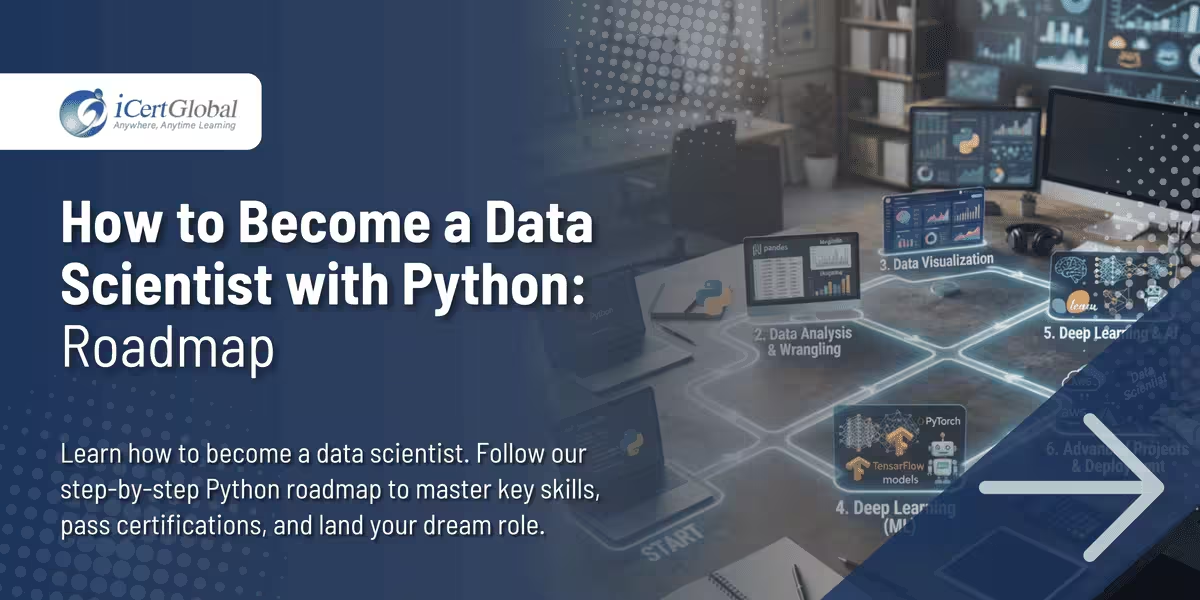
How to Become a Data Scientist with Python:
Learn how to become a data scientist. Follow our step-by-step Python roadmap to master key skills, pass certifications,...
.avif)
10 Data Science Projects Ideas to Build with
Build career-ready skills with 10 Python data science projects. Master data pipelines, machine learning, and visualization to land...
What Industry Experts Include in a Data Science
Build the skills employers want. Explore the standard data science with python syllabus to master pandas, machine learning,...

Data Scientist vs. Machine Learning Engineer:Key Differences
Discover the key differences between a Data Scientist and a Machine Learning Engineer, including roles, skills & career...


