You've spent years in Excel or basic SQL, generating historical reports that tell management what they already knew last quarter. Your job is analysis, but your output is descriptive, not predictive. The industry has moved on: companies in York, PA are building predictive maintenance models, fraud detection systems, and customer churn scores. They're not looking for report writers; they're paying a 50%+ premium for certified Data Scientists who can code in Python and translate complex statistical outcomes into clear, scalable, and profitable business solutions through Data Science with Python Training. You're currently stuck because your resume lacks the keywords: Pandas, Scikit-learn, Hypothesis Testing, REST APIs, and Deployment Pipelines. HR filters are scanning for certified proof that you can handle the math and the code required to deliver actual business value through a recognized Data Science with Python certification. That stops now. This isn't another generalized Python course. This Data Science with Python course is designed by professional Data Scientists to bridge the massive gap between data analysis and rigorous predictive modeling and productionization. You will learn the why behind the how: understanding the assumptions of a model, dealing with messy real-world data issues (missing values, outliers), and critically, interpreting model coefficients to drive business strategy—not just getting a high R-squared. We built this for ambitious Analysts, BI Developers, and Statisticians in York, PA who need to rapidly upskill. You get direct, hands-on labs using Jupyter Notebooks, extensive case studies in finance and e-commerce, and personalized feedback on your model code. Beyond the exam, you leave with a portfolio of robust models—from market basket analysis to classification algorithms—ready to impress any senior Data Science Manager. Stop settling for low-impact reporting. Start building the models that dictate high-value business decisions.
Data Science with Python Training Program Overview York, PA
Data Science with Python Training Course Highlights
More Than a Course—It's Your Career Accelerator
Rigorous Statistical Modeling
Master the three pillars of enterprise analytics—Regression, Classification, and Clustering—through a comprehensive Data Science with Python program using Scikit-learn.
Live Python Coding Labs
Engage in 30+ hours of intensive, hands-on practice in Jupyter and Spyder for data manipulation, visualization, and complex model construction.
Exhaustive Practice Scenarios
Access over 2,000 questions focused on statistical assumptions, model interpretation, and practical Python coding output to cut through generic test banks.
Critical Library Mastery
Gain practical fluency in the packages that matter most in production environments: Pandas, Scikit-learn, NumPy, and Statsmodels.
Portfolio-Ready Final Project
Complete an end-to-end Data Science project, from data cleaning to basic deployment, designed to be showcased to employers in a highly competitive analytics market.
24x7 Expert Guidance
Receive immediate, high-quality support from certified Data Scientists throughout your training, covering Python code errors, statistical confusion, and model validation issues.
Upcoming Schedule
Why get Data Science certified?
The Credential That Ends the Gatekeeping
Command High-Level Attention
Stop getting filtered out by HR bots. Secure the senior Data Scientist and modeling interviews your statistical and technical experience already deserves.
Access Premium Compensation
Unlock the higher salary bands and specialized roles reserved for professionals who can build and deploy scalable, complex statistical models using Python.
Pivot to Strategic Leadership
Transition from descriptive reporting to strategic, predictive analytics, earning a mandatory seat at the core business decision-making table.
Who This Program Is For
This certification training is ideal for:
Individuals currently working as BI Analysts
Those in roles as Market Researchers
Professionals categorized as Software Engineers
Leaders holding the title of IT Professionals
Managers focused on Data Analysts
Professionals working as Statisticians & Economists
If you have a solid analytical mindset, basic programming exposure, and are tired of being overlooked for high-impact Python-based roles, this intensive training in Python and statistical modeling is your required path to a Data Scientist title.Opening doors to entry level data science jobs as well as advanced roles.
Work Responsibilities
Data Science with Python Certification Training Program is designed to prepare participants for a wide range of work responsibilities, including data analysis, machine learning model development, and statistical modeling. Upon completing this program, participants will be equipped to work in various roles, such as data scientist, business analyst, or quantitative analyst, and contribute to data-driven decision-making in their organizations.
In this program, participants will learn to design and implement machine learning models, including supervised and unsupervised learning techniques, and evaluate their performance using metrics such as accuracy, precision, and recall. They will also develop skills in data visualization, using tools such as Matplotlib and Seaborn to communicate findings effectively to stakeholders.
In York, PA, companies often require data science professionals to work closely with cross-functional teams, including business leaders, engineers, and IT professionals. With Data Science with Python Certification Training Program, participants will be equipped to collaborate effectively with these teams, communicate complex technical concepts, and drive data-driven innovation in their organizations.
Eligibility and prerequisites for Data Science with Python Certification
Data Science with Python Certification Requirements
Objective: To certify your practical expertise in statistical modeling within the Python ecosystem. Candidates must demonstrate proficiency across the following pillars:
Growth
Data Science with Python Certification Training Program offers significant opportunities for professional growth and advancement. By mastering the skills and tools covered in this program, participants can take on more senior roles, contribute to high-impact projects, and drive business growth in their organizations.
Upon completing this program, participants will be well-positioned to pursue advanced certifications, such as AWS Certified Data Scientist or Google Cloud Certified - Professional Data Engineer. They will also have a solid foundation to explore specialized areas, such as deep learning, natural language processing, or computer vision.
In York, PA, companies recognize the value of data science professionals and often provide opportunities for professional development, including training, mentorship, and career advancement. With Data Science with Python Certification Training Program, participants can position themselves for success and drive their careers forward in data-driven industries.
Skills You Will Gain In Our Data Science with Python Training Program York, PA
Statistical Inference & Hypothesis Testing
Move beyond p-values. You will learn to design rigorous A/B tests and draw statistically valid conclusions that confidently inform million-dollar business decisions.
Data Manipulation & Wrangling
Become ruthlessly efficient with a hands-on Data Science with Python course. Master the Pandas/NumPy stack to clean, transform, and reshape messy, real-world data from York, PA systems (e.g., SQL, JSON, CSV) in seconds.
Predictive Modeling (Regression)
Build robust forecasting systems as part of an advanced Data Science with Python certification. You will master Linear and Generalized Linear Models, understanding assumptions, diagnostics, and interpretation of coefficients for critical business drivers using Scikit-learn.
Advanced Classification Techniques
Solve real-world classification problems (e.g., fraud, churn) within a structured data science with python program. You will implement Logistic Regression, Decision Trees, and Random Forests in Python, and interpret their output.
Unsupervised Learning (Clustering/Association)
Uncover hidden customer segments. You will master K-Means clustering and Association Rules (Market Basket Analysis) to drive personalized marketing and inventory strategy using datascience with python.
Advanced Data Visualization
Stop sending ugly charts. Master Matplotlib and Seaborn to create compelling, publication-quality data visualizations that effectively communicate complex model results to non-technical stakeholders.
Course Modules & Curriculum
Module 1: Foundational Python Programming and Data Structures
Lesson 1: Introduction to Business Analytics and Python
Understand the role of the Data Scientist, the Analytics Life Cycle, and the advantages of Python over traditional tools. Install Jupyter/Spyder and set up the working environment as part of this Data Science with Python course.
Lesson 2: Python Programming and Data Structures
Master core Python data types (lists, tuples, dictionaries) and control structures (loops, conditionals). Learn to import and export data from common formats (CSV, JSON).
Lesson 3: Pandas Mastery and Efficient Data Manipulation
Master the Pandas library and the NumPy array structure. Achieve fluency in data cleaning, transformation, and reshaping messy, real-world data efficiently.
Module 2: Statistical Inference and Hypothesis Testing
Lesson 1: Introduction to Statistics for Data Science
A practical overview of descriptive statistics, probability distributions, and inferential concepts (sampling, Central Limit Theorem). Focus on application, not academic proofs.
Lesson 2: Hypothesis Testing I (T-Tests and ANOVA)
Master the core process of hypothesis formulation, test selection, and p-value interpretation. Hands-on implementation of T-tests and ANOVA in Python for comparing means and making valid conclusions.
Lesson 3: Hypothesis Testing II (Chi-Squared and Non-Parametric)
Apply Chi-Squared tests for categorical data analysis. Understand when to use non-parametric tests and implement them using Python's Statsmodels, ensuring you never draw a statistically invalid conclusion from real-world data.
Module 3: Predictive Modeling (Regression and Classification)
Lesson 1: Regression Analysis
Master the assumptions and interpretation of Simple and Multiple Linear Regression. Learn model diagnostics, variable selection, and how to effectively communicate model coefficients to business leadership using Scikit-learn.
Lesson 2: Classification Models (Logistic Regression)
Dive deep into Logistic Regression for binary classification problems. Understand concepts like log-odds, ROC curves, AUC, and how to set appropriate threshold values for optimal business impact using Scikit-learn.
Lesson 3: Tree-Based Models (Decision Trees & Random Forests)
Implement powerful non-linear classification models. Master Decision Trees and Random Forests in Python, learning hyperparameter tuning and variable importance interpretation for robust, high-accuracy predictions.
Module 4: Unsupervised Learning and Visualization
Lesson 1: Clustering Techniques
Master K-Means and Hierarchical Clustering for identifying hidden customer segments or data anomalies. Learn to interpret cluster validity and size for actionable business strategy using Scikit-learn.
Lesson 2: Association Rule Mining and Model Persistence
Implement the Apriori algorithm for Market Basket Analysis. Learn best practices for model object saving/loading using joblib or pickle for production deployment.
Lesson 3: Advanced Data Visualization
Master Matplotlib and Seaborn to create complex, informative, and visually compelling plots (scatter plots, box plots, heat maps) to clearly communicate model findings and data insights.
Module 5: Model Validation, API Deployment, and Advanced Python
Lesson 1: Model Evaluation and Validation
Master key performance metrics (Accuracy, Precision, Recall, F1-Score) and techniques like cross-validation to ensure your models are robust and perform reliably on unseen data.
Lesson 2: Database Connectivity and Advanced Data Sourcing
A practical overview of connecting Python to relational databases (PostgreSQL/MySQL) using libraries like SQLAlchemy—a mandatory enterprise skill.
Lesson 3: Advanced Reporting and Productionization
Learn to create dynamic, reproducible reports and dashboards using Jupyter Notebooks. Final project consolidation, code optimization, and best practices for creating REST APIs for model serving.
Data Science with Python Certification Training Program Roadmap
Skill Development
Data Science with Python Certification Training Program is designed to foster the development of essential skills in machine learning, Python programming, and statistical modeling. By enrolling in this program, participants will gain hands-on experience with Python libraries, such as Scikit-learn and TensorFlow, and learn to apply statistical techniques, including hypothesis testing and confidence intervals. As a result, they will be able to analyze and interpret complex data, optimize machine learning models, and visualize results effectively.
In this program, participants will delve into the fundamentals of Python programming, including object-oriented design and data structures. They will also explore various machine learning algorithms, including supervised learning techniques, such as decision trees and random forests, and unsupervised learning methods, such as clustering and dimensionality reduction. By mastering these concepts, participants will be equipped to tackle real-world data analysis problems and contribute to data-driven decision-making processes in their organizations.
In York, PA, companies across various industries rely on effective data analysis to drive business growth and competitiveness. Data Science with Python Certification Training Program provides professionals in these organizations with the skills and knowledge necessary to extract insights from vast datasets, communicate findings to stakeholders, and inform data-driven strategies. By leveraging Python and machine learning tools, they can identify trends, optimize processes, and drive innovation, ultimately contributing to the success of their businesses.
Industry Applicability
Data Science with Python Certification Training Program is highly relevant to the needs of various industries, including healthcare, finance, marketing, and more. In these sectors, professionals with expertise in data science and machine learning can develop predictive models to forecast patient outcomes, detect anomalies in financial transactions, or identify patterns in consumer behavior. By applying statistical techniques and machine learning algorithms, they can extract actionable insights from complex data, drive business growth, and inform strategic decision-making.
In the healthcare industry, for instance, data science professionals can leverage machine learning algorithms to identify high-risk patients, detect early warning signs of disease, and develop personalized treatment plans. Similarly, in finance, they can use statistical modeling to analyze market trends, detect potential fraud, and optimize investment strategies. By mastering the skills and tools covered in this program, participants can contribute to data-driven innovation and drive business success in various industries.
In York, PA, companies in the manufacturing and logistics sectors often rely on data science professionals to optimize supply chain operations, predict demand, and minimize costs. With Data Science with Python Certification Training Program, professionals in these sectors can develop the skills needed to extract insights from large datasets, identify trends, and inform strategic decisions that drive business growth and competitiveness.
Customer Testimonials
Hear from our successful graduates
"Enrolling in the course was seamless, and the learning portal was easy to navigate. The live sessions were interactive, and the trainers were highly skilled. I appreciated the flexible schedule and the follow-up sessions offered. I would definitely return to iCert Global for more certifications."

Catherine
"I recently completed my CSM course in Houston from icertglobal and it was one of the best experience. icertglobal management was so humble and understanding and went extra mile to adjust my last minute classroom request.The classroom course was held in Houston, USA and the trainer was by far one of the best i have came across till date.He provided us with workshops that really helped in understanding Scrum to the core.Thank you icertglobal of such a wonderful experience and keep the good work up."
Sandy Tholuchuri
"The PMP practice test and PMP exam prep questions were of great help in preparing for the project management exam. Thanks to the Trainer for all the hard work."
Kevin Chris
"I had an awesome experience with icert global, before signing up for training had a doubt on quality of training..but the trainer was so good in communicating things to each individual providing live examples.. the course content is well customized and easy to understand..Training quality and the course content is too goood..loved it.. have to thank the sales team who suggested me in choosing the course which would help me in my career growth and trust me it worked out well... Thank you guys for all your support.."
Ptek Multiples
"Fantastic training on Lean Management. It was a good learning experience that will definitely help me in my career. I would recommend iCert Global to my friends and colleagues."
Tim Malone
"Icert global really goes out of the way in assisting the applicants. The mentorship is amazing throughout the certification process. I am sure all the people associated with icert global have the same motive to help the applicants, but I would like give a special thanks to Ankita who helped me to be flawless with the procedure....."
kalp vyas
"I would like to recommend iCertGlobal to anyone who wants to enroll for ITIL certification programs. Explanations are clear, easy to understand and the course preparation is good enough to create interest in learning and prepare for the actual certification exam. I came out successful. Good work icertglobal."
Jason Walter
"The training was good, the instructor was knowledgeable, easy to understand the content, the doubts were clarified. It was on point. I was able to clear the certification exam in the first attempt. Thank you icert global team!"
Sophiya P
"Successfully completed Training and certification from iCertGlobal for PRINCE2 Foundation and Practitioner certification. Trainer was very knowledgeable and explained concepts very clearly and I am moving to USA and , hopefully, this certification helps me to secure good job in silicon valley."
Robert Williams
"Excellent to work with! Working with ICert Global on planning PMP preparation has been wonderful! I especially like the flexibility to attend online preparation. Leena and Sam have been a pleasure to work with! Thank you!"
Annette Callan
"Great! Leena and Sameer were great and helped with the registration process. Looking forward to the classes."
Annie
"The Six Sigma Lean Green Belt Class was excellent. I enjoyed learning in this online course. And I feel like I was fully prepared to take the exam"
Helen Selika Underwood
"Sam Feedback Online PMP Session This was a great experience to learn and grow with peers in project management. The diverse set of experiences and backgrounds help understand various scenarios well. The virtual aspect of the class took the learning experience to a new level and simulated a geographically diverse team in the corporate world. Sam did a great job and was very knowledgeable on PMP. Sam started each day with a review from the previous day as well as an agenda/plan and concluded each day with a recap of what had been covered and plan for the next day - very helpful."
Peter Schramm
"The trainer was very knowledgeable and very well organized. There are many real life example use cases. Great training pace and opportunities for clarification and questions. The total training time was 10am-1pm and 2-6pm (EST). Only one hour lunch break and 10 minutes break in the morning and afternoon session. We really had long days for the 35 PDU and completely justified the training."
Yanxin Gao
"Others course content is ? Others course content is remarkable. I certglobal can work on growing global partnerships."
Rufus Alexander
"LSS Green Belt Certification The training course was great and well run. I took alot from it that I will now use in my work environment. I would highly recommend this for anyone who is interested."
Drew
"Project Manager Boing It was a great class Lots of energy And I enjoyed"
Kevin Hambrice
"Sr. Project Manager, Montco Oilfield Contractors, LLC As a participant it was smooth sailing for me."
Eric Tumlinson
Corporate Training
Tailored programs for teams with enterprise support

Ready to transform your team?
Get a custom quote for your organization's training needs.
Course & Support
Everything you need to know about our training options and support
Practical Application
Data Science with Python Certification Training Program provides hands-on experience with real-world applications, enabling participants to apply theoretical concepts to practical problems. Through a combination of assignments, projects, and case studies, participants will learn to tackle complex data analysis tasks, develop machine learning models, and communicate findings effectively to stakeholders. In this program, participants will work with real-world datasets, including census data, financial transactions, and customer behavior.
They will apply statistical techniques, such as regression analysis and hypothesis testing, and machine learning algorithms, including decision trees and clustering. By mastering these concepts, participants will be equipped to tackle real-world problems and contribute to data-driven decision-making in their organizations. In York, PA, companies across various industries rely on data science professionals to drive business growth and competitiveness.
By completing Data Science with Python Certification Training Program, participants can apply their skills and knowledge to drive innovation, identify trends, and inform strategic decision-making in their organizations.
Build In-Demand Skills
Explore our instructor-led Data Science with Python training to learn about the course duration, cost, eligibility, and certification process. You get practical learning, exam-focused preparation, and expert guidance. Ready to get started? Compare Data Science with Python certification training options and choose a classroom or live online format that fits your schedule.
Data Science with Python Training in Other Cities
Our Data Science with Python certification training is available in major cities worldwide
Related Blogs
Stay updated with the latest insights and trends in your field
Core tools: Jupyter, NumPy, pandas, Matplotlib/Seaborn, and scikit-learn
Learn the core Python data science tools: Jupyter, NumPy, pandas, Matplotlib, and scikit-learn. Gain practical skills to advance your career.
Can a Python developer without a data science
Transition from a Python developer to AI engineer without a data science degree. Learn the exact skills and roadmap you need to launch your AI career.
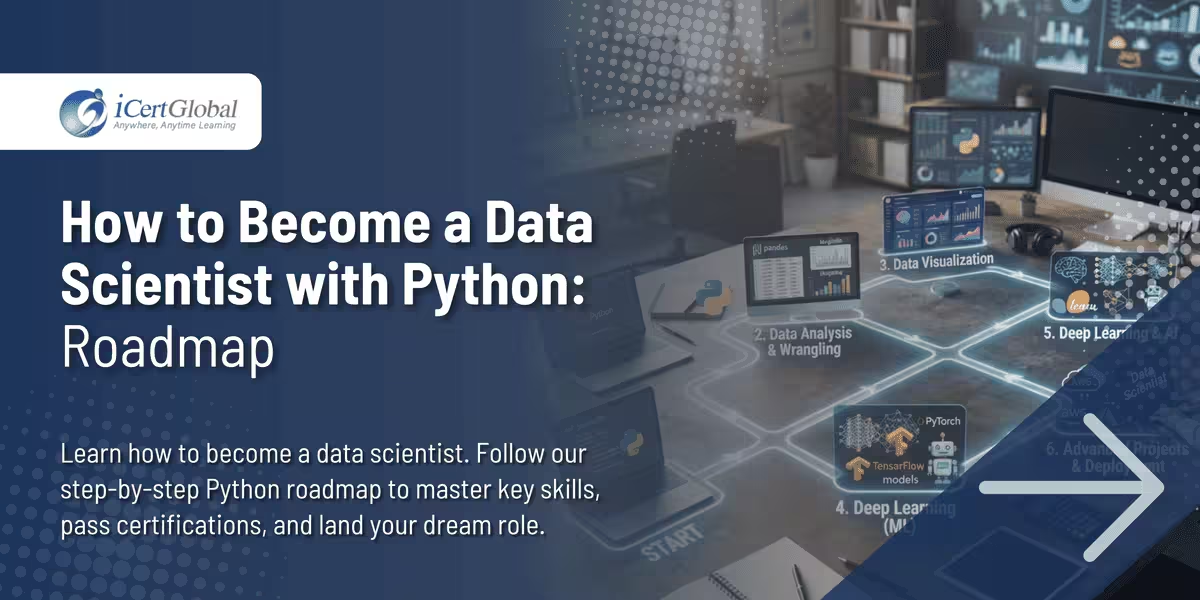
How to Become a Data Scientist with Python:
Learn how to become a data scientist. Follow our step-by-step Python roadmap to master key skills, pass certifications, and land your dream role.
.avif)
10 Data Science Projects Ideas to Build with
Build career-ready skills with 10 Python data science projects. Master data pipelines, machine learning, and visualization to land your next role.
What Industry Experts Include in a Data Science
Build the skills employers want. Explore the standard data science with python syllabus to master pandas, machine learning, and advance your career.

Data Scientist vs. Machine Learning Engineer:Key Differences
Discover the key differences between a Data Scientist and a Machine Learning Engineer, including roles, skills & career paths, to choose the right fit for you.