



ITIL 4 Foundation vs Practitioner: Certification Path Explained
Compare ITIL 4 Foundation vs Practitioner. Discover which certification aligns with your career goals, boosts your salary, and
Stop treating new services like risky experiments. Start guaranteeing controlled, auditable, and repeatable deployment into the live environment. This is the mandatory ITIL Service Transition Certification module.
Your services are beautifully designed, but they die when deployed. The business judges IT on delivery, and if every release is a high-stakes fire drill, your entire ITIL investment is worthless. The ITIL Service Transition Certification proves you are the professional who can enforce control, reduce risk, and guarantee that what was designed is exactly what gets delivered and supported. This course is designed to eliminate the fatal flaw of IT organizations in high-volume environments like Berkeley, CA: poor handoffs. It teaches you the precise principles and processes required to manage complex changes, releases, and deployments without disrupting the live service. You'll learn how Change Management is linked to Knowledge Management ITIL, ensuring every transition builds the organizational experience base. The market demands that senior IT roles - Release Managers, Change Managers, Transition Managers - possess the ITIL ST credential. Without it, you lack the accredited, standardized knowledge to run effective, low-risk deployments. Stop letting poor service transitions sabotage your Service Operation; start using the framework to enforce predictability. We built this for professionals who understand that risk mitigation is paramount. The training provides scenario-based application of the seven core processes, ensuring your knowledge translates directly into optimized, low-risk deployment packages.
Earns 3 credits toward your ITIL Expert status, completing a mandatory component of the ITIL Lifecycle ST path.
Deep dive into Change Management, Release and Deployment Management, Service Asset and Configuration Management (SACM), and Knowledge Management ITIL.
Rigorous training on how the ITIL V model is used to plan, build, test, and verify releases before production deployment.
Master the techniques for minimizing risk, maintaining the integrity of the CMS/CMDB, and ensuring successful handover to Operation.
Practice with graded mock exams that target the scenario-based, multi-choice format required to pass the Intermediate exam.
Understand the critical dependencies between Design (SD) and Transition (ST), specifically through the ITIL Service Transition plan.
Earning the ITIL Service Transition Certification demonstrates an individual's ability to successfully apply the principles of service transition in a real-world setting. This credential is a key component of the ITIL certification scheme, which is widely recognized as the industry standard for IT service management. Service transition is the process by which new or changed services are placed into live operation in an IT organization.
The service transition process involves planning, building, testing, deploying, and improving IT services. This involves the integration of several key disciplines, including change management, service asset and configuration management, and release and deployment management. By mastering these disciplines, service transition professionals can ensure that new services meet the needs of the business and are delivered in a controlled and efficient manner.
In Berkeley, CA, where technology innovation is a driving force behind the regional economy, the need for skilled service transition professionals has never been greater. As organizations continue to invest in digital transformation initiatives, the demand for ITIL-certified professionals with expertise in service transition continues to grow.

Get a custom quote for your organization's training needs.
By obtaining the ITIL Service Transition Certification, professionals can demonstrate their expertise in planning and implementing successful service transitions. This can be a critical differentiator in the job market, particularly for those working in IT service management roles.
Service transition professionals are in high demand, and having the ITIL certification can open up a wide range of career opportunities. Additionally, the certification can also serve as a foundation for more advanced certifications, such as the ITIL Expert level.
Learn the goals and principles of Change Management, including categorization, prioritization, risk assessment, and the use of the Change Advisory Board (CAB).
Master the four stages of release and deployment and the various deployment approaches (Big Bang, Phased, Push/Pull).
Understand the goals of Service Asset and Configuration Management, ensuring the CMDB accurately reflects the configuration of the live environment.
Master the importance of the Service Knowledge Management System (SKMS) and how to manage the transition of knowledge from design to operation.
Learn how to create a complete ITIL Service Transition plan and manage the resources and risks associated with major service introductions.
Master the processes of testing, validation, and evaluation to ensure the new service meets the business requirements defined in the design stage.
If your role requires you to guarantee a smooth, low-risk service handover, this ITIL Service Transition Certification is essential.
The ITIL Service Transition Certification is aligned with industry best practices and provides a comprehensive understanding of the service transition process.
This includes the planning, building, testing, and deployment of new or changed services.
By mastering the service transition process, professionals can ensure that IT services are delivered in a controlled and efficient manner, while minimizing the impact on the business.
The ITIL Service Transition Certification proves you possess the accredited knowledge to manage and control service change.
This credential is a mandatory filter for Release, Change, and Configuration Manager roles in structured IT organizations.
Earn 3 credits toward your ITIL Expert status, validating your competence in the crucial ITIL Lifecycle ST stage.
This is an Intermediate Lifecycle module. The requirements are strict:
ITIL Foundation Certificate: You must hold the ITIL Foundation Certificate in IT Service Management.
Required Training: Completion of a minimum of 21 contact hours (3 days) of formal, accredited ITIL Service Transition Certification training is mandatory.
Recommended Experience: At least 2 years of professional experience working in a Change Management or Release Management environment is highly recommended.
The ITIL Service Transition Certification can fill a critical gap in an organization's IT service management capabilities.
By providing professionals with the knowledge and skills required to plan and implement successful service transitions, organizations can improve their overall service quality and reduce the risk of service disruptions.
In Berkeley, CA, where technology innovation is a driving force behind the regional economy, the need for skilled IT service management professionals has never been greater.
Master the lifecycle of Change Management: categorization, prioritization, risk assessment, and the function of the Change Advisory Board (CAB).
Understand the goals of SACM, how to maintain the Configuration Management System (CMS), and the crucial role of the CMDB.
Learn the four stages of release and deployment and the various deployment options (Big Bang, Phased, Automated) to minimize service risk.
Master the planning and execution of testing activities to ensure the deployed service meets design specifications and operational requirements.
Understand the process for assessing the performance of a service change against the expected business outcomes immediately after transition.
Master the process of ensuring the right information is available at the right time (DIKW structure) and the management of the Service Knowledge Management System (SKMS).
Understand the overall process of planning, coordinating, and controlling the resources and risks during the Service Transition stage.
Examine how technology, tools, and automation support the ITIL Service Transition processes, especially in deployment and configuration.
Analyze the key challenges (e.g., poor SACM integrity, resistance to Change Management) and CSFs unique to the transition stage.
Intensive review of complex transition scenarios, dissecting conflicts between speed of deployment and control/risk mitigation.
Specific, focused training on identifying the 'best' answer (5 points) and eliminating the 'distractor' (0 points) on the closed-book exam, based on common ITIL ST exam tips.
Final mock exam execution, time management drills, and self-assessment against the exam requirements to ensure readiness.
By obtaining the ITIL Service Transition Certification, professionals can take their careers to the next level and enjoy greater job security and career advancement opportunities.
The certification can also serve as a foundation for more advanced certifications, such as the ITIL Expert level.
Additionally, the certification can also provide professionals with a comprehensive understanding of the service transition process, including the planning, building, testing, and deployment of new or changed services.
Great class, very informative.

Great PMP<sup>®</sup> Bootcamp. I had a great time taking this course. I took the course to prepare to sit for the CAPM<sup>®</sup> but may be able to sit for the PMP<sup>®</sup>. I learnt a lot was challenging. Great course. We need one more day. Content was very detailed.

it was a great class. Lots of energy. And I enjoyed.

Fantastic course to prepare for PMP<sup>®</sup> exam.

As a participant it was smooth sailing for me.

Trainer was excellent. Shared good resources and good experiences.

Good content and training.
I wanted to let you know that I took and passed the PMP exam. Thanks to iCertGlobal and especially my Cincinnati course instructor, who was an excellent teacher and helped me immensely.

Trainer was good. Trainer was very engaged and interacting. Very much satisfied with the training.

I was pleasantly surprised at the quality of this training. Yomi was awesome as a trainer and working to make sure that we understood the concepts. Controlling Cost and Controlling Risk are the most complicated, but Yomi spent time after class working through questions to help others understand. This class also helped to change my perception of the PMP being this MONSTER to something that I can I can successfully do.

Great class with a lot of information and tips to prepare for the exam

It was a great course, covered all the things that i ended up hitting road bumps on. I was the only one in the class, but the trainer was just as involved as if it had been a full class.

I was nervous about taking it online versus classroom; but I am actually glad I took it online. Instructor was very great and gave a good learning experience with his relevant project management experience.
The training was very intense but covered with course material. It was more than I expected.

I thought the class was very informative. The instructor did an excellent job breaking down each chapter to where it was easy to understand. I was also very impressed with his commitment to help us pass ever after the class is over.

Excellent training. Instructor was very knowledgeable and explained information in an understandable way
Quality Materials presented, Instructor very knowledgeable. Exceeded my expectations.
The training is a great introduction into the PMI mindset. Very informative and helpful

Explore our instructor-led ITIL Service Transition training to learn about the course duration, cost, eligibility, and certification process. You get practical learning, exam-focused preparation, and expert guidance. Ready to get started? Compare ITIL Service Transition certification training options and choose a classroom or live online format that fits your schedule.
Explore Our ITIL Service Transition certification training is available in a city near you
Stay updated with the latest insights and trends in your field
Compare ITIL 4 Foundation vs Practitioner. Discover which certification aligns with your career goals, boosts your salary, and
Master the top 10 ITSM best practices for modern businesses. Transform your service desk with proven frameworks to
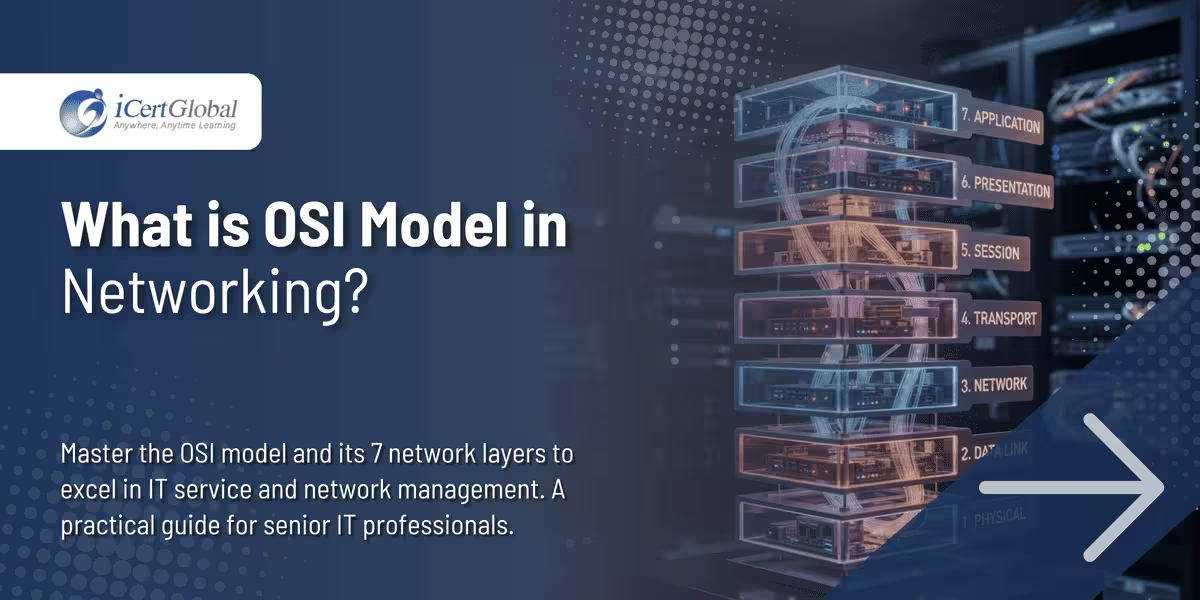
Master the OSI model and its 7 network layers to excel in IT service and network management. A
Learn the top benefits of ITIL certification and how it boosts your IT career and organizational value.
Learn how businesses keep their technology like computers and internet running well with ITSM and ITIL.
Learn what COBIT is and why it matters for managing technology in businesses.
Learn about the key responsibilities, skills, and career path of a Service Desk Manager.

Explore the top high-paying programming languages for 2026 and gain in-demand skills to boost your career, stay competitive,

Master frontend frameworks to accelerate your career. Compare React, Angular, Vue, Svelte, and Next.js to build modern web
Harness the power of Data Science in IT Process Management to streamline operations, improve decision-making, and maximize efficiency
Our experts are ready to help you with any questions about courses, admissions, or career paths. Get personalized guidance from industry professionals.
Request a Call Back

"PMI®", "PMBOK®", "PMP®", "CAPM®" and "PMI-ACP®" are registered marks of the Project Management Institute, Inc. | "CSM", "CST" are Registered Trade Marks of The Scrum Alliance, USA. | COBIT® is a trademark of ISACA® registered in the United States and other countries.

