





Product vs Service: Key Differences With Real-World Examples
Learn the key differences between a product vs service to boost your professional skills, ace your certification exams,
Stop losing contracts due to process chaos. Get the knowledge to become the internal expert who builds the systems that win.
You're already doing process improvement - you just don't have the framework. You're the one documenting procedures, conducting root cause analysis, and trying to standardize how your teams deliver, but you're still called a "Quality Lead" or "Process Coordinator." Meanwhile, CMMI-certified professionals are leading multi-crore organizational transformation initiatives, sitting in C-suite meetings, and commanding salaries 30-50% higher for implementing the structured maturity model you're trying to build from scratch. Your company loses contracts to competitors who put "CMMI Level 3 Appraised" on their proposals, and you're powerless to change it. That stops now. This isn't a theoretical walkthrough of the CMMI model that reads like a compliance manual. Our CMMI Training Program is designed by CMMI Institute-certified Lead Appraisers and Instructors who've conducted actual SCAMPI appraisals across Madurai - they've seen which organizations fake maturity with documentation theaters and which ones actually achieve it. They've built this program to teach you the CMMI framework while showing you how to implement Process Areas that teams will actually follow instead of circumvent. Unlike training providers that dump model definitions on you, we build process improvement professionals who can execute. You'll learn how to conduct gap analysis that identifies real capability gaps versus checklist items, design process improvements that increase efficiency instead of creating bureaucratic overhead, and gather the objective evidence that survives appraiser scrutiny during formal evaluations. The exam is just the validation - the real value is walking into your next leadership meeting and presenting a roadmap to CMMI Level 3 that will unlock the enterprise contracts your sales team can't close. We've built this for working professionals who can't take months off to study process models. Weekday evening and weekend batches, fully interactive with live case studies from Madurai IT services and GCC environments. Every session recorded. Beyond the training, you get gap analysis templates you can deploy immediately, appraisal readiness checklists based on actual SCAMPI experiences, 24/7 expert support, and practical guidance on which Process Areas deliver ROI versus which ones waste effort - the distinction most consultants won't tell you because complexity keeps them billable.
Learn directly from the experts who conduct formal CMMI appraisals, gaining unparalleled insight into what it takes to succeed.
This isn't theory. We focus on how to apply CMMI practices in the messy reality of your organization's projects and politics.
The entire curriculum is structured to prepare you and your organization for the rigors of a Standard CMMI Appraisal Method for Process Improvement (SCAMPI).
Learn from the successes and failures of Madurai IT, ITeS, and engineering companies on their CMMI journey.
Choose from weekend-only batches or weekday evening sessions designed to fit your demanding work schedule without requiring a career break.
Get your CMMI questions answered around the clock by certified experts, ensuring you're never stuck on a concept or implementation challenge.
The growth of an organization depends on its ability to improve processes and reduce defects. The Capability Maturity Model Integration (CMMI) provides a framework for implementing process improvements, ensuring that all stakeholders are aligned towards a common goal.
In this context, the CMMI Certification Training Program helps participants understand the model's application in improving process maturity and reducing process-related risks, ultimately leading to increased efficiency in organizations. Effective implementation of CMMI practices results in improved project outcomes, enhanced customer satisfaction, and increased return on investment.
Organizations like ours in Madurai can benefit from this increased efficiency and improved project outcomes.

Get a custom quote for your organization's training needs.
The CMMI model is composed of several process areas, each focusing on specific aspects of process improvement. The development, process and product quality, and project management process areas are critical in achieving high maturity levels.
By understanding these process areas and their interdependencies, participants can develop a comprehensive understanding of the CMMI model. This is crucial for organizations that aspire to improve their process maturity levels.
The CMMI model also provides a framework for identifying strengths and weaknesses within an organization, enabling informed decision-making and strategic planning.
Learn to systematically evaluate your organization's existing processes against the CMMI model's Process Areas to identify critical gaps and weaknesses.
Stop the confusion. Master the clear distinctions between Maturity Levels 2 through 5 and understand the tangible business value each level represents.
Gain practical, actionable steps for implementing key PAs like Project Planning (PP), Requirements Management (REQM), and Risk Management (RSKM).
Understand the SCAMPI appraisal method from the inside out. Learn how to gather objective evidence, prepare teams for interviews, and avoid common pitfalls that lead to failure.
Learn how to use Generic Goals and Practices to ensure that your process improvements are not just temporary fixes but are deeply embedded into your organization's culture.
Go beyond just "doing" the process. Learn how to define and use meaningful metrics to quantitatively demonstrate process performance and improvement, a key step for high maturity.
If your role involves defining, following, or improving processes, this program is engineered to make you a strategic asset to your organization.
Practical application of CMMI best practices requires careful consideration of organizational context and capabilities. Participants in the CMMI Certification Training Program learn how to identify and prioritize process areas for improvement, develop effective implementation strategies, and measure the return on investment.
By applying CMMI best practices, organizations can reduce process-related risks, improve project outcomes, and enhance customer satisfaction. Effective CMMI implementation also enables organizations to respond more quickly to changing market conditions and customer needs, giving them a competitive edge in the market.
This is particularly relevant for organizations in Madurai that operate in highly competitive environments.


Stop losing bids and contracts to competitors who can prove their process maturity with a CMMI rating.
Transform from a tactical firefighter into a strategic leader who builds robust systems that prevent problems from occurring.
End the internal chaos of unpredictable project delivery and build a reputation for consistent, high-quality results.
The Certified CMMI Associate is the foundational certification that proves your understanding of the CMMI model. It is designed to be accessible, serving as the starting point for a career in process improvement. There are no complex prerequisites.
No Prior Experience Required: You do not need years of project management or quality assurance experience to be eligible for this certification.
Completion of Official Training: You must complete an official "Foundations of Capability" or "Building Development Excellence" course from a CMMI Institute Partner, like iCertGlobal. This program fully satisfies that requirement.
Pass the Official Exam: You must pass the Certified CMMI Associate Exam administered online by the CMMI Institute.
Work responsibilities for CMMI practitioners include process improvement, project management, and quality management. To fulfill these responsibilities, CMMI practitioners must have a deep understanding of the CMMI model and its application in various process areas.
They must also be able to analyze organizational context and capabilities, identify areas for improvement, and develop effective implementation strategies. Additionally, CMMI practitioners must be able to measure the return on investment and continuously evaluate the effectiveness of CMMI practices.
This requires a combination of technical expertise, business acumen, and communication skills. Organizations in Madurai that employ CMMI practitioners can expect improved project outcomes, enhanced customer satisfaction, and increased return on investment.
Learn to implement the foundational PAs that end project chaos: Requirements Management (REQM), Project Planning (PP), Project Monitoring and Control (PMC), and Supplier Agreement Management (SAM).
Build the support structures for success. Master the implementation of Measurement and Analysis (MA), Process and Product Quality Assurance (PPQA), and Configuration Management (CM).
Understand what it truly means to have a "managed" process. Deep dive into the Generic Practices for GG2: Establish an Organizational Policy, Plan the Process, Provide Resources, Assign Responsibility, and Train People.
Learn to create organizational standards. Master Organizational Process Focus (OPF), Organizational Process Definition (OPD), and Organizational Training (OT) to build a consistent, organization-wide process library.
Move from project-level to engineering discipline. Implement Technical Solution (TS), Product Integration (PI), Verification (VER), Validation (VAL), and Risk Management (RSKM) for robust product development.
Understand what it means to have a "defined" process. Master the Generic Practices for GG3: Establish a Defined Process, and Collect Improvement Information.
Get a clear overview of the concepts that separate good organizations from great ones. Understand the shift to statistical management with Quantitative Project Management (QPM) and Organizational Performance Management (OPM).
Learn the cornerstone of a learning organization. Master the CAR process area to identify the root causes of defects and problems and implement actions to prevent them from recurring.
Understand the key changes and structural differences in the latest version of the CMMI model, ensuring your knowledge is current and relevant for future appraisals.
Learn the different types of appraisals (Class A, B, C) and their specific purposes. Understand the Standard CMMI Appraisal Method for Process Improvement (SCAMPI) and what a Class A appraisal entails.
This is where most appraisals fail. Learn what constitutes "objective evidence," the difference between direct and indirect artifacts, and how to create an evidence trail that will satisfy a Lead Appraiser. I think a visual representation of the evidence lifecycle would be very helpful here.
Master the art of preparing your teams for the intense interview sessions of a SCAMPI appraisal. Learn what questions to expect, how to answer them effectively, and how to demonstrate process institutionalization through affirmations.
The CMMI Certification Training Program is applicable to various industries, including software development, aerospace, and defense. In these industries, CMMI best practices have been shown to improve process maturity levels, reduce process-related risks, and enhance quality.
The CMMI model also provides a framework for identifying and mitigating risks, which is critical in high-risk industries like aerospace and defense. By applying CMMI best practices, organizations in Madurai can improve their competitiveness, reduce costs, and enhance customer satisfaction.
This is particularly relevant for industries that operate in highly regulated environments.
I have had the opportunity to connect with the sales team from iCertGlobal regarding ITIL certification course. Must say, I was extremely impressed on the entire journey and experience. I dealt with some of the best professionals.

A professional approach towards career development. Friendly and accommodative co-ordinators that understand and then help you with the requirements. Overall, I had a very pleasant training experience. Thank you, iCertGlobal.

My experience with iCertGlobal for ITIL Expert and PRINCE2® program was wonderful! I had direct contact with my trainer. Good environment and very helpful co-ordinators. I am looking forward for more training courses. Thank you!

iCertGlobal had been truly professional in their dealings and the training instilled a lot of confidence in me to take PMP<sup>®</sup> exam. The content of the course was detailed and the trainer related concepts with real-life examples.

At a high Level, it was a good learning experience. Looking forward to the next level of Implementation course.

The training has been very helpful in clearing my queries on cloud and giving me a detailed information on the upcoming technology

Excellent course and excellent faculty. The course is done and executed very clearly<br/><br/>

This training is worth & helped me to understand more on ITIL best practice. Hope this will help me to improve my career. Thanks
Training was really useful to understand the foundation of ITIL concepts and was able to relate the concepts to the real life.
Excellent course material and faculty skill level helped me to write ITIL 2011 foundation exam with full confidence.
Training was good, elaborations are very good and the case study shared was also very good.<br/><br/>
The course content & coverage is good. The explanation by faculty is very good.<br/><br/>
Training was well organized and helped in understanding the contents very well. The trainer was very knowledgeable and shared real life scenarios.
It was very good and the trainer was providing real world examples to explain the concepts so where we able to understand the concepts very easily. Thanks iCertGlobal.
Real-time scenarios and integrating with course content helped a lot in understanding the concept. Topics were discussed in Depth, Coverage and Attention to detail.
It was a very nice experience with iCertGlobal. The faculty was very much experienced and well aware of the upcoming changes to PMP<sup>®</sup>. The class was not only about knowing the stuff but also was very much exam oriented.

Thanks to iCertGlobal people who have supported in providing good material and also like to thanks to our Mentor for his excellent guidance in completing the PMP<sup>®</sup> Certification. <br/><br/>

iCertGlobal has the best team, very professional and knowledgeable. Trainer has focused on core concepts and guided in all aspects that include, understanding my current role, filling the application and best way for preparation.

Explore CMMI Our PMP certification training is available in a city near you
Stay updated with the latest insights and trends in your field
Learn the key differences between a product vs service to boost your professional skills, ace your certification exams,
Build high-demand skills in computer security. Learn key threats, protection methods, and practical strategies to advance your cybersecurity
Master multimodal AI to elevate your tech career. Learn how combining text, audio, and images transforms systems and
Learn how to configure xmx java parameters to optimize JVM heap memory, prevent OutOfMemoryError, and pass your Java
Master JVM memory tuning. Learn the difference between XMX vs XMS, configure heap sizes, and optimize Java performance

Learn how to use the growth formula in Excel to calculate percentage and annual rates. Boost your data
Learn how corporate certification training builds your skills, validates your expertise, and drives measurable team performance.
Deciding between self paced vs live online training? Discover which learning format accelerates your career growth and fits
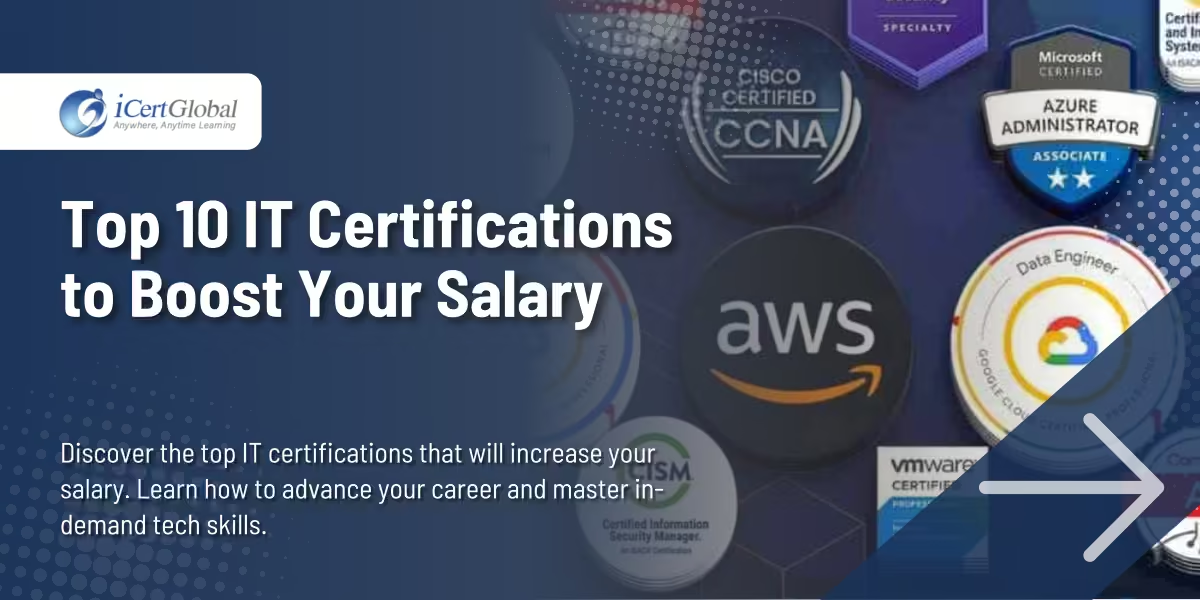
Discover the top IT certifications that will increase your salary in 2026. Learn how to advance your career
Advance your career by mastering Six Sigma belt levels. Learn the differences between Yellow, Green, and Black Belts
Our experts are ready to help you with any questions about courses, admissions, or career paths. Get personalized guidance from industry professionals.
Request a Call Back

"PMI®", "PMBOK®", "PMP®", "CAPM®" and "PMI-ACP®" are registered marks of the Project Management Institute, Inc. | "CSM", "CST" are Registered Trade Marks of The Scrum Alliance, USA. | COBIT® is a trademark of ISACA® registered in the United States and other countries.

