





DMAIC Explained Through a Realistic Process Improvement Example
Master the DMAIC process with a practical, step-by-step example. Learn how to solve process issues, pass your exam,
Stop losing contracts due to process chaos. Get the knowledge to become the internal expert who builds the systems that win.
You're already doing process improvement - you just don't have the framework. You're the one documenting procedures, conducting root cause analysis, and trying to standardize how your teams deliver, but you're still called a "Quality Lead" or "Process Coordinator." Meanwhile, CMMI-certified professionals are leading multi-crore organizational transformation initiatives, sitting in C-suite meetings, and commanding salaries 30-50% higher for implementing the structured maturity model you're trying to build from scratch. Your company loses contracts to competitors who put "CMMI Level 3 Appraised" on their proposals, and you're powerless to change it. That stops now. This isn't a theoretical walkthrough of the CMMI model that reads like a compliance manual. Our CMMI Training Program is designed by CMMI Institute-certified Lead Appraisers and Instructors who've conducted actual SCAMPI appraisals across Menifee, CA - they've seen which organizations fake maturity with documentation theaters and which ones actually achieve it. They've built this program to teach you the CMMI framework while showing you how to implement Process Areas that teams will actually follow instead of circumvent. Unlike training providers that dump model definitions on you, we build process improvement professionals who can execute. You'll learn how to conduct gap analysis that identifies real capability gaps versus checklist items, design process improvements that increase efficiency instead of creating bureaucratic overhead, and gather the objective evidence that survives appraiser scrutiny during formal evaluations. The exam is just the validation - the real value is walking into your next leadership meeting and presenting a roadmap to CMMI Level 3 that will unlock the enterprise contracts your sales team can't close. We've built this for working professionals who can't take months off to study process models. Weekday evening and weekend batches, fully interactive with live case studies from Menifee, CA IT services and GCC environments. Every session recorded. Beyond the training, you get gap analysis templates you can deploy immediately, appraisal readiness checklists based on actual SCAMPI experiences, 24/7 expert support, and practical guidance on which Process Areas deliver ROI versus which ones waste effort - the distinction most consultants won't tell you because complexity keeps them billable.
Learn directly from the experts who conduct formal CMMI appraisals, gaining unparalleled insight into what it takes to succeed.
This isn't theory. We focus on how to apply CMMI practices in the messy reality of your organization's projects and politics.
The entire curriculum is structured to prepare you and your organization for the rigors of a Standard CMMI Appraisal Method for Process Improvement (SCAMPI).
Learn from the successes and failures of Menifee, CA IT, ITeS, and engineering companies on their CMMI journey.
Choose from weekend-only batches or weekday evening sessions designed to fit your demanding work schedule without requiring a career break.
Get your CMMI questions answered around the clock by certified experts, ensuring you're never stuck on a concept or implementation challenge.
To implement process improvement and achieve high maturity levels, the Practical Application of CMMI is crucial. This involves integrating project management, engineering, and quality assurance to deliver quality products and services.
By adopting a CMMI model, organizations can improve their processes and gain a competitive edge. Process areas like project planning, requirements management, and process and product quality assurance are critical components of a CMMI implementation.
These areas help organizations to establish a stable and mature process environment. For instance, in Menifee, CA, companies can benefit from implementing a CMMI model to improve their software development processes.

Get a custom quote for your organization's training needs.
The benefits of CMMI implementation are numerous and vary from organization to organization.
However, studies have shown that high-maturity organizations tend to have fewer defects, reduced costs, and improved productivity.
By adopting a CMMI model, organizations can also improve their risk management and reduce the likelihood of project failure.
Learn to systematically evaluate your organization's existing processes against the CMMI model's Process Areas to identify critical gaps and weaknesses.
Stop the confusion. Master the clear distinctions between Maturity Levels 2 through 5 and understand the tangible business value each level represents.
Gain practical, actionable steps for implementing key PAs like Project Planning (PP), Requirements Management (REQM), and Risk Management (RSKM).
Understand the SCAMPI appraisal method from the inside out. Learn how to gather objective evidence, prepare teams for interviews, and avoid common pitfalls that lead to failure.
Learn how to use Generic Goals and Practices to ensure that your process improvements are not just temporary fixes but are deeply embedded into your organization's culture.
Go beyond just "doing" the process. Learn how to define and use meaningful metrics to quantitatively demonstrate process performance and improvement, a key step for high maturity.
If your role involves defining, following, or improving processes, this program is engineered to make you a strategic asset to your organization.
Work Responsibilities in CMMI Certification involve ensuring that the organization's processes are well-defined, measurable, and controllable. This includes establishing clear roles and responsibilities for personnel involved in process improvement initiatives. A CMMI-compliant organization has clearly defined process components that are measurable and analyzable.
This includes process metrics, which are used to monitor and control processes. For example, in Menifee, CA, organizations can use metrics to measure their process performance and identify areas for improvement. In addition, the CMMI model emphasizes the importance of continuous process improvement.
This involves identifying process flaws and implementing corrective actions to rectify these issues. This can be achieved through regular process reviews and audits, which help to ensure that the organization's processes are stable and mature.


Stop losing bids and contracts to competitors who can prove their process maturity with a CMMI rating.
Transform from a tactical firefighter into a strategic leader who builds robust systems that prevent problems from occurring.
End the internal chaos of unpredictable project delivery and build a reputation for consistent, high-quality results.
The Certified CMMI Associate is the foundational certification that proves your understanding of the CMMI model. It is designed to be accessible, serving as the starting point for a career in process improvement. There are no complex prerequisites.
No Prior Experience Required: You do not need years of project management or quality assurance experience to be eligible for this certification.
Completion of Official Training: You must complete an official "Foundations of Capability" or "Building Development Excellence" course from a CMMI Institute Partner, like iCertGlobal. This program fully satisfies that requirement.
Pass the Official Exam: You must pass the Certified CMMI Associate Exam administered online by the CMMI Institute.
To ensure successful implementation of CMMI, Skill Development is essential. This includes providing training and coaching to personnel involved in process improvement initiatives. Training programs should focus on specific skill areas, such as process management, measurement, and analysis.
CMMI training programs typically cover process areas like project planning, requirements management, and process quality assurance. These process areas are critical to the success of a CMMI implementation and should be thoroughly understood by all personnel involved. For instance, in Menifee, CA, organizations can benefit from training programs that focus on process analysis and measurement.
Effective skill development also involves providing personnel with the necessary tools and resources to perform their jobs. This includes access to process documentation, metrics, and other relevant information. By providing personnel with the necessary skills and resources, organizations can ensure a successful CMMI implementation.
Learn to implement the foundational PAs that end project chaos: Requirements Management (REQM), Project Planning (PP), Project Monitoring and Control (PMC), and Supplier Agreement Management (SAM).
Build the support structures for success. Master the implementation of Measurement and Analysis (MA), Process and Product Quality Assurance (PPQA), and Configuration Management (CM).
Understand what it truly means to have a "managed" process. Deep dive into the Generic Practices for GG2: Establish an Organizational Policy, Plan the Process, Provide Resources, Assign Responsibility, and Train People.
Learn to create organizational standards. Master Organizational Process Focus (OPF), Organizational Process Definition (OPD), and Organizational Training (OT) to build a consistent, organization-wide process library.
Move from project-level to engineering discipline. Implement Technical Solution (TS), Product Integration (PI), Verification (VER), Validation (VAL), and Risk Management (RSKM) for robust product development.
Understand what it means to have a "defined" process. Master the Generic Practices for GG3: Establish a Defined Process, and Collect Improvement Information.
Get a clear overview of the concepts that separate good organizations from great ones. Understand the shift to statistical management with Quantitative Project Management (QPM) and Organizational Performance Management (OPM).
Learn the cornerstone of a learning organization. Master the CAR process area to identify the root causes of defects and problems and implement actions to prevent them from recurring.
Understand the key changes and structural differences in the latest version of the CMMI model, ensuring your knowledge is current and relevant for future appraisals.
Learn the different types of appraisals (Class A, B, C) and their specific purposes. Understand the Standard CMMI Appraisal Method for Process Improvement (SCAMPI) and what a Class A appraisal entails.
This is where most appraisals fail. Learn what constitutes "objective evidence," the difference between direct and indirect artifacts, and how to create an evidence trail that will satisfy a Lead Appraiser. I think a visual representation of the evidence lifecycle would be very helpful here.
Master the art of preparing your teams for the intense interview sessions of a SCAMPI appraisal. Learn what questions to expect, how to answer them effectively, and how to demonstrate process institutionalization through affirmations.
CMMI Certification Training Program focuses on Growth and organizational maturity. This involves continuous process improvement and the adoption of best practices. The CMMI model emphasizes the importance of continuous process improvement.
This can be achieved through regular process reviews and audits, which help to identify areas for improvement. For instance, in Menifee, CA, organizations can use process metrics to measure their process performance and identify areas for improvement. Effective process improvement involves identifying process flaws and implementing corrective actions to rectify these issues.
This can be achieved through the use of process metrics and other analytical tools. By continuously improving their processes, organizations can achieve higher levels of maturity and gain a competitive edge.
Great class, very informative.

Great PMP<sup>®</sup> Bootcamp. I had a great time taking this course. I took the course to prepare to sit for the CAPM<sup>®</sup> but may be able to sit for the PMP<sup>®</sup>. I learnt a lot was challenging. Great course. We need one more day. Content was very detailed.

it was a great class. Lots of energy. And I enjoyed.

Fantastic course to prepare for PMP<sup>®</sup> exam.

As a participant it was smooth sailing for me.

Trainer was excellent. Shared good resources and good experiences.

Good content and training.
I wanted to let you know that I took and passed the PMP exam. Thanks to iCertGlobal and especially my Cincinnati course instructor, who was an excellent teacher and helped me immensely.

Trainer was good. Trainer was very engaged and interacting. Very much satisfied with the training.

I was pleasantly surprised at the quality of this training. Yomi was awesome as a trainer and working to make sure that we understood the concepts. Controlling Cost and Controlling Risk are the most complicated, but Yomi spent time after class working through questions to help others understand. This class also helped to change my perception of the PMP being this MONSTER to something that I can I can successfully do.

Great class with a lot of information and tips to prepare for the exam

It was a great course, covered all the things that i ended up hitting road bumps on. I was the only one in the class, but the trainer was just as involved as if it had been a full class.

I was nervous about taking it online versus classroom; but I am actually glad I took it online. Instructor was very great and gave a good learning experience with his relevant project management experience.
The training was very intense but covered with course material. It was more than I expected.

I thought the class was very informative. The instructor did an excellent job breaking down each chapter to where it was easy to understand. I was also very impressed with his commitment to help us pass ever after the class is over.

Excellent training. Instructor was very knowledgeable and explained information in an understandable way
Quality Materials presented, Instructor very knowledgeable. Exceeded my expectations.
The training is a great introduction into the PMI mindset. Very informative and helpful

Explore our instructor-led CMMI training to learn about the course duration, cost, eligibility, and certification process. You get practical learning, exam-focused preparation, and expert guidance. Ready to get started? Compare CMMI certification training options and choose a classroom or live online format that fits your schedule.
Explore Our CMMI certification training is available in a city near you
Stay updated with the latest insights and trends in your field
Master the DMAIC process with a practical, step-by-step example. Learn how to solve process issues, pass your exam,
Learn how to identify and execute high-impact projects. Master Lean Six Sigma project selection to drive business results
Advance your career by mastering Six Sigma belt levels. Learn the differences between Yellow, Green, and Black Belts
Master the DMAIC methodology and pass your Six Sigma Green Belt Certification Exam. Learn proven study strategies to
Advance your career with Lean Six Sigma Green Belt skills. Explore the top 10 industries actively hiring certified
Master essential lean six sigma principles to pass your certification exam, eliminate process waste, and advance your career.
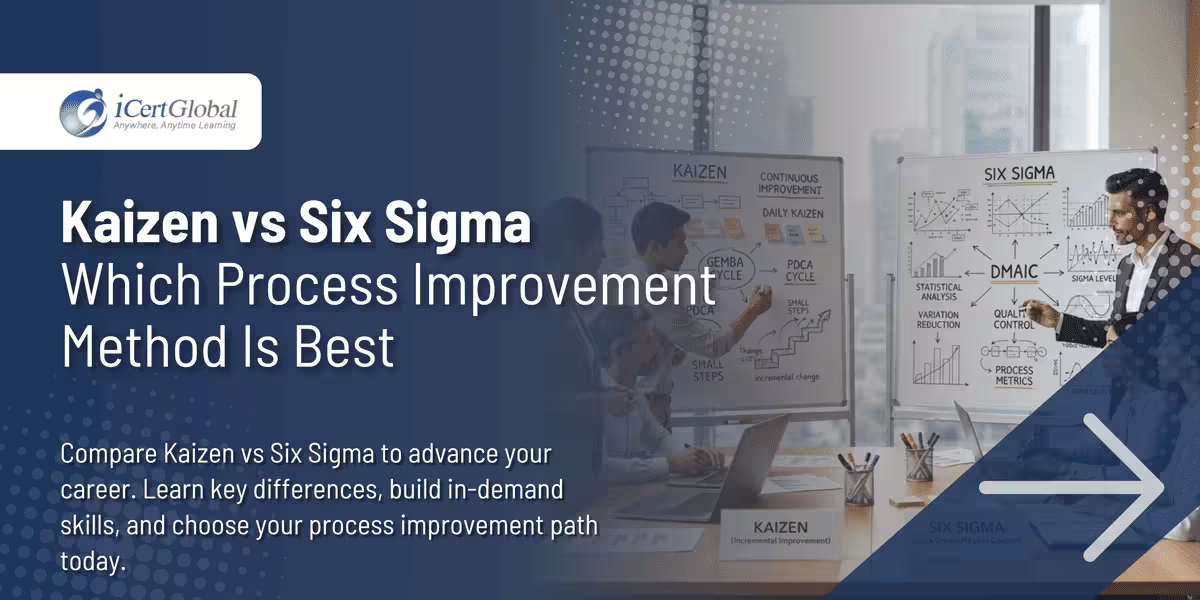
Compare Kaizen vs Six Sigma to advance your career. Learn key differences, build in-demand skills, and choose your
Advance your career by mastering quality management. Discover the key differences between Six Sigma and TQM to choose
.avif)
Master the DMAIC framework and boost your career. Learn how to achieve Six Sigma Green Belt Certification with
Discover the complete breakdown of Six Sigma Yellow Belt Certification costs in 2026. Compare ASQ vs. IASSC fees,
Our experts are ready to help you with any questions about courses, admissions, or career paths. Get personalized guidance from industry professionals.
Request a Call Back

"PMI®", "PMBOK®", "PMP®", "CAPM®" and "PMI-ACP®" are registered marks of the Project Management Institute, Inc. | "CSM", "CST" are Registered Trade Marks of The Scrum Alliance, USA. | COBIT® is a trademark of ISACA® registered in the United States and other countries.

