


Lean Six Sigma Green Belt and Black Belt
Discover the true Lean Six Sigma certification cost for Green and Black Belts. Compare exam fees, career ROI,
Classroom Training and Live Online Courses
Stop just improving processes. Get the strategic framework to lead an entire enterprise-wide business transformation.
If you've successfully led Lean Six Sigma Green Belt projects, reduced waste, and delivered documented savings, you are ready to move beyond project-level improvements. You can see the systemic, cross-functional problems crippling the business - but without a Lean Six Sigma Black Belt certification, you lack the strategic framework and executive mandate to drive enterprise-wide change. While Green Belts lead incremental improvements, certified Black Belts design and deploy corporate operational excellence programs, report directly to the C-suite, and build a culture of continuous improvement. This barrier between project leadership and business transformation ends today. This is not another course that merely adds Lean concepts to a standard Lean Six Sigma Black Belt course. Our program is designed by Master Black Belts who have led transformational projects in complex Albany, NY manufacturing, IT, and services companies. You will learn when to apply Lean for speed and flow, and when Six Sigma rigor is required for variation reduction and quality improvement. Unlike programs that focus purely on technical mastery, we build enterprise transformation capability. You will learn how to design a corporate deployment strategy for Lean Six Sigma, mentor and develop cohorts of Green Belts, manage a portfolio of improvement projects aligned to strategic business goals, and utilize advanced tools like Design for Six Sigma (DFSS). The certification proves your technical expertise - the real value is returning to your organization with a credible plan to build an operational excellence function that delivers millions in documented value, positioning you as a key business leader. We've built this for certified Green Belts, Quality Heads, and senior Operations Managers who are ready to drive enterprise-level change without disrupting their careers. Our formats are designed for demanding schedules, with every session recorded. Beyond the classroom, you get program deployment roadmaps, project portfolio dashboards, executive presentation templates, and 24/7 access to Master Black Belts to mentor you through your high-impact LSSBB projects - where most candidates fail to demonstrate the strategic, financial, and cultural impact required for this elite certification.
More Than a Course- It's Your Career Accelerator
Train through a program aligned with globally accepted Black Belt Bodies of Knowledge, ensuring your credential holds weight across industries and geographies.
Learn from certified MBBs who've led transformations at Fortune 500 companies and understand the political and technical realities of driving change in complex organizations.
Access weekend-only batches, weekday evening sessions, or intensive 2-week bootcamps designed around your professional commitments - no career breaks required.
Get one-on-one coaching for your mandatory Black Belt project from charter approval through final presentation, increasing your certification completion rate significantly.
Gain hands-on proficiency in Minitab, the industry-standard tool for Six Sigma analysis, with lifetime access to practice datasets and templates.
Access our team of certified Black Belts and Master Black Belts around the clock for project guidance, statistical analysis support, and methodology questions.
In many organizations, operational efficiency and customer satisfaction rely heavily on the deployment of Lean Six Sigma methodologies. The need for process improvement and defect reduction demands a professional with expertise in Lean Six Sigma tools and techniques. Lean Six Sigma Black Belt certification training programs provide the necessary foundation for these specialists.
Lean Six Sigma Black Belt certification holders are equipped to lead and support projects that drive business growth and customer satisfaction through data-driven decision making and process optimization. They are skilled in statistical process control, root cause analysis, and design of experiments. These skills enable them to identify and prioritize process improvements, implement effective change management strategies, and measure the impact of their initiatives.
In Albany, NY's industrial sector, a Lean Six Sigma Black Belt is a valuable asset for organizations seeking to improve operational efficiency and customer satisfaction. They bring a systematic approach to problem-solving and are adept at communicating the benefits of process improvements to stakeholders. Their expertise helps organizations adapt to changing market conditions and remain competitive in the industry.
Tailored programs for teams with enterprise support
Get a custom quote for your organization's training needs.
Lean Six Sigma Black Belt certification is highly sought after in various industries, including manufacturing, healthcare, finance, and services. Professionals with this certification have a broad understanding of process improvement methodologies and can apply their skills in diverse settings. From implementing waste reduction initiatives to streamlining business processes, their expertise is transferable across industries.
The Lean Six Sigma Black Belt certification requires a thorough understanding of statistical tools and techniques, such as regression analysis and hypothesis testing. It also involves knowledge of process mapping, measurement systems analysis, and change management strategies. These technical skills enable professionals to analyze complex problems and develop effective solutions that drive business results.
In Albany, NY's diverse industrial landscape, a Lean Six Sigma Black Belt can leverage their expertise to drive process improvements in various industries. Their analytical skills and knowledge of process improvement methodologies make them an asset for organizations seeking to optimize their operations and improve customer satisfaction.
Stop making decisions based on gut feel and incomplete data. You'll master hypothesis testing, regression analysis, ANOVA, and DOE to identify true root causes and validate improvement impact with statistical confidence.
Cut through the noise of multiple variables and interactions that confuse most problem-solvers. Learn to systematically optimize processes using factorial designs, response surface methodology, and mixture experiments that minimize trial-and-error waste. DOE is a critical skill covered in every Lean Six Sigma Black Belt certification online program.
Understand whether your process can actually meet customer requirements before making promises. You'll calculate Cp, Cpk, and Pp indices, design control charts that catch problems early, and establish monitoring systems that sustain gains.
Master the political landscape or watch your technically perfect solution gather dust. You'll develop frameworks for managing resistance, building coalitions, communicating value in financial terms, and securing executive sponsorship for transformation initiatives.
Speak the language of leadership with confidence. Learn to calculate hard savings, soft savings, cost avoidance, and Cost of Poor Quality (COPQ) using methodologies that finance teams and auditors accept. Demonstrating measurable ROI is a key component of any Lean Six Sigma Black Belt certification.
Prevent scope creep, resource conflicts, and timeline disasters that kill improvement projects. You'll master tollgate reviews, RACI matrices, risk mitigation planning, and Gantt chart development specifically for DMAIC and Kaizen projects.
This certification training is ideal for:
If you lead complex improvement initiatives, manage cross-functional teams, and are ready to deliver six-figure cost reductions, this program will equip you with the advanced tools and strategic frameworks to succeed.
A significant skill gap exists among professionals who attempt to implement Lean Six Sigma methodologies without proper training and certification. Without a systematic approach to process improvement, initiative results can be inconsistent and unsustainable. Lean Six Sigma Black Belt certification training programs address this gap by equipping professionals with the necessary knowledge and skills to lead and support process improvement initiatives.
Lean Six Sigma Black Belt certification holders are equipped to analyze complex problems, identify root causes, and develop effective solutions. They have a deep understanding of process mapping, measurement systems analysis, and change management strategies, which enables them to navigate the intricate relationships between business processes and customer satisfaction. In Albany, NY's industrial sector, professionals with a Lean Six Sigma Black Belt certification fill the skill gap by applying their expertise to drive operational efficiency and customer satisfaction.
Their ability to lead process improvement initiatives and communicate their benefits to stakeholders is essential for sustainable business growth and competitive advantage.


The Credential That Ends the Gatekeeping
Because you lack the credential that validates your analytical capability to skeptical executives.
Organizations pay 25-40% more for certified Black Belts who can deliver validated financial impact.
By designing robust processes that eliminate defects at the source rather than inspecting quality later.
The Black Belt credential is the highest level of individual Six Sigma certification for practitioners, and the requirements reflect that standard. This isn't an entry-level certification. Certification bodies expect you to demonstrate both formal training and proven capability to lead complex improvement projects that deliver substantial financial impact. Here's what you need to qualify.
Lean Six Sigma Green Belt Certification: Most certifying organizations require candidates to hold an active Green Belt credential before pursuing a Lean Six Sigma Black Belt course. This ensures you have foundational methodology knowledge and are prepared to tackle enterprise-level projects.
Completion of Black Belt Training: You must complete a minimum of 160 hours of formal Black Belt training from a recognized provider covering the full Body of Knowledge - this program satisfies that requirement completely.
Led & Completed Black Belt Project: Candidates must successfully lead at least one significant improvement project through all five DMAIC phases, demonstrating measurable results and proper application of advanced tools. Successfully completing this step is critical for Lean Six Sigma Black Belt jobs and enhances your professional credibility.
Documented Financial Impact: Your project must deliver quantified, validated financial benefits (typically minimum ₹10-25 lakhs in annual savings, though requirements vary by certification body).
For comprehensive details on project documentation requirements, financial validation methods, and certification body-specific criteria, refer to our detailed FAQ section.
Lean Six Sigma Black Belt certification is considered a benchmark for process improvement professionals. It demonstrates expertise in Lean Six Sigma tools and techniques, as well as a deep understanding of business processes and customer satisfaction. Certified professionals can command higher salaries and enjoy greater career advancement opportunities.
The Lean Six Sigma Black Belt certification process involves a rigorous examination of a professional's knowledge and skills in process improvement methodologies. It requires a thorough understanding of statistical tools and techniques, as well as a demonstrated ability to analyze complex problems and develop effective solutions. This certification process ensures that professionals possess the necessary expertise to drive business results.
In Albany, NY's industry, a Lean Six Sigma Black Belt certification holder is recognized as a subject matter expert in process improvement. Their expertise is highly valued by organizations seeking to improve operational efficiency and customer satisfaction. This certification is a testament to their commitment to excellence and a guarantee of their ability to drive business results.
Learn to identify projects that matter to leadership by connecting process problems to strategic business objectives. Master the project charter structure that secures executive sponsorship, funding, and cross-functional resources. Understand how to quantify opportunity size, define measurable goals, and set realistic timelines that account for organizational constraints.
Transform vague customer complaints into specific, measurable process requirements using Kano analysis and CTQ trees. Gain expertise in advanced Lean Six Sigma Black Belt training methods for collecting VOC data across B2B and B2C contexts, including conjoint analysis and MaxDiff studies. Prioritize conflicting customer needs using weighted criteria aligned with business strategy - skills that increase your value in Lean Six Sigma Black Belt jobs.
Map your stakeholder landscape to identify supporters, resistors, and influencers who can determine your project's success. Master Lean Six Sigma Black Belt certification online strategies for stakeholder engagement, communication planning, and resistance management. Learn to navigate organizational politics, build support, and influence decision-makers - essential for improving your Lean Six Sigma Black Belt salary potential and establishing credibility as a certified professional.
Stop making decisions based on garbage data from unreliable measurement systems. Learn to quantify measurement error using Gage R&R studies for continuous and attribute data. Master the interpretation of %GRR, discrimination ratios, and number of distinct categories to determine whether your data is trustworthy enough for decision-making.
Understand whether your process is capable of meeting specifications before launching improvement efforts that can't possibly succeed. Calculate and interpret Cp, Cpk, Pp, and Ppk indices for both normal and non-normal distributions. Learn when capability studies mislead you and how to account for real-world complications like multiple specifications and small sample sizes.
Design data collection plans that balance statistical rigor with resource constraints in real organizations. Master sampling techniques including stratified, systematic, and cluster sampling. Learn to determine appropriate sample sizes for different statistical tests and avoid the common sampling biases that invalidate your conclusions.
Move beyond anecdotal evidence to statistically validated conclusions about process behavior. Master the full range of hypothesis tests: t-tests, ANOVA, chi-square, proportion tests, and non-parametric alternatives. Learn to interpret p-values correctly, understand Type I and Type II errors, and determine the practical significance versus statistical significance of your findings.
Determine which input variables truly drive your outputs and separate signal from noise. Build and validate linear regression models, interpret R-squared and residual plots, and detect multicollinearity. Advanced techniques such as stepwise regression and polynomial regression help you tackle non-linear relationships. This analytical expertise is a core part of any Lean Six Sigma Black Belt course and vital for Lean Six Sigma Black Belt certification online preparation.
Investigate complex problems using Multi-Vari charts to reveal positional, cyclical, and temporal variation patterns. Facilitate advanced fishbone diagrams, conduct 5-Why analysis, and leverage scatter plots for insight. Communicate findings visually to non-technical stakeholders - an indispensable skill for professionals holding a Lean Six Sigma Black Belt.
Stop wasting time with trial-and-error improvements and leverage Lean Six Sigma Black Belt certification knowledge to systematically optimize processes. Learn to design and execute full factorial and fractional factorial experiments to identify main effects and interactions. Understand confounding patterns, resolution levels, and selecting the right design based on your factors and resources - critical skills for Lean Six Sigma Black Belt jobs and improving your Lean Six Sigma Black Belt salary.
Once you've identified key factors, use RSM to find optimal settings that maximize performance. Master central composite designs, Box-Behnken designs, and contour plot interpretation. Learn to handle multiple responses with conflicting objectives using desirability functions and create robust parameter settings that work across varied conditions.
Design solutions that prevent defects rather than detect them after they occur using Poka-Yoke principles. Learn the hierarchy of error-proofing from elimination and replacement through facilitation and detection. Master Lean concepts including value stream mapping, 5S workplace organization, SMED setup reduction, and pull systems that eliminate waste from your improved process.
Prevent your hard-won improvements from degrading over time through proper process monitoring. Design and implement control charts (X-bar, R, I-MR, P, NP, C, U) appropriate for your data type. Learn to calculate control limits, interpret special cause patterns, and establish effective response plans when processes signal out-of-control conditions.
Create comprehensive control plans that specify what to measure, how frequently, who's responsible, and what actions to take when problems arise. Develop standard work instructions that capture new procedures in a way that operators can actually follow. Learn documentation strategies that survive organizational turnover and maintain process stability.
Quantify and validate your project's financial impact using methods that finance teams and external auditors will accept. Distinguish between hard savings, soft savings, and cost avoidance. Calculate return on investment, payback period, and net present value. Prepare compelling project reports and executive presentations that showcase business results, not just statistical analysis.
Everything you need to know about our training options and support
Lean Six Sigma Black Belt certification training programs equip professionals with the necessary knowledge and skills to lead and support process improvement initiatives. Through experiential learning and case studies, professionals develop a deep understanding of Lean Six Sigma tools and techniques, as well as a systematic approach to problem-solving.
The Lean Six Sigma Black Belt certification process involves the development of a comprehensive project plan, which enables professionals to apply their skills and knowledge in a real-world setting. This approach ensures that professionals are equipped to analyze complex problems, identify root causes, and develop effective solutions that drive business results.
In Albany, NY's industrial sector, professionals who complete a Lean Six Sigma Black Belt certification program develop the skills and knowledge necessary to drive process improvements and improve customer satisfaction. Their expertise enables them to navigate the intricate relationships between business processes and customer satisfaction, ensuring sustainable business growth and competitive advantage.
Great class, very informative.

Great PMP<sup>®</sup> Bootcamp. I had a great time taking this course. I took the course to prepare to sit for the CAPM<sup>®</sup> but may be able to sit for the PMP<sup>®</sup>. I learnt a lot was challenging. Great course. We need one more day. Content was very detailed.

it was a great class. Lots of energy. And I enjoyed.

Fantastic course to prepare for PMP<sup>®</sup> exam.

As a participant it was smooth sailing for me.

Trainer was excellent. Shared good resources and good experiences.

Good content and training.
I wanted to let you know that I took and passed the PMP exam. Thanks to iCertGlobal and especially my Cincinnati course instructor, who was an excellent teacher and helped me immensely.

Trainer was good. Trainer was very engaged and interacting. Very much satisfied with the training.

I was pleasantly surprised at the quality of this training. Yomi was awesome as a trainer and working to make sure that we understood the concepts. Controlling Cost and Controlling Risk are the most complicated, but Yomi spent time after class working through questions to help others understand. This class also helped to change my perception of the PMP being this MONSTER to something that I can I can successfully do.

Great class with a lot of information and tips to prepare for the exam

It was a great course, covered all the things that i ended up hitting road bumps on. I was the only one in the class, but the trainer was just as involved as if it had been a full class.

I was nervous about taking it online versus classroom; but I am actually glad I took it online. Instructor was very great and gave a good learning experience with his relevant project management experience.
The training was very intense but covered with course material. It was more than I expected.

I thought the class was very informative. The instructor did an excellent job breaking down each chapter to where it was easy to understand. I was also very impressed with his commitment to help us pass ever after the class is over.

Excellent training. Instructor was very knowledgeable and explained information in an understandable way
Quality Materials presented, Instructor very knowledgeable. Exceeded my expectations.
The training is a great introduction into the PMI mindset. Very informative and helpful

Explore our instructor-led Lean Six Sigma Black Belt training to learn about the course duration, cost, eligibility, and certification process. You get practical learning, exam-focused preparation, and expert guidance. Ready to get started? Compare Lean Six Sigma Black Belt certification training options and choose a classroom or live online format that fits your schedule.
Explore Our Lean Six Sigma Black Belt certification training is available in a city near you
Stay updated with the latest insights and trends in your field
Discover the true Lean Six Sigma certification cost for Green and Black Belts. Compare exam fees, career ROI,
Master the DMAIC process with a practical, step-by-step example. Learn how to solve process issues, pass your exam,
Learn how to identify and execute high-impact projects. Master Lean Six Sigma project selection to drive business results
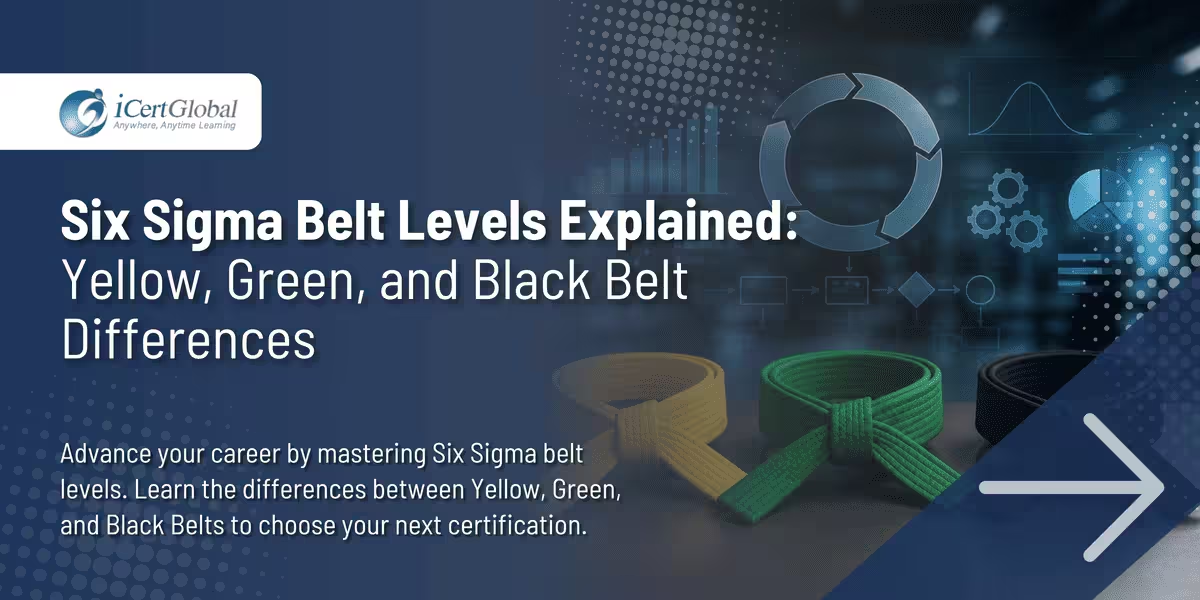
Advance your career by mastering Six Sigma belt levels. Learn the differences between Yellow, Green, and Black Belts
Master the DMAIC methodology and pass your Six Sigma Green Belt Certification Exam. Learn proven study strategies to
Advance your career with Lean Six Sigma Green Belt skills. Explore the top 10 industries actively hiring certified

Master essential lean six sigma principles to pass your certification exam, eliminate process waste, and advance your career.
Compare Kaizen vs Six Sigma to advance your career. Learn key differences, build in-demand skills, and choose your
Advance your career by mastering quality management. Discover the key differences between Six Sigma and TQM to choose
.avif)
Master the DMAIC framework and boost your career. Learn how to achieve Six Sigma Green Belt Certification with
Our experts are ready to help you with any questions about courses, admissions, or career paths. Get personalized guidance from industry professionals.

Live online and classroom training in PMP, ITIL, Agile, Six Sigma and more, with exam support included.
Subscribe to our newsletter for the latest updates on certifications and training opportunities.
Search iCertGlobal for certifications, courses and articles.

"PMI®", "PMBOK®", "PMP®", "CAPM®" and "PMI-ACP®" are registered marks of the Project Management Institute, Inc. | "CSM", "CST" are Registered Trade Marks of The Scrum Alliance, USA. | COBIT® is a trademark of ISACA® registered in the United States and other countries.