





DMAIC Explained Through a Realistic Process Improvement Example
Master the DMAIC process with a practical, step-by-step example. Learn how to solve process issues, pass your exam,
Stop firefighting the same issues. Get the integrated toolkit to lead projects that eliminate waste and deliver measurable results.
You see broken processes every day - waiting, rework, unnecessary motion, overproduction - but without Lean Six Sigma Green Belt certification, your suggestions get overlooked. Certified Lean Six Sigma Green Belts lead cross-functional improvement teams, secure project budgets, and document measurable financial savings that increase their compensation by 35-50%. You know Lean principles and basic Six Sigma concepts, but organizations want proof you can lead structured DMAIC projects and deliver measurable business impact. That's what our program ensures. This isn't another course separating Lean and Six Sigma. Our Lean Six Sigma Green Belt course is designed by Black Belt practitioners who integrate waste elimination with statistical process control in real San Clemente, CA manufacturing, IT operations, and healthcare environments. Learn when to deploy Lean tools for speed and when Six Sigma rigor is essential. Unlike programs that focus only on methodology, we build project leadership capability. You'll learn how to lead kaizen events that maintain momentum after the week ends, apply value stream mapping to identify constraint operations, use statistical process control to distinguish signal from noise, and document hard savings that finance teams validate. The certification proves you know integrated Lean Six Sigma - the real value is returning to your organization and leading a project that reduces lead time by 40%+ while cutting defects in half, creating measurable business impact that gets reported to executive leadership. We've built this for professionals in manufacturing, operations, quality, or process roles who need to lead improvement initiatives without abandoning their current responsibilities. Weekday evening and weekend batches, all fully interactive. Every session recorded. Beyond the classroom, you get value stream mapping templates, control plan formats, waste identification checklists, real case studies from San Clemente, CA automotive, electronics, and pharmaceutical manufacturing, 24/7 expert support from Black Belts, and hands-on guidance on your certification project - where most candidates fail because they pursue improvements without statistical validation or financial rigor.
Learn with confidence knowing your training program aligns with IASSC standards for Lean Six Sigma Green Belt certification, giving you flexibility to choose the certifying body that matches your industry and budget.
Unlock your leadership potential with expert instructors who hold Six Sigma Black Belt or Master Black Belt credentials and actively lead process improvement portfolios in manufacturing, IT, and service organizations.
Aim for Green Belt certification without disrupting your current role - choose weekday-evening batches, weekend-only schedules, or an intensive 4-day bootcamp that accelerates your learning.
Master advanced DMAIC methodology with 32 hours of hands-on training, real project work, and individualized performance feedback through phase-specific statistical assessments covering hypothesis testing, DOE, and regression analysis.
Eliminate knowledge gaps with 2000+ tailor-made practice questions, full-length mock exams, real project case studies from San Clemente, CA manufacturing and service sectors, and statistical software tutorials.
Be worry-free as Six Sigma Black Belt experts are available 24x7 to clarify advanced statistical concepts, review your project documentation, and assist you at every turn from project selection through control plan validation.
Lean Six Sigma Green Belt participants in San Clemente, CA, will be responsible for identifying and addressing key process inefficiencies, applying statistical methods to analyze data, and implementing process improvements to achieve operational excellence. They will work closely with cross-functional teams to implement changes and measure results.
Lean Six Sigma Green Belt professionals must possess a fundamental understanding of quality management and process improvement principles. This includes knowledge of the DMAIC (Define, Measure, Analyze, Improve, Control) framework and the ability to apply statistical process control techniques, such as control charts, to monitor process performance.
In San Clemente, CA, business leaders recognize the importance of Lean Six Sigma Green Belt certification in driving process improvement initiatives and enhancing operational efficiency. Organizations must now prioritize workforce development, ensuring employees possess the necessary skills to lead and participate in improvement projects, thereby achieving sustainable business outcomes.

Get a custom quote for your organization's training needs.
Real-world application of Lean Six Sigma Green Belt requires understanding complex industrial processes, their interdependencies, and performance metrics. Practitioners must be able to analyze complex data, use tools like Pareto charts to identify key drivers, and communicate results effectively to stakeholders. By developing this expertise, professionals can optimize production workflows and minimize waste.
In the San Clemente, CA, manufacturing sector, process improvement is a high priority, driven by an increasing focus on productivity and quality. Lean Six Sigma Green Belt professionals can drive measurable improvements through the diligent application of data-driven analysis techniques like regression analysis and hypothesis testing, and the effective implementation of process controls. Lean Six Sigma Green Belt certification demonstrates a participant's ability to analyze and interpret process data using statistical analysis tools, identify areas for improvement, and implement targeted solutions.
This includes knowledge of tools like the Fishbone diagram and the ability to apply cause-and-effect analysis to identify root causes of problems. By mastering these skills, professionals can enhance their organization's operational efficiency and competitiveness.
Stop waiting for permission to lead improvements. You will learn proven techniques for selecting high-impact projects, developing compelling business cases, creating project charters that secure executive sponsorship, and managing cross-functional teams through the complete DMAIC lifecycle without formal authority.
Master it or watch your conclusions get demolished by leadership. You will develop competence in hypothesis testing (t-tests, chi-square, ANOVA), correlation and regression analysis, confidence intervals, and statistical software usage that enables data-driven decisions instead of anecdotal recommendations that get ignored.
Learn to optimize processes systematically instead of guessing. You will create full factorial and fractional factorial designs, conduct multi-vari studies, analyze main effects and interactions, and identify optimal factor settings that maximize quality and minimize cost. This is a core component of our Lean Six Sigma Green Belt training and part of the Lean Six Sigma Green Belt certification program.
Cut through measurement noise to find process truth. You get frameworks and statistical methods for conducting Gage R&R studies, assessing attribute agreement, validating measurement accuracy and precision, and ensuring your data reflects reality before making million-dollar decisions based on flawed measurements.
Build control systems or watch improvements decay within months. You will understand control chart theory, select appropriate chart types (X-bar/R, I-MR, p, c, u), interpret control limits versus specification limits, detect out-of-control conditions, and implement real-time monitoring that sustains gains after project closure.
Technical improvements alone aren't enough - you must document savings. Learn to calculate hard savings, soft savings, cost avoidance, payback periods, NPV, and ROI using methods accepted by finance teams. This ensures that your Lean Six Sigma Green Belt certification translates into measurable business impact and leadership recognition, reinforcing the value of your Lean Six Sigma Green Belt certified status.
If you're ready to lead process improvement projects and meet certifying body requirements (experience varies by organization), this program is engineered to get you certified and project-ready.
San Clemente, CA, organizations with operations reliant on inventory management and supply chain logistics recognize the critical need for Lean Six Sigma Green Belt expertise to optimize these processes. With these skills, professionals can develop and implement robust process controls, reduce inventory costs, and enhance supply chain responsiveness, leading to improved bottom-line performance.
Lean Six Sigma Green Belt professionals in San Clemente, CA, who successfully complete this course can implement continuous improvement initiatives, apply statistical methods for process control, and evaluate the effectiveness of their process improvements. This enables them to align organizational goals with operational performance and contribute to achieving strategic objectives.
Lean Six Sigma Green Belt certified professionals can now apply theoretical knowledge to real-world problems, analyzing complex processes, identifying areas of inefficiency, and implementing effective solutions. This expertise facilitates communication and collaboration within teams, fostering a culture of continuous improvement.


Stop getting filtered out by HR systems requiring "Lean Six Sigma Green Belt" for quality manager and continuous improvement leader roles that pay ₹12-18 lakhs annually in manufacturing, IT, and healthcare sectors.
Prove project leadership competence to hiring managers who won't risk appointing unqualified leaders to cost-reduction initiatives that impact quarterly financial results and executive bonuses.
Transition from tactical execution into strategic process improvement leadership where you lead cross-functional teams, present to executives, and earn recognition through documented six-figure cost savings instead of just following procedures.
The Lean Six Sigma Green Belt sits between entry-level Yellow Belt and senior-level Black Belt, requiring demonstrated ability to lead projects and apply statistical methods. Requirements vary significantly by certifying body, so understanding these differences is critical before selecting your certification path.
IASSC Green Belt: No work experience required, no project requirement, exam-only certification. Costs $395 USD for 100 questions in 3 hours. Ideal for career switchers and early-career professionals building credentials.
ASQ Green Belt (CSSGB): Requires either 3 years of work experience in one or more areas of the Six Sigma Body of Knowledge OR 1 year of work experience plus Bachelor's degree. Must complete a project with signed affidavit. Exam costs $438 USD for members (135 questions, 3.5 hours).
CSSC Green Belt: No experience requirement, no project requirement, open-book exam. Costs $295 USD for 100 questions in 2 hours. Most affordable option but less recognized in large corporations.
Recommended Training: While not mandatory for most bodies, formal training dramatically increases pass rates and ensures you can apply methodology in real projects, not just pass exams.
For comprehensive breakdowns of certification body selection, project documentation requirements, and experience qualification criteria, please refer to our detailed FAQ section.
Lean Six Sigma Green Belt certification empowers professionals to facilitate organizational change and improvement initiatives, applying statistical process control techniques, analyzing data, and monitoring performance. By leveraging this expertise, they can ensure sustainable business growth and meet stakeholder expectations.
In San Clemente, CA, many businesses struggle to optimize their product development and launch processes due to complexities, inefficiencies, and variability in these operations. Lean Six Sigma Green Belt certification equips professionals with the necessary skills and knowledge to streamline and standardize these processes, reducing costs and improving product quality.
With Lean Six Sigma Green Belt certification, San Clemente, CA, professionals can contribute to their organization's mission by leading cross-functional teams, analyzing complex data, and developing and implementing effective process improvements. This enables organizations to enhance operational efficiency and make informed decisions, ultimately driving business growth.
Build detailed process documentation before attempting improvement. In our Lean Six Sigma Green Belt course, you will learn to create value stream maps, detailed process flowcharts, and data collection plans that specify what to measure, how to measure it, who will collect the data, and how to ensure data integrity throughout the Measure phase. This is a crucial skill for every Lean Six Sigma Green Belt certified professional aiming to drive measurable process improvements.
Master the statistical foundation required for hypothesis testing. Learn to calculate and interpret measures of central tendency (mean, median, mode), measures of dispersion (range, variance, standard deviation), understand normal distributions, Z-scores, and probability concepts that underpin all advanced statistical analysis.
Validate your measurement system before trusting the data. You will learn to conduct Gage Repeatability & Reproducibility (GR&R) studies using ANOVA method, assess attribute agreement analysis, interpret %GRR and number of distinct categories, and determine whether your measurement system is adequate for process capability assessment and decision-making.
Quantify whether your process can meet customer specifications. Learn to calculate Cp, Cpk, Pp, Ppk indices, interpret capability metrics, understand short-term versus long-term capability, calculate defects per million opportunities (DPMO), determine sigma levels, and communicate capability gaps that justify improvement investments to leadership.
Master the statistical rigor that separates Green Belts from Yellow Belts. You will learn hypothesis testing theory, Type I and Type II errors, significance levels, p-values, power analysis, and how to select appropriate tests (1-sample t-test, 2-sample t-test, paired t-test, chi-square, ANOVA) based on data type and business questions.
Identify and quantify relationships between variables. Learn to create scatter plots, calculate correlation coefficients, distinguish correlation from causation, conduct simple linear regression, interpret R-squared values, assess residuals, and use regression equations for prediction and process optimization that withstands statistical scrutiny.
Move beyond obvious symptoms to identify true root causes. You will master advanced techniques including multi-vari studies, failure modes and effects analysis (FMEA), fault tree analysis, and systematic brainstorming methods that generate implementable solutions rather than theoretical improvements that never get executed.
Learn to optimize processes through controlled experimentation instead of trial-and-error guessing. Master DOE terminology, full factorial designs, fractional factorial designs, screening designs, analyze main effects and interactions, interpret Pareto charts of effects, and identify optimal factor settings that maximize quality while minimizing cost.
Evaluate improvement alternatives objectively. In our Lean Six Sigma Green Belt certification course, you will learn to conduct cost-benefit analysis, create solution selection matrices, design pilot studies, implement improvements on a controlled scale, collect validation data, and prepare for full-scale implementation with risk mitigation strategies. This ensures your Lean Six Sigma Green Belt certified status reflects practical, real-world capability.
Implement monitoring systems that sustain improvements after project closure. You will learn control chart theory, rational subgrouping, calculate control limits, distinguish common cause from special cause variation, select appropriate charts (X-bar/R, I-MR, p, c, u), and train operators to use control charts for real-time process monitoring.
Create comprehensive control systems. Learn to develop control plans that specify what to measure, measurement frequency, who is responsible, reaction plans for out-of-control conditions, and documentation standards. Understand process audit procedures, standard operating procedure (SOP) updates, and how to transfer ownership to process owners for long-term sustainability.
Close projects with documented results that earn recognition. You will learn to calculate hard savings, soft savings, cost avoidance, validate financial benefits with finance departments, create executive-level presentations, document lessons learned, and complete project closure reports that satisfy certification body requirements and position you for promotion.
Lean Six Sigma Green Belt certified professionals can analyze and interpret data from multiple sources, using statistical methods to isolate key drivers of process performance. By applying this expertise, they can enhance process reliability, reduce errors, and optimize performance in San Clemente, CA, manufacturing operations.
Lean Six Sigma Green Belt certification equips professionals with the necessary skills to develop, implement, and evaluate process improvements in San Clemente, CA, organizations. This involves analyzing data, using statistical process control techniques, and monitoring process performance to ensure sustained improvements.
Lean Six Sigma Green Belt certified professionals play a critical role in organizational change initiatives, applying statistical methods to analyze data, identify root causes of problems, and develop targeted solutions. By mastering these skills, they can drive meaningful process improvements in San Clemente, CA, operations and enhance organizational resilience.
Great class, very informative.

Great PMP<sup>®</sup> Bootcamp. I had a great time taking this course. I took the course to prepare to sit for the CAPM<sup>®</sup> but may be able to sit for the PMP<sup>®</sup>. I learnt a lot was challenging. Great course. We need one more day. Content was very detailed.

it was a great class. Lots of energy. And I enjoyed.

Fantastic course to prepare for PMP<sup>®</sup> exam.

As a participant it was smooth sailing for me.

Trainer was excellent. Shared good resources and good experiences.

Good content and training.
I wanted to let you know that I took and passed the PMP exam. Thanks to iCertGlobal and especially my Cincinnati course instructor, who was an excellent teacher and helped me immensely.

Trainer was good. Trainer was very engaged and interacting. Very much satisfied with the training.

I was pleasantly surprised at the quality of this training. Yomi was awesome as a trainer and working to make sure that we understood the concepts. Controlling Cost and Controlling Risk are the most complicated, but Yomi spent time after class working through questions to help others understand. This class also helped to change my perception of the PMP being this MONSTER to something that I can I can successfully do.

Great class with a lot of information and tips to prepare for the exam

It was a great course, covered all the things that i ended up hitting road bumps on. I was the only one in the class, but the trainer was just as involved as if it had been a full class.

I was nervous about taking it online versus classroom; but I am actually glad I took it online. Instructor was very great and gave a good learning experience with his relevant project management experience.
The training was very intense but covered with course material. It was more than I expected.

I thought the class was very informative. The instructor did an excellent job breaking down each chapter to where it was easy to understand. I was also very impressed with his commitment to help us pass ever after the class is over.

Excellent training. Instructor was very knowledgeable and explained information in an understandable way
Quality Materials presented, Instructor very knowledgeable. Exceeded my expectations.
The training is a great introduction into the PMI mindset. Very informative and helpful

Explore our instructor-led Lean Six Sigma Green Belt training to learn about the course duration, cost, eligibility, and certification process. You get practical learning, exam-focused preparation, and expert guidance. Ready to get started? Compare Lean Six Sigma Green Belt certification training options and choose a classroom or live online format that fits your schedule.
Explore Our Lean Six Sigma Green Belt certification training is available in a city near you
Stay updated with the latest insights and trends in your field
Master the DMAIC process with a practical, step-by-step example. Learn how to solve process issues, pass your exam,
Learn how to identify and execute high-impact projects. Master Lean Six Sigma project selection to drive business results
Advance your career by mastering Six Sigma belt levels. Learn the differences between Yellow, Green, and Black Belts
Master the DMAIC methodology and pass your Six Sigma Green Belt Certification Exam. Learn proven study strategies to
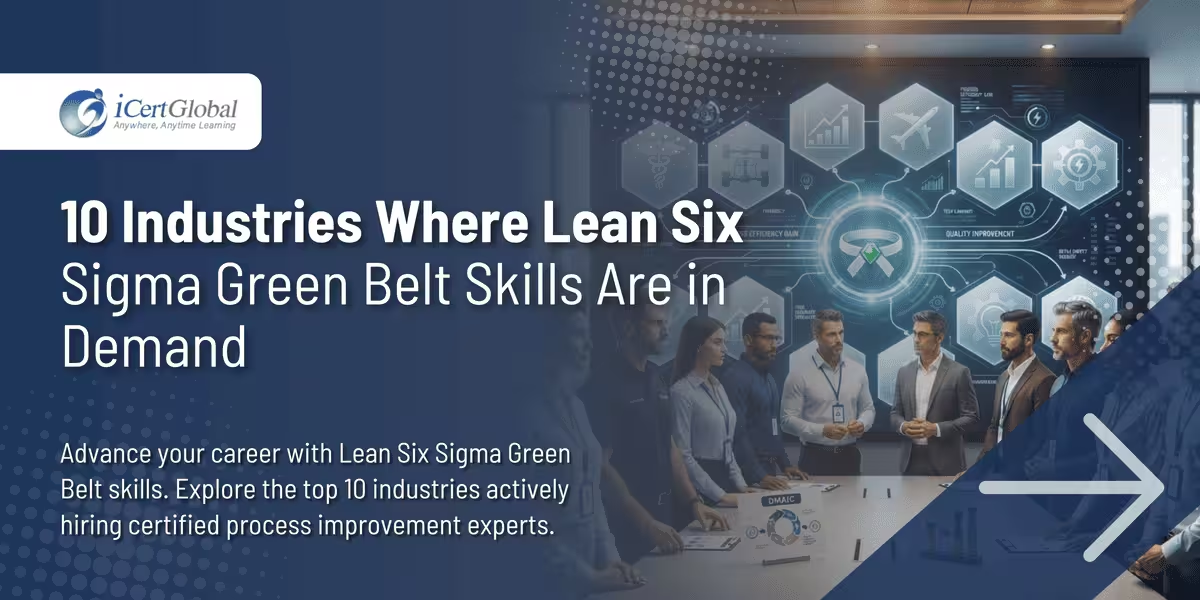
Advance your career with Lean Six Sigma Green Belt skills. Explore the top 10 industries actively hiring certified

Master essential lean six sigma principles to pass your certification exam, eliminate process waste, and advance your career.
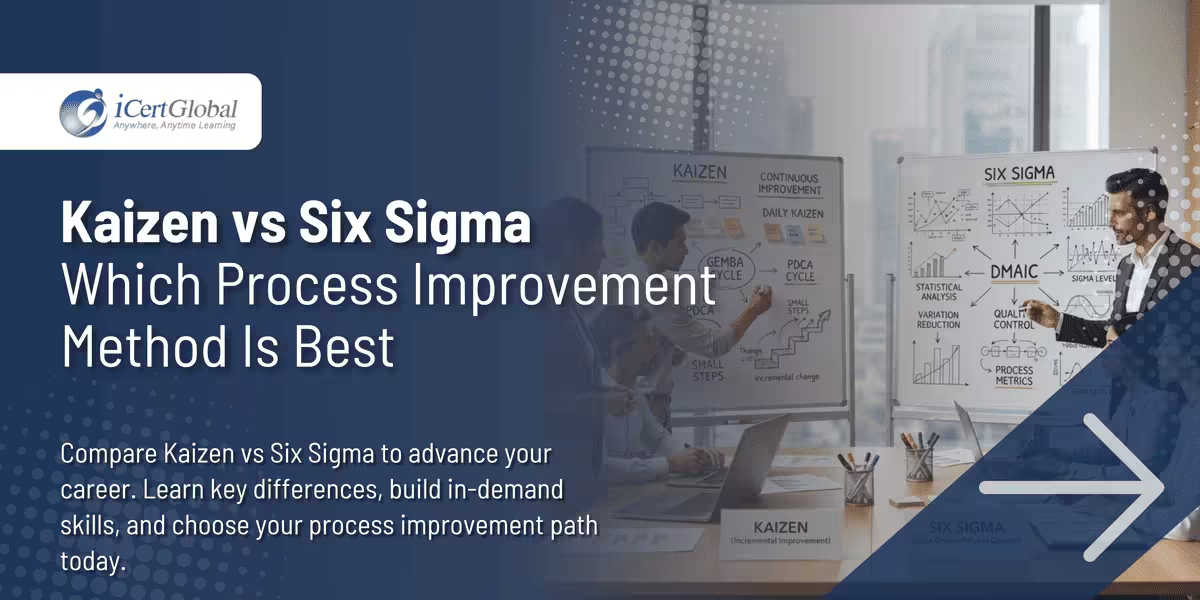
Compare Kaizen vs Six Sigma to advance your career. Learn key differences, build in-demand skills, and choose your
Advance your career by mastering quality management. Discover the key differences between Six Sigma and TQM to choose
.avif)
Master the DMAIC framework and boost your career. Learn how to achieve Six Sigma Green Belt Certification with
Discover the complete breakdown of Six Sigma Yellow Belt Certification costs in 2026. Compare ASQ vs. IASSC fees,
Our experts are ready to help you with any questions about courses, admissions, or career paths. Get personalized guidance from industry professionals.
Request a Call Back

"PMI®", "PMBOK®", "PMP®", "CAPM®" and "PMI-ACP®" are registered marks of the Project Management Institute, Inc. | "CSM", "CST" are Registered Trade Marks of The Scrum Alliance, USA. | COBIT® is a trademark of ISACA® registered in the United States and other countries.

