





DMAIC Explained Through a Realistic Process Improvement Example
Master the DMAIC process with a practical, step-by-step example. Learn how to solve process issues, pass your exam,
Stop being a spectator. Learn the fundamentals of Six Sigma and become a valuable contributor to improvement projects.
Your operations experience deserves more than firefighting the same recurring problems every month. While you're busy reacting, quality teams are getting budget, headcount, and leadership visibility by leading structured improvement projects. The difference? They have a Six Sigma Yellow Belt certification that proves they can use data to identify root causes - not just talk about symptoms. That changes today. Our Six Sigma Yellow Belt course isn't another theory-heavy class that drowns you in complex statistics. It's a practical learning experience designed by certified Black Belt practitioners who've successfully led projects in manufacturing, IT services, and healthcare operations around Dublin, CA. You'll master the DMAIC framework and learn how to apply it in real-world environments - where processes aren't documented, data is incomplete, and resistance to change is high. Unlike generic programs that only prepare you for the Six Sigma Yellow Belt exam, this course builds hands-on problem-solving capability. You'll learn how to: Create process maps that expose bottlenecks Use Pareto analysis to prioritize issues that matter Your Six Sigma Yellow Belt certification will prove you understand the methodology - but the real value lies in applying it. You'll return to your workplace ready to identify waste, measure improvement, and present a clear business case for change that management can't ignore. This Six Sigma Yellow Belt training is built for working professionals in operations, production, and quality roles who want to upskill without career disruption. Choose from weekday evening or weekend batches - fully interactive and recorded for flexibility.
Learn with confidence knowing your training program aligns with IASSC, ASQ, and CSSC standards for Six Sigma Yellow Belt certification.
Master the methodology from experts who hold Six Sigma Black Belt credentials and actively lead process improvement initiatives in the field.
Break into process improvement without disrupting your current job. Choose weekday-evening, weekend-only, or intensive 3-day bootcamp options.
Master DMAIC fundamentals fast with 21 hours of hands-on training and individualized feedback through phase-specific assessments.
Identify and eliminate knowledge gaps with 1000+ tailor-made practice questions, mock tests, and real-world manufacturing and service scenarios.
Get unstuck immediately as Six Sigma Black Belt experts are available 24x7 to clarify DMAIC concepts and statistical tools at every turn.
In many organizations, process improvement initiatives rely heavily on cross-functional teams, where members with varying skill sets collaborate to drive change. Six Sigma Yellow Belt (SSYB) Certification Training Program equips professionals with foundational knowledge to participate in these initiatives and support their implementation in Dublin, CA. Within the SSYB program, professionals learn the fundamentals of quality management, including the definition, measurement, and analysis phases of the DMAIC framework.
This framework is widely recognized as a structured approach to process improvement, emphasizing data-driven decision-making and continuous monitoring of key performance indicators (KPIs). By understanding these concepts, professionals can contribute to identifying and addressing process gaps and opportunities for improvement. Practitioners with SSYB certification can effectively participate in project teams and communicate with team members who have more advanced roles, such as Green Belts or Black Belts.
They can also contribute to process mapping, identify key process indicators, and track their performance.

Get a custom quote for your organization's training needs.
SSYB certification addresses a critical skill gap in the industry by providing a structured approach to process improvement. In Dublin, CA, professionals often struggle to identify and mitigate process waste, a key concept in lean principles. SSYB training provides the necessary tools and knowledge to measure and analyze process data, reducing the risk of errors and variability.
SSYB training focuses on the application of statistical tools, such as control charts and hypothesis testing, to identify and analyze process variation. By understanding these statistical techniques, professionals can identify opportunities for improvement and develop effective solutions. They can also communicate the results of their analysis to stakeholders, using data to drive decision-making.
Professionals with SSYB certification can apply their knowledge and skills in various industries, such as healthcare, finance, and manufacturing. They can contribute to process improvement initiatives, reducing waste and improving efficiency, and enhance their organization's overall performance.
Note: The training location may be subject to change depending on the number of participants registered for the session and participant convenience. Confirmed venue details will be shared by email after enrollment.
Stop accepting broken processes as normal. In this Six Sigma Yellow Belt course, you'll learn proven techniques for creating value stream maps, flowcharts, and SIPOC diagrams that uncover hidden waste and inefficiencies.
Master it or watch problems recur endlessly. You will develop frameworks using Fishbone diagrams, 5 Whys, and Pareto analysis to identify true root causes instead of treating symptoms.
Quantify problems with data, not assumptions. Learn to calculate process capability, interpret control charts, and apply descriptive statistics skills that make your Six Sigma Yellow Belt training impactful and measurable.
Cut through the noise to find the 8 wastes of Lean. You get templates and structures for identifying defects, overproduction, waiting, non-utilized talent, transportation, inventory, motion, and extra-processing in any operation.
Build competence or remain sidelined. You will understand how to support Define, Measure, Analyze, Improve, and Control phases as a contributing team member on process improvement projects.
Realize that bad data leads to bad decisions. You will learn how to design data collection plans, validate measurement systems, and ensure data integrity before analysis.
If you're starting your process improvement career or transitioning from operational or support roles, this program is engineered to get you credentialed and project-ready.
Throughout the SSYB Certification Training Program, professionals develop essential skills to participate in process improvement initiatives. By learning how to apply lean principles, such as the 5S methodology and root cause analysis, professionals can address process inefficiencies and eliminate waste. The SSYB program focuses on the importance of communication and collaboration in process improvement.
Professionals learn how to effectively communicate with team members, stakeholders, and customers, using data to drive discussion and decision-making. By understanding the principles of quality management, they can contribute to the development of effective solutions and measure their impact. Professionals in Dublin, CA, can apply their SSYB skills in various roles, supporting process improvement initiatives and driving continuous improvement.
They can also collaborate with cross-functional teams, using their knowledge and skills to achieve organizational objectives.


Get noticed for quality and continuous improvement roles that require Six Sigma certification and match your true capability.
Show measurable skill and credibility in manufacturing, healthcare, IT, and service industries where certified analysts are trusted with cost-critical projects.
Move beyond following SOPs to identifying waste, reducing defects, and driving measurable cost savings across your organization.
The Six Sigma Yellow Belt is intentionally designed as an entry-level certification with minimal barriers to entry. Certifying bodies created this credential to validate foundational knowledge for professionals who are starting their process improvement careers or transitioning from operational roles. Here's what you need to qualify:
No Educational Prerequisites: There are no degree or diploma requirements. Anyone with interest in process improvement and quality management can pursue Yellow Belt certification.
Training Recommended But Not Mandatory: While most certifying bodies recommend formal training, only AIGPE requires completion of their course to sit for the exam.
Certification Body Selection: Choose between IASSC ($250 USD, 60 questions, 2 hours), ASQ ($347 USD for members, 90 questions, 2.3 hours), or CSSC ($99 USD, 50 questions, 1 hour) based on industry recognition and budget.
Comprehensive Guidance: For a detailed breakdown of exam formats, passing scores, and preparation strategies, please refer to our FAQ section.
In SSYB Certification Training Program, professionals gain hands-on experience with statistical tools and data analysis techniques. By applying these skills, they can identify process variations, root causes, and opportunities for improvement. This knowledge and experience enable professionals to contribute to process improvement initiatives and drive positive change in their organizations.
The SSYB program emphasizes the importance of continuous monitoring and evaluation of process performance. Professionals learn how to develop and implement effective metrics, track process performance, and identify areas for improvement. By understanding how to collect and analyze data, they can drive data-driven decision-making and support process optimization.
Professionals with SSYB certification can apply their skills in various industries, driving process improvement and efficiency gains. They can also contribute to organizational goals, enhancing performance and reducing waste in Dublin, CA.
Stop accepting ambiguous processes. You will learn to create value stream maps, detailed flowcharts, and swim lane diagrams that expose hidden waste, redundant steps, and handoff delays in any process - manufacturing or transactional.
Understand that opinions don't drive improvement - data does. Learn to design data collection plans, select appropriate sampling methods, and distinguish between continuous and discrete data. Master operational definitions that ensure data consistency across multiple collectors.
Learn to validate your measurement system before trusting the data. Understand Gage R&R studies, accuracy, precision, and stability. Recognize when measurement error is masking true process variation and how to fix it before proceeding to analysis.
Move beyond Excel averages. You will learn to calculate mean, median, mode, range, variance, and standard deviation. Master histograms, box plots, scatter diagrams, and run charts that reveal patterns invisible in spreadsheet tables.
Understand whether your process can actually meet customer specifications. Learn to calculate Cp, Cpk, Pp, and Ppk indices. Interpret sigma levels and understand what "six sigma quality" actually means in real-world terms.
Master the core techniques: Fishbone (Ishikawa) diagrams, 5 Whys analysis, and Pareto charts. Learn when each technique is appropriate and how to facilitate root cause sessions without wasting everyone's time chasing symptoms instead of causes.
Identify and eliminate waste systematically. Learn to recognize Defects, Overproduction, Waiting, Non-Utilized Talent, Transportation, Inventory, Motion, and Extra-Processing (DOWNTIME) in manufacturing, service, and transactional processes.
Understand that not every improvement requires a six-month Black Belt project. Learn to facilitate rapid kaizen events that deliver measurable results in days, not months. Master 5S workplace organization and visual management techniques.
Generate improvement solutions that are actually implementable. Learn structured brainstorming techniques, affinity diagrams, and multi-criteria decision matrices to evaluate solutions against cost, impact, and feasibility constraints.
Understand that implementation isn't the finish line. Learn to create control plans that sustain improvements after project closure. Master poka-yoke (error-proofing) techniques that prevent defects from occurring in the first place.
Learn to monitor process stability using control charts. Understand common cause versus special cause variation. Interpret X-bar and R charts, p-charts, and c-charts to detect when processes drift out of control.
Consolidate your knowledge across all five DMAIC phases and address any remaining weak spots through targeted review. Complete final practice assessments aligned with IASSC, ASQ, or CSSC formats and prepare for your certification journey with confidence.
SSYB certification provides professionals with a structured approach to process improvement, enhancing their expertise and career opportunities. By applying lean principles and quality management techniques, professionals can demonstrate their value to their organization and drive positive change.
Professionals with SSYB certification are equipped to participate in cross-functional teams, contributing to process improvement initiatives and driving continuous improvement. They can also communicate effectively with stakeholders, using data to drive discussion and decision-making.
The SSYB program enhances professionals' knowledge and skills, enabling them to apply process improvement principles in various roles and industries. They can drive organizational performance, reduce waste, and improve efficiency, supporting business objectives in Dublin, CA.
Great class, very informative.

Great PMP<sup>®</sup> Bootcamp. I had a great time taking this course. I took the course to prepare to sit for the CAPM<sup>®</sup> but may be able to sit for the PMP<sup>®</sup>. I learnt a lot was challenging. Great course. We need one more day. Content was very detailed.

it was a great class. Lots of energy. And I enjoyed.

Fantastic course to prepare for PMP<sup>®</sup> exam.

As a participant it was smooth sailing for me.

Trainer was excellent. Shared good resources and good experiences.

Good content and training.
I wanted to let you know that I took and passed the PMP exam. Thanks to iCertGlobal and especially my Cincinnati course instructor, who was an excellent teacher and helped me immensely.

Trainer was good. Trainer was very engaged and interacting. Very much satisfied with the training.

I was pleasantly surprised at the quality of this training. Yomi was awesome as a trainer and working to make sure that we understood the concepts. Controlling Cost and Controlling Risk are the most complicated, but Yomi spent time after class working through questions to help others understand. This class also helped to change my perception of the PMP being this MONSTER to something that I can I can successfully do.

Great class with a lot of information and tips to prepare for the exam

It was a great course, covered all the things that i ended up hitting road bumps on. I was the only one in the class, but the trainer was just as involved as if it had been a full class.

I was nervous about taking it online versus classroom; but I am actually glad I took it online. Instructor was very great and gave a good learning experience with his relevant project management experience.
The training was very intense but covered with course material. It was more than I expected.

I thought the class was very informative. The instructor did an excellent job breaking down each chapter to where it was easy to understand. I was also very impressed with his commitment to help us pass ever after the class is over.

Excellent training. Instructor was very knowledgeable and explained information in an understandable way
Quality Materials presented, Instructor very knowledgeable. Exceeded my expectations.
The training is a great introduction into the PMI mindset. Very informative and helpful

Explore our instructor-led Six Sigma Yellow Belt training to learn about the course duration, cost, eligibility, and certification process. You get practical learning, exam-focused preparation, and expert guidance. Ready to get started? Compare Six Sigma Yellow Belt certification training options and choose a classroom or live online format that fits your schedule.
Explore Our Six Sigma Yellow Belt certification training is available in a city near you
Stay updated with the latest insights and trends in your field
Master the DMAIC process with a practical, step-by-step example. Learn how to solve process issues, pass your exam,
Learn how to identify and execute high-impact projects. Master Lean Six Sigma project selection to drive business results
Advance your career by mastering Six Sigma belt levels. Learn the differences between Yellow, Green, and Black Belts
Master the DMAIC methodology and pass your Six Sigma Green Belt Certification Exam. Learn proven study strategies to
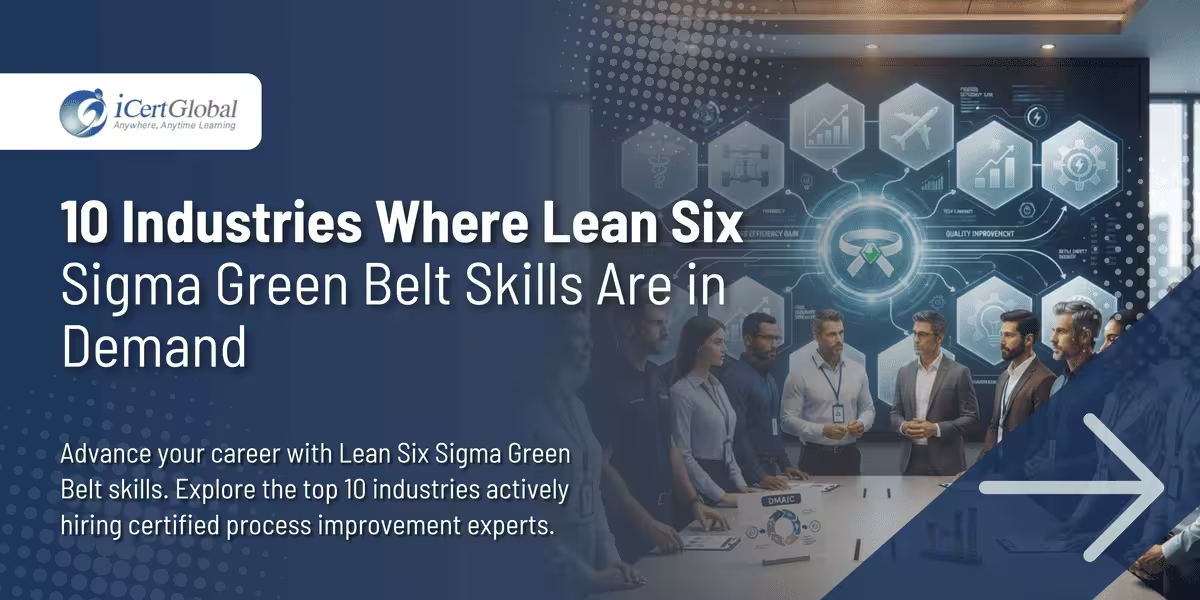
Advance your career with Lean Six Sigma Green Belt skills. Explore the top 10 industries actively hiring certified
Master essential lean six sigma principles to pass your certification exam, eliminate process waste, and advance your career.
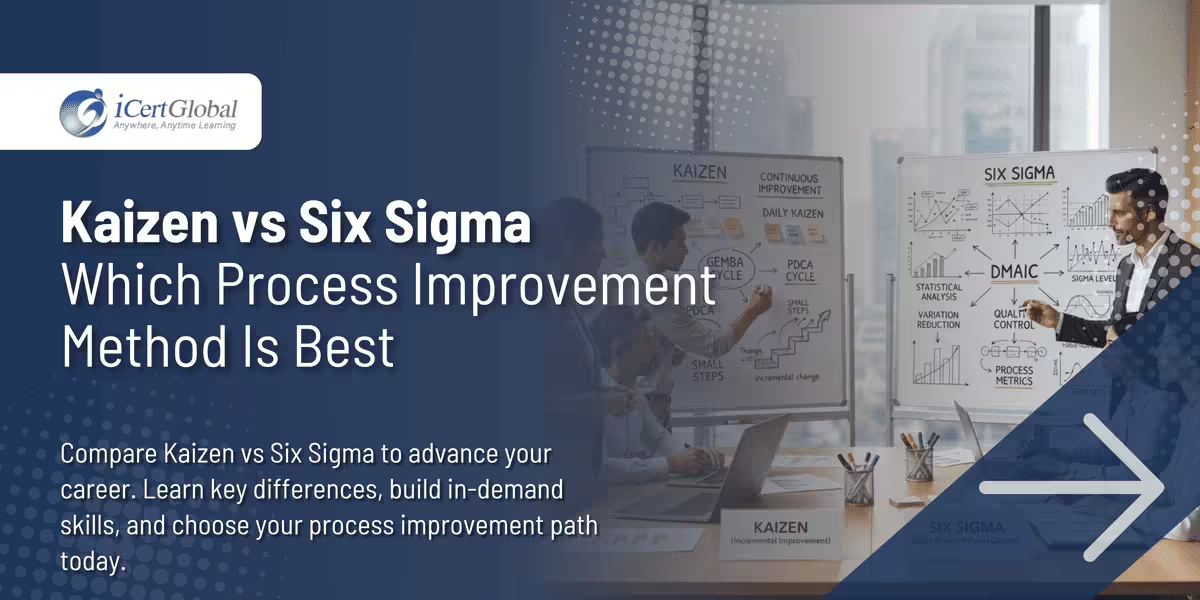
Compare Kaizen vs Six Sigma to advance your career. Learn key differences, build in-demand skills, and choose your
Advance your career by mastering quality management. Discover the key differences between Six Sigma and TQM to choose
.avif)
Master the DMAIC framework and boost your career. Learn how to achieve Six Sigma Green Belt Certification with
Discover the complete breakdown of Six Sigma Yellow Belt Certification costs in 2026. Compare ASQ vs. IASSC fees,
Our experts are ready to help you with any questions about courses, admissions, or career paths. Get personalized guidance from industry professionals.
Request a Call Back

"PMI®", "PMBOK®", "PMP®", "CAPM®" and "PMI-ACP®" are registered marks of the Project Management Institute, Inc. | "CSM", "CST" are Registered Trade Marks of The Scrum Alliance, USA. | COBIT® is a trademark of ISACA® registered in the United States and other countries.

