You've been applying standard Machine Learning models, but the cutting edge - the projects defining the future of AI in Mission Viejo, CA finance, healthcare, and autonomous tech - requires Deep Learning expertise. HR filters resumes for candidates experienced in CNNs for image classification or LSTMs for time-series prediction. Your skills are broad; the industry demands mastery of deep learning algorithms and deep learning frameworks. This isn't a conceptual overview. Our Deep Learning course is engineered by seasoned AI Architects and Senior ML Engineers tackling GPU limitations, vanishing gradients, and training models on massive real-world datasets in Mission Viejo, CA. You'll gain hands-on experience with deep learning AI systems, bridging the gap between theory and production-ready solutions. Unlike superficial courses that provide only code snippets, this deep learning specialization focuses on practical engineering. You'll master the mathematics behind backpropagation and gradient descent, enabling you to debug and optimize any network architecture. Learn the trade-offs between optimizers (Adam vs. RMSprop) and regularization techniques (Dropout vs. L2) that save training time while boosting accuracy. Designed for ambitious professionals in Mission Viejo, CA the program offers weekday evening and weekend batches, fully interactive with coding exercises and mathematical Q&A. Every session is recorded. Beyond the training, you gain access to complex, real-world Mission Viejo, CA image and text datasets for hands-on deep learning projects, 24/7 expert support, and guidance to build a specialized GitHub portfolio. This ensures your deep learning with Python expertise and portfolio open doors to top AI firms globally.
Deep Learning Training Program Overview Mission Viejo, CA
Deep Learning Training Course Highlights in Mission Viejo, CA
More Than a Course - It's Your Career Accelerator
TensorFlow and Keras Mastery
Gain proficiency in the industry-standard libraries, focusing on building and deploying complex models efficiently and scalably.
Taught by AI Architects
Unlock your potential with expert instructors who are actively designing and managing Deep Learning pipelines in high-stakes production environments.
Mathematically Rigorous Approach
Master the concepts fast with 120+ hours of instruction focused on the mathematical "why," enabling you to effectively debug and innovate.
Production-Grade Projects
Execute multiple mandatory, high-impact projects on real-world datasets, moving from Jupyter Notebooks to cloud-deployable solutions.
Exhaustive Practice Materials
Get on top of your weaknesses with 2000+ tailor-made technical questions covering architecture, math, and optimization best practices.
24x7 Expert Guidance & Support
Be worry-free as certified AI experts are available 24x7 to solve your complex coding and mathematical modeling doubts.
Upcoming Schedule
Where your classroom training takes place
Note: The training location may be subject to change depending on the number of participants registered for the session and participant convenience. Confirmed venue details will be shared by email after enrollment.
Why get Deep Learning-certified?
The Credential That Ends the Gatekeeping
Stop Getting Filtered by Specific Tech Demands
Stop getting filtered out by firms demanding "experience with CNNs and LSTMs" or "TensorFlow deployment at scale."
Unlock the Highest Salary Bands and Stock Options
Unlock the highest salary bands and stock option packages reserved for specialists who solve complex, non-linear AI problems.
Transition to Strategic AI Systems Architect
Transition from a general data practitioner to an AI systems architect who designs the future of predictive technology.
Who This Program Is For
This certification training is ideal for:
Experienced Machine Learning Engineers
Data Scientists
Research Scientists
Python Developers
Senior Technical Architects
PhD or M.Tech Students Seeking Production-Level Deep Learning Experience
If you possess strong coding and mathematical fundamentals and are ready to tackle the complexity required for advanced AI systems, this program is engineered to make you a deployable Deep Learning expert.
Work Responsibilities
Upon completion, professionals in Mission Viejo, CA will be well-positioned to take on leadership roles in their organizations, driving the adoption of deep learning solutions and advising on strategic initiatives.
The skills and knowledge gained through this training program highlight the gap between current industry standards and the proficiency required to implement deep learning solutions effectively.
Key deficits include the lack of expertise in deep learning frameworks, model interpretability, and the ability to integrate deep learning with other machine learning techniques. Participants will also learn to address common challenges in deep learning, such as overfitting and underfitting.
By addressing these skill gaps, professionals in Mission Viejo, CA will gain a competitive edge in the job market and be better equipped to drive business success through the strategic application of deep learning techniques.
Eligibility and prerequisites
This certification is for the serious professionals who have a solid foundation in core technical and mathematical disciplines. It is not for beginners.
Mandatory Programming and ML Foundation: Non-negotiable proficiency in Python and fundamental Machine Learning concepts (e.g., cross-validation, bias-variance tradeoff, basic regression/classification).
Advanced Mathematical Aptitude: Essential working knowledge of Multivariable Calculus (partial derivatives, chain rule for gradients) and Linear Algebra (matrix/vector operations). The training includes a refresher, but a solid base is required.
GPU/Compute Familiarity (Preferred): Experience utilizing cloud environments (AWS/GCP/Azure) or local GPUs for high-compute tasks is highly beneficial, as Deep Learning models are computationally expensive.
Commitment to Intensity: This course moves at the pace of innovation. You must commit substantial time to hands-on coding and solving mathematically complex problems.
Skill Gap
The Deep Learning Certification Training Program has direct applicability to a range of industries and applications, including computer vision, natural language processing, and recommender systems. Key areas of focus include the development of convolutional neural networks for image recognition, the application of recurrent neural networks for sequence modeling, and the use of deep learning for predictive maintenance and quality control.
Professionals in Mission Viejo, CA, working in industries like manufacturing and logistics, will benefit from the ability to develop and deploy deep learning models that improve operational efficiency and reduce costs.
Skills You Will Gain In Our Deep Learning Training Program in Mission Viejo, CA
Core Neural Network Architecture
Learn to design, initialize, and structure multi-layered networks. You will master the practical trade-offs of using various activation functions and loss metrics for different problem types.
Gradient Descent and Optimization
Stop relying on default settings. You will gain a deep understanding of backpropagation and how to choose and tune advanced optimizers (Adam, RMSprop, AdaGrad) for faster, more stable model convergence.
Convolutional Neural Networks (CNNs)
Master the application of CNNs for image and video data. You will learn to design complex architectures (ResNet, VGG) and implement critical techniques like transfer learning and data augmentation.
Recurrent Neural Networks (RNNs/LSTMs)
Learn to process sequential data like text, time series, and speech. You will master the architecture and deployment of LSTMs and GRUs to solve forecasting and natural language processing (NLP) challenges.
Optimization and Regularization
Become a hyperparameter tuning expert. You will learn practical methods to combat overfitting (the biggest failure point) using techniques like Dropout, Batch Normalization, and early stopping.
Deep Learning Deployment
Master the production pipeline. You will learn how to serialize models, optimize them for mobile/edge devices, and deploy them as scalable services on cloud infrastructure.
Course Modules & Curriculum
Module 1: Foundational Math & Network Essentials
Lesson 1: Introduction to TensorFlow and Deep Learning Math
Master the TensorFlow ecosystem and set up your compute environment. Rigorously review the Multivariable Calculus and Linear Algebra essential for understanding how Neural Networks learn, focusing on the Chain Rule and Jacobian matrices.
Lesson 2: Perceptrons and Activation Functions
Go beyond theory and deconstruct the perceptron - the core computational unit of deep learning AI. Understand the crucial role of non-linear activation functions such as ReLU, Sigmoid, and Tanh, and why they're essential for solving complex real-world problems. Learn how these activation functions influence gradient flow and model convergence in deep learning with Python.
Lesson 3: Artificial Neural Networks (ANNs) from Scratch
Build, train, and evaluate your first Artificial Neural Network (ANN) using TensorFlow and Keras. This lesson takes you step-by-step through creating dense, multi-layered architectures, initializing weights, and implementing both forward and backward propagation. You'll gain hands-on experience building neural networks from the ground up - the foundation of every deep learning course and deep learning specialization.
Module 2: Backpropagation and Optimization
Lesson 1: Gradient Descent and Backpropagation Mastery
Master the mathematics of backpropagation - the engine of Deep Learning. Understand how gradients are calculated and propagated backward through the network to update weights, a non-negotiable skill for debugging.
Lesson 2: Optimization Techniques
Learn the practical necessity of advanced optimizers. Master the differences and application of Adam, RMSprop, and Adagrad to achieve faster convergence and avoid local minima during complex model training.
Lesson 3: Optimization and Regularization
Combat overfitting (the biggest failure mode). You will learn and implement key regularization techniques including L1/L2 loss, Dropout, and the critical use of Batch Normalization to stabilize training and improve generalization.
Module 3: Convolutional Neural Networks (CNNs) for Vision
Lesson 1: Intro to Convolutional Neural Networks (CNNs) & Architecture
Gain a deep, mathematical understanding of Convolutional Neural Networks (CNNs) - the cornerstone of Deep Learning AI for image processing and computer vision. Learn how convolutional, pooling, and flatten layers work together to extract spatial features. You'll calculate parameters, output shapes, and understand why CNNs outperform traditional deep learning algorithms for visual tasks
Lesson 2: Advanced CNN Techniques
Dive into high-performance strategies: Transfer Learning using pre-trained models (VGG, ResNet) and advanced techniques like data augmentation and object detection fundamentals for real-world computer vision tasks in industry.
Lesson 3: Practical Computer Vision Project
Apply your knowledge to a full-scale Deep Learning with Python project. You'll implement and fine-tune CNNs on real-world datasets, such as medical imaging or traffic classification problems. The focus is on achieving measurable accuracy, optimizing architectures, and producing documentation that reflects production-level standards - skills directly aligned with modern deep learning AI careers.
Module 4: Recurrent Neural Networks (RNNs) for Sequences
Lesson 1: Intro to Recurrent Neural Networks (RNNs) & Sequence Data
Master the architecture of RNNs, designed for sequence data like text and time series. Understand the concept of "hidden state" and the critical problem of the vanishing gradient in standard RNNs.
Lesson 2: LSTMs and GRUs for Advanced NLP
Learn to implement and deploy Long Short-Term Memory (LSTM) and Gated Recurrent Units (GRU) - the industry standard for sequential data. Master their internal "gates" that solve the vanishing gradient problem.
Lesson 3: Practical NLP and Time Series Project
Execute a mandatory project using LSTMs/GRUs on a complex sequence dataset (e.g., text sentiment analysis, stock price prediction). Focus on data preparation (tokenization, padding) and evaluating predictive power.
Module 5: Deployment, Application, and Readiness
Lesson 1: Deep Learning Applications & Ethics
Examine the current state-of-the-art applications of Deep Learning (e.g., LLMs, Generative AI) and the crucial ethical considerations for deploying biased models in real-world systems.
Lesson 2: Model Deployment and Scaling
Bridge the gap between research and production. Learn to serialize, optimize, and deploy deep learning models using TensorFlow Lite for mobile and edge devices. Master scalable deployment strategies through major cloud platforms (AWS, Azure, GCP) to achieve low-latency, high-throughput performance. These practical skills transform you from a learner to a Deep Learning Engineer ready for enterprise deployment scenarios.
Lesson 3: Final Certification Review & Portfolio Finalization
Consolidate knowledge across all architectural, mathematical, and deployment domains. Complete final comprehensive practice assessments and polish your mandatory, high-stakes portfolio projects, ensuring maximum impact for recruiters.
Deep Learning Certification Training Program Roadmap Mission Viejo, CA


Career Relevance
Deep Learning Certification Training Program is highly relevant to professionals seeking to advance their careers in the field. This certification demonstrates expertise in the application of machine learning algorithms and neural networks to a wide range of problems. Professionals with a strong background in statistics, linear algebra, and calculus will find this training program particularly valuable, as it builds upon these foundational concepts to introduce advanced topics like convolutional neural networks and long short-term memory networks.
Participants will also learn to utilize various deep learning frameworks, including TensorFlow and PyTorch. In Mission Viejo, CA, professionals in industries like healthcare and finance will benefit from the ability to develop predictive models and optimize complex systems using deep learning techniques.
This training program equips professionals with the skills necessary to design, implement, and deploy deep learning models in various contexts.
Participants will learn to optimize neural network architectures, tune hyperparameters, and debug model performance.
Skill Development
Key skills developed through this training include expertise in deep learning frameworks, model interpretability, and the ability to integrate deep learning with other machine learning techniques. Students will also learn to apply domain knowledge to inform model development and evaluation.
Through hands-on exercises and projects, professionals in Mission Viejo, CA will gain practical experience in developing and deploying deep learning models, preparing them to tackle real-world problems in their industries.
Professionals can expect to take on a range of work responsibilities upon completing this training program, including designing and implementing deep learning models, optimizing neural network architectures, and evaluating model performance.
These responsibilities will require strong analytical and problem-solving skills, as well as the ability to work effectively in a team to integrate deep learning with other machine learning techniques. Participants will also learn to communicate complex technical concepts to non-technical stakeholders.
Customer Testimonials
Hear from our successful graduates
"Enrolling in the course was seamless, and the learning portal was easy to navigate. The live sessions were interactive, and the trainers were highly skilled. I appreciated the flexible schedule and the follow-up sessions offered. I would definitely return to iCert Global for more certifications."

Catherine
"I recently completed my CSM course in Houston from icertglobal and it was one of the best experience. icertglobal management was so humble and understanding and went extra mile to adjust my last minute classroom request.The classroom course was held in Houston, USA and the trainer was by far one of the best i have came across till date.He provided us with workshops that really helped in understanding Scrum to the core.Thank you icertglobal of such a wonderful experience and keep the good work up."
Sandy Tholuchuri
"The PMP practice test and PMP exam prep questions were of great help in preparing for the project management exam. Thanks to the Trainer for all the hard work."
Kevin Chris
"I had an awesome experience with icert global, before signing up for training had a doubt on quality of training..but the trainer was so good in communicating things to each individual providing live examples.. the course content is well customized and easy to understand..Training quality and the course content is too goood..loved it.. have to thank the sales team who suggested me in choosing the course which would help me in my career growth and trust me it worked out well... Thank you guys for all your support.."
Ptek Multiples
"Fantastic training on Lean Management. It was a good learning experience that will definitely help me in my career. I would recommend iCert Global to my friends and colleagues."
Tim Malone
"Icert global really goes out of the way in assisting the applicants. The mentorship is amazing throughout the certification process. I am sure all the people associated with icert global have the same motive to help the applicants, but I would like give a special thanks to Ankita who helped me to be flawless with the procedure....."
kalp vyas
"I would like to recommend iCertGlobal to anyone who wants to enroll for ITIL certification programs. Explanations are clear, easy to understand and the course preparation is good enough to create interest in learning and prepare for the actual certification exam. I came out successful. Good work icertglobal."
Jason Walter
"The training was good, the instructor was knowledgeable, easy to understand the content, the doubts were clarified. It was on point. I was able to clear the certification exam in the first attempt. Thank you icert global team!"
Sophiya P
"Successfully completed Training and certification from iCertGlobal for PRINCE2 Foundation and Practitioner certification. Trainer was very knowledgeable and explained concepts very clearly and I am moving to USA and , hopefully, this certification helps me to secure good job in silicon valley."
Robert Williams
"Excellent to work with! Working with ICert Global on planning PMP preparation has been wonderful! I especially like the flexibility to attend online preparation. Leena and Sam have been a pleasure to work with! Thank you!"
Annette Callan
"Great! Leena and Sameer were great and helped with the registration process. Looking forward to the classes."
Annie
"The Six Sigma Lean Green Belt Class was excellent. I enjoyed learning in this online course. And I feel like I was fully prepared to take the exam"
Helen Selika Underwood
"Sam Feedback Online PMP Session This was a great experience to learn and grow with peers in project management. The diverse set of experiences and backgrounds help understand various scenarios well. The virtual aspect of the class took the learning experience to a new level and simulated a geographically diverse team in the corporate world. Sam did a great job and was very knowledgeable on PMP. Sam started each day with a review from the previous day as well as an agenda/plan and concluded each day with a recap of what had been covered and plan for the next day - very helpful."
Peter Schramm
"The trainer was very knowledgeable and very well organized. There are many real life example use cases. Great training pace and opportunities for clarification and questions. The total training time was 10am-1pm and 2-6pm (EST). Only one hour lunch break and 10 minutes break in the morning and afternoon session. We really had long days for the 35 PDU and completely justified the training."
Yanxin Gao
"Others course content is ? Others course content is remarkable. I certglobal can work on growing global partnerships."
Rufus Alexander
"LSS Green Belt Certification The training course was great and well run. I took alot from it that I will now use in my work environment. I would highly recommend this for anyone who is interested."
Drew
"Project Manager Boing It was a great class Lots of energy And I enjoyed"
Kevin Hambrice
"Sr. Project Manager, Montco Oilfield Contractors, LLC As a participant it was smooth sailing for me."
Eric Tumlinson
Corporate Training
Tailored programs for teams with enterprise support

Ready to transform your team?
Get a custom quote for your organization's training needs.
Course & Support
Everything you need to know about our training options and support
Industry Applicability
The Deep Learning Certification Training Program will help professionals in Mission Viejo, CA, stay current with industry developments and leverage the latest advancements in deep learning research. Key topics covered in the program include the latest deep learning architectures, the application of transfer learning, and the use of deep learning for anomaly detection and fault diagnosis.
Students will also learn to address emerging challenges in deep learning, such as security and explainability. Upon completion, professionals will be well-positioned to drive innovation and improvement in their organizations, applying the latest deep learning techniques to drive business success.
Build In-Demand Skills
Explore our instructor-led Deep Learning training to learn about the course duration, cost, eligibility, and certification process. You get practical learning, exam-focused preparation, and expert guidance. Ready to get started? Compare Deep Learning certification training options and choose a classroom or live online format that fits your schedule.
Deep Learning Training in Other Cities
Our Deep Learning certification training is available in major cities worldwide
Related Blogs
Stay updated with the latest insights and trends in your field
Building Your First Neural Network from Scratch with
Master deep learning fundamentals by building a neural network from scratch in PyTorch. Boost your machine learning skills and advance your career today.
7 Common Deep Learning Mistakes and How to
Master your neural networks by fixing these 7 common deep learning mistakes. Learn practical debugging tips to build better models and advance your AI career.
Deep Learning Engineer Salary in 2026: What You
Discover what you can earn as a deep learning engineer in 2026. Compare salaries by experience and find the skills you need to maximize your career ROI.
What Are the Requirements for Deep Learning Certification?
Master the requirements for Deep Learning certification. Learn about prerequisites, costs, and exam prep to lead AI initiatives in 2026.
Why Deep Learning Is Driving the Future of
Explore how deep learning and artificial neural networks are redefining tech evolution through real-world applications in healthcare and finance.
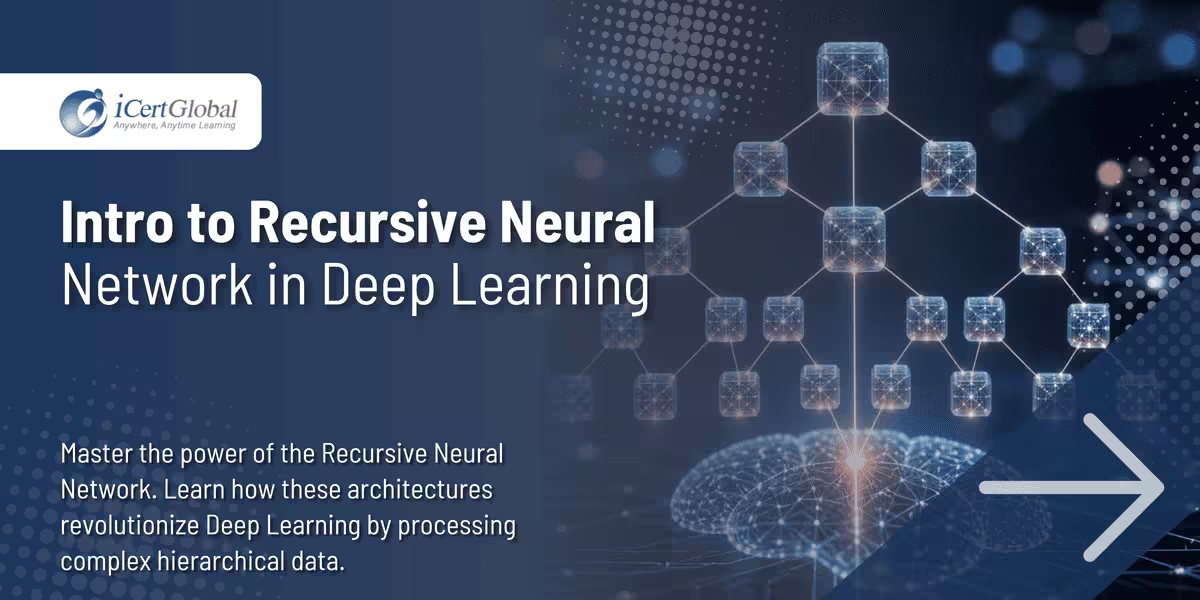
Intro to Recursive Neural Network in Deep Learning
Master the power of the Recursive Neural Network. Learn how these architectures revolutionize Deep Learning by processing complex hierarchical data.
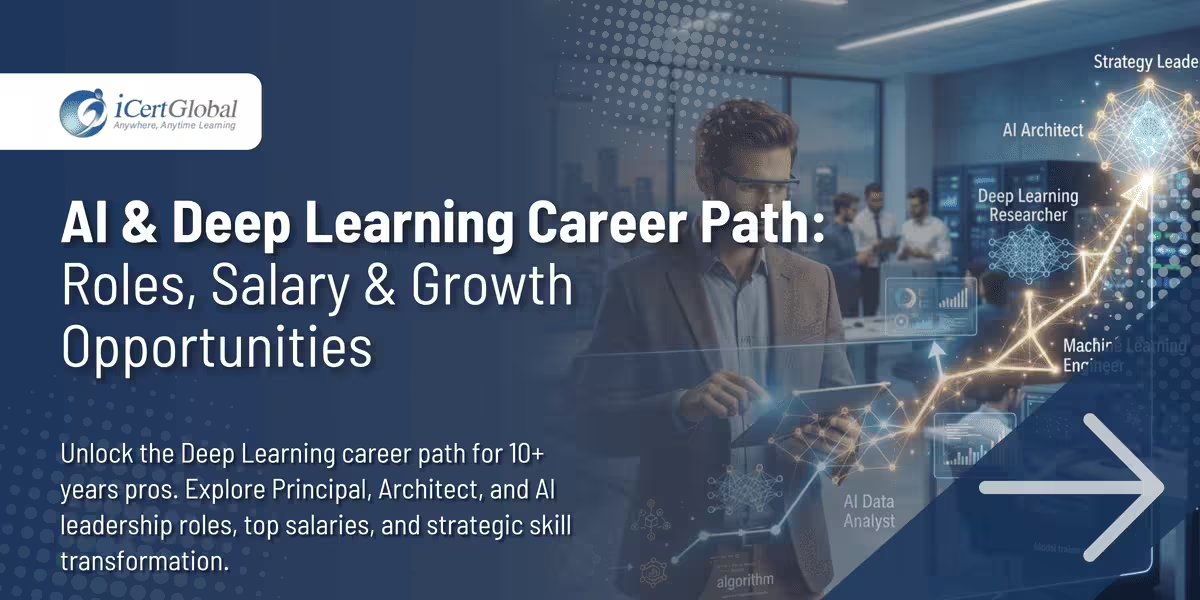
AI & Deep Learning Career Path: Roles, Salary
Unlock the Deep Learning career path for 10+ years pros. Explore Principal, Architect, and AI leadership roles, top salaries, and strategic skill transformation.
A Deep Dive into the Product Owners Key
Explore the vital role of a Product Owner in Scrum, including their responsibilities, skills, interactions with the team, and how they contribute to product success.
Deep Learning's Impact on Autonomous Vehicles and Safety
Explore how deep learning is transforming autonomous vehicles, boosting safety, and driving innovation to shape the future of transportation like never before
Deep Learning for Image and Video Recognition Insights.
Explore the power of deep learning in image and video recognition. Enhance your understanding of this technology and its impact across industries today!!!!