





Top Machine Learning Interview Questions You Must Prepare
Master top machine learning interview questions for 2026. Validate your skills, ace technical rounds, and advance your career
Stop being just a general data scientist. Get the specialized, cutting-edge certification that makes you an AI architect and unlocks the highest salary ceiling in the technology sector.
You've been applying standard Machine Learning models, but the cutting edge - the projects defining the future of AI in Rialto, CA finance, healthcare, and autonomous tech - requires Deep Learning expertise. HR filters resumes for candidates experienced in CNNs for image classification or LSTMs for time-series prediction. Your skills are broad; the industry demands mastery of deep learning algorithms and deep learning frameworks. This isn't a conceptual overview. Our Deep Learning course is engineered by seasoned AI Architects and Senior ML Engineers tackling GPU limitations, vanishing gradients, and training models on massive real-world datasets in Rialto, CA. You'll gain hands-on experience with deep learning AI systems, bridging the gap between theory and production-ready solutions. Unlike superficial courses that provide only code snippets, this deep learning specialization focuses on practical engineering. You'll master the mathematics behind backpropagation and gradient descent, enabling you to debug and optimize any network architecture. Learn the trade-offs between optimizers (Adam vs. RMSprop) and regularization techniques (Dropout vs. L2) that save training time while boosting accuracy. Designed for ambitious professionals in Rialto, CA the program offers weekday evening and weekend batches, fully interactive with coding exercises and mathematical Q&A. Every session is recorded. Beyond the training, you gain access to complex, real-world Rialto, CA image and text datasets for hands-on deep learning projects, 24/7 expert support, and guidance to build a specialized GitHub portfolio. This ensures your deep learning with Python expertise and portfolio open doors to top AI firms globally.
Gain proficiency in the industry-standard libraries, focusing on building and deploying complex models efficiently and scalably.
Unlock your potential with expert instructors who are actively designing and managing Deep Learning pipelines in high-stakes production environments.
Master the concepts fast with 120+ hours of instruction focused on the mathematical "why," enabling you to effectively debug and innovate.
Execute multiple mandatory, high-impact projects on real-world datasets, moving from Jupyter Notebooks to cloud-deployable solutions.
Get on top of your weaknesses with 2000+ tailor-made technical questions covering architecture, math, and optimization best practices.
Be worry-free as certified AI experts are available 24x7 to solve your complex coding and mathematical modeling doubts.
Deep learning techniques are increasingly being used in computer vision, natural language processing, and predictive analytics to develop sophisticated solutions. Many organizations in Rialto, CA, and around the world, are leveraging convolutional neural networks to enhance their image classification capabilities and support business decision-making. To achieve accurate image classification, deep learning models require large amounts of labeled training data.
The use of transfer learning and fine-tuning is becoming increasingly popular as a way to adapt pre-trained models to specific applications. By applying these techniques, organizations can accelerate their development timelines and improve the accuracy of their models. In practice, industry professionals using the Deep Learning Certification Training Program can apply these concepts to develop innovative solutions that drive business outcomes.
For instance, they can utilize object detection models to improve supply chain efficiency or develop chatbots that enhance customer engagement.

Get a custom quote for your organization's training needs.
The demand for professionals with deep learning expertise is on the rise, driven by the increasing adoption of artificial intelligence and machine learning technologies. The Deep Learning Certification Training Program prepares professionals for a wide range of career opportunities, from data scientist to product manager. To succeed in these roles, individuals must have a solid understanding of deep learning concepts, including backpropagation and stochastic gradient descent.
They must also be able to apply these concepts to real-world problems, using tools such as TensorFlow and PyTorch. By mastering these skills, professionals can unlock opportunities in top companies and drive innovation in the field. In Rialto, CA, companies are actively seeking professionals with deep learning expertise to lead their AI initiatives.
By completing the Deep Learning Certification Training Program, individuals can position themselves for success and gain a competitive edge in the job market.
Learn to design, initialize, and structure multi-layered networks. You will master the practical trade-offs of using various activation functions and loss metrics for different problem types.
Stop relying on default settings. You will gain a deep understanding of backpropagation and how to choose and tune advanced optimizers (Adam, RMSprop, AdaGrad) for faster, more stable model convergence.
Master the application of CNNs for image and video data. You will learn to design complex architectures (ResNet, VGG) and implement critical techniques like transfer learning and data augmentation.
Learn to process sequential data like text, time series, and speech. You will master the architecture and deployment of LSTMs and GRUs to solve forecasting and natural language processing (NLP) challenges.
Become a hyperparameter tuning expert. You will learn practical methods to combat overfitting (the biggest failure point) using techniques like Dropout, Batch Normalization, and early stopping.
Master the production pipeline. You will learn how to serialize models, optimize them for mobile/edge devices, and deploy them as scalable services on cloud infrastructure.
If you possess strong coding and mathematical fundamentals and are ready to tackle the complexity required for advanced AI systems, this program is engineered to make you a deployable Deep Learning expert.
Deep learning models are capable of learning complex patterns in large datasets, enabling them to make predictions and take actions with high accuracy. The Deep Learning Certification Training Program provides professionals with the knowledge and skills needed to develop and apply these models. To achieve growth in deep learning, professionals must understand the importance of hyperparameter tuning and model evaluation.
They must also be able to apply techniques such as regularization and dropout to prevent overfitting and improve model generalization. By mastering these concepts, professionals can develop models that drive business outcomes and support strategic decision-making. In the field of computer vision, deep learning models are being used to develop applications such as autonomous vehicles and facial recognition systems.
By applying the concepts learned in the Deep Learning Certification Training Program, professionals can drive growth and innovation in this field and contribute to the development of cutting-edge technologies.


Stop getting filtered out by firms demanding "experience with CNNs and LSTMs" or "TensorFlow deployment at scale."
Unlock the highest salary bands and stock option packages reserved for specialists who solve complex, non-linear AI problems.
Transition from a general data practitioner to an AI systems architect who designs the future of predictive technology.
This certification is for the serious professionals who have a solid foundation in core technical and mathematical disciplines. It is not for beginners.
Mandatory Programming and ML Foundation: Non-negotiable proficiency in Python and fundamental Machine Learning concepts (e.g., cross-validation, bias-variance tradeoff, basic regression/classification).
Advanced Mathematical Aptitude: Essential working knowledge of Multivariable Calculus (partial derivatives, chain rule for gradients) and Linear Algebra (matrix/vector operations). The training includes a refresher, but a solid base is required.
GPU/Compute Familiarity (Preferred): Experience utilizing cloud environments (AWS/GCP/Azure) or local GPUs for high-compute tasks is highly beneficial, as Deep Learning models are computationally expensive.
Commitment to Intensity: This course moves at the pace of innovation. You must commit substantial time to hands-on coding and solving mathematically complex problems.
The Deep Learning Certification Training Program provides professionals with a comprehensive set of skills in deep learning, including model development, data preprocessing, and algorithm selection. Individuals can apply these skills to develop a wide range of applications, from natural language processing to predictive maintenance. To develop these skills, professionals must have a solid understanding of deep learning concepts, including activation functions and optimization algorithms.
They must also be able to apply these concepts to real-world problems, using tools such as scikit-learn and Keras. By mastering these skills, professionals can develop innovative solutions that drive business outcomes and support strategic decision-making. In Rialto, CA, companies are actively seeking professionals with deep learning skills to drive innovation and growth.
By completing the Deep Learning Certification Training Program, individuals can develop the skills needed to succeed in this field and contribute to the development of cutting-edge technologies.
Master the mathematics of backpropagation - the engine of Deep Learning. Understand how gradients are calculated and propagated backward through the network to update weights, a non-negotiable skill for debugging.
Learn the practical necessity of advanced optimizers. Master the differences and application of Adam, RMSprop, and Adagrad to achieve faster convergence and avoid local minima during complex model training.
Combat overfitting (the biggest failure mode). You will learn and implement key regularization techniques including L1/L2 loss, Dropout, and the critical use of Batch Normalization to stabilize training and improve generalization.
Gain a deep, mathematical understanding of Convolutional Neural Networks (CNNs) - the cornerstone of Deep Learning AI for image processing and computer vision. Learn how convolutional, pooling, and flatten layers work together to extract spatial features. You'll calculate parameters, output shapes, and understand why CNNs outperform traditional deep learning algorithms for visual tasks
Dive into high-performance strategies: Transfer Learning using pre-trained models (VGG, ResNet) and advanced techniques like data augmentation and object detection fundamentals for real-world computer vision tasks in industry.
Apply your knowledge to a full-scale Deep Learning with Python project. You'll implement and fine-tune CNNs on real-world datasets, such as medical imaging or traffic classification problems. The focus is on achieving measurable accuracy, optimizing architectures, and producing documentation that reflects production-level standards - skills directly aligned with modern deep learning AI careers.
Master the architecture of RNNs, designed for sequence data like text and time series. Understand the concept of "hidden state" and the critical problem of the vanishing gradient in standard RNNs.
Learn to implement and deploy Long Short-Term Memory (LSTM) and Gated Recurrent Units (GRU) - the industry standard for sequential data. Master their internal "gates" that solve the vanishing gradient problem.
Execute a mandatory project using LSTMs/GRUs on a complex sequence dataset (e.g., text sentiment analysis, stock price prediction). Focus on data preparation (tokenization, padding) and evaluating predictive power.
Examine the current state-of-the-art applications of Deep Learning (e.g., LLMs, Generative AI) and the crucial ethical considerations for deploying biased models in real-world systems.
Bridge the gap between research and production. Learn to serialize, optimize, and deploy deep learning models using TensorFlow Lite for mobile and edge devices. Master scalable deployment strategies through major cloud platforms (AWS, Azure, GCP) to achieve low-latency, high-throughput performance. These practical skills transform you from a learner to a Deep Learning Engineer ready for enterprise deployment scenarios.
Consolidate knowledge across all architectural, mathematical, and deployment domains. Complete final comprehensive practice assessments and polish your mandatory, high-stakes portfolio projects, ensuring maximum impact for recruiters.
As a certified deep learning professional, individuals can take on a wide range of work responsibilities, from developing predictive models to leading AI initiatives. The Deep Learning Certification Training Program prepares professionals for these roles by providing them with the knowledge and skills needed to develop and apply deep learning models. To succeed in these roles, individuals must have a solid understanding of deep learning concepts, including backpropagation and stochastic gradient descent.
They must also be able to apply these concepts to real-world problems, using tools such as TensorFlow and PyTorch. By mastering these concepts, professionals can drive growth and innovation in the field and contribute to the development of cutting-edge technologies. In practice, certified deep learning professionals can apply the concepts learned in the Deep Learning Certification Training Program to develop innovative solutions that drive business outcomes and support strategic decision-making.
For instance, they can use deep learning models to predict equipment failure and improve maintenance efficiency or develop chatbots that enhance customer engagement.
Great class, very informative.

Great PMP<sup>®</sup> Bootcamp. I had a great time taking this course. I took the course to prepare to sit for the CAPM<sup>®</sup> but may be able to sit for the PMP<sup>®</sup>. I learnt a lot was challenging. Great course. We need one more day. Content was very detailed.

it was a great class. Lots of energy. And I enjoyed.

Fantastic course to prepare for PMP<sup>®</sup> exam.

As a participant it was smooth sailing for me.

Trainer was excellent. Shared good resources and good experiences.

Good content and training.
I wanted to let you know that I took and passed the PMP exam. Thanks to iCertGlobal and especially my Cincinnati course instructor, who was an excellent teacher and helped me immensely.

Trainer was good. Trainer was very engaged and interacting. Very much satisfied with the training.

I was pleasantly surprised at the quality of this training. Yomi was awesome as a trainer and working to make sure that we understood the concepts. Controlling Cost and Controlling Risk are the most complicated, but Yomi spent time after class working through questions to help others understand. This class also helped to change my perception of the PMP being this MONSTER to something that I can I can successfully do.

Great class with a lot of information and tips to prepare for the exam

It was a great course, covered all the things that i ended up hitting road bumps on. I was the only one in the class, but the trainer was just as involved as if it had been a full class.

I was nervous about taking it online versus classroom; but I am actually glad I took it online. Instructor was very great and gave a good learning experience with his relevant project management experience.
The training was very intense but covered with course material. It was more than I expected.

I thought the class was very informative. The instructor did an excellent job breaking down each chapter to where it was easy to understand. I was also very impressed with his commitment to help us pass ever after the class is over.

Excellent training. Instructor was very knowledgeable and explained information in an understandable way
Quality Materials presented, Instructor very knowledgeable. Exceeded my expectations.
The training is a great introduction into the PMI mindset. Very informative and helpful

50 sample questions, the PMBOK® 8th-edition ECO cheat sheet, and a 5-week study plan — one PDF.
Delivered to your inbox in under a minute. Unsubscribe anytime.
Your PMP® Exam Prep Kit is on its way.
Scenario-based questions that mirror the real exam. Get your score plus a weak-area report.
We only use your email to send the simulator and your results.
Check your inbox for the login link.
Syllabus, batch dates and exam-voucher offer in one email
Module-by-module syllabus, upcoming batch dates, and the current ATP exam-voucher discount — sent to your inbox.
Curriculum, batch dates and fee breakdown are heading to your inbox.
Answer four quick questions to see which PMI eligibility path fits you.
Experience needed, by education
Experience means leading or directing projects, within the last 8 years. Every path also needs 35 hours of PM education, or the CAPM® certification.
Your eligibility path is in your inbox.
Indicative check based on published PMI criteria. PMI makes the final decision when you apply.
Book a free 15-minute counselling call — we'll map your eligibility, timeline, and salary ROI.
Free · 15 minutes · No obligation
An advisor will call you in your chosen slot.
Latest exam updates, PMBOK® 8th edition highlights, and the strategy to pass on your first attempt.
Check your inbox for the free guide.
Explore our instructor-led Deep Learning training to learn about the course duration, cost, eligibility, and certification process. You get practical learning, exam-focused preparation, and expert guidance. Ready to get started? Compare Deep Learning certification training options and choose a classroom or live online format that fits your schedule.
Explore Our Deep Learning certification training is available in a city near you
Stay updated with the latest insights and trends in your field
Master top machine learning interview questions for 2026. Validate your skills, ace technical rounds, and advance your career
Master your next technical round with these 50+ Python interview questions and answers. Boost your career and land
Master your next technical interview. Practice 50 essential Claude AI interview questions and expert answers to validate your
Prepare for your next AI role with 50 essential prompt engineering interview questions. Master LLM concepts, RAG, and

Ace your next technical interview. Master these 50 essential Generative AI interview questions and answers to secure your
Advance your career with high-paying blockchain developer jobs. Learn the in-demand skills, certifications, and salary expectations for 2026.
Launch your career in AI. Discover top machine learning jobs, master the required technical skills, and learn how
Discover what you can earn as a deep learning engineer in 2026. Compare salaries by experience and find
Master generative AI assistants to automate manual tasks, accelerate your daily workflow, and build high-value skills that modern
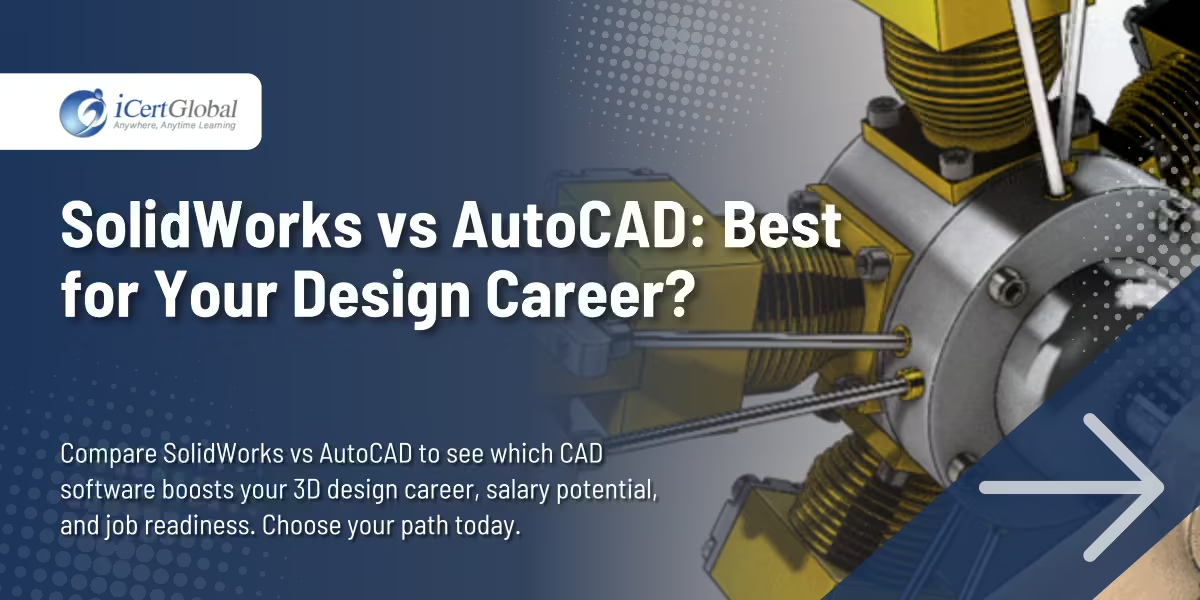
Compare SolidWorks vs AutoCAD to see which CAD software boosts your 3D design career, salary potential, and job
Our experts are ready to help you with any questions about courses, admissions, or career paths. Get personalized guidance from industry professionals.

Live online and classroom training in PMP, ITIL, Agile, Six Sigma and more, with exam support included.
Subscribe to our newsletter for the latest updates on certifications and training opportunities.
Search iCertGlobal for certifications, courses and articles.

"PMI®", "PMBOK®", "PMP®", "CAPM®" and "PMI-ACP®" are registered marks of the Project Management Institute, Inc. | "CSM", "CST" are Registered Trade Marks of The Scrum Alliance, USA. | COBIT® is a trademark of ISACA® registered in the United States and other countries.