


Lean Six Sigma Green Belt and Black Belt
Discover the true Lean Six Sigma certification cost for Green and Black Belts. Compare exam fees, career ROI,
Classroom Training and Live Online Courses
Stop the slow career climb. Get the integrated program that takes you from practitioner to leader in record time.
You're stuck in the middle - too experienced for entry-level quality roles, but lacking the credentials for senior process improvement positions. You watch Lean Six Sigma Green Belt professionals handle basic projects while Black Belts lead strategic initiatives worth crores. You're capable of both but certified for neither. Meanwhile, combo-certified professionals are fast-tracking into Continuous Improvement Manager and Operational Excellence Director roles by demonstrating both tactical execution and strategic leadership in half the time. Your applications get rejected because you don't check both boxes, and internal opportunities go to those who invested in comprehensive certification. That changes now. This isn't two separate courses duct-taped together. Our Lean Six Sigma Combo program is an integrated pathway designed by Master Black Belts who've led transformations at Rockwall, TX manufacturing giants and global capability centers - they understand that real process improvement requires both Green Belt problem-solving speed and Black Belt statistical depth. They've structured this program to build your capability progressively: master DMAIC fundamentals, certify through our Lean Six Sigma Green Belt course, then immediately advance to complex statistical methods and leadership without repeating content or wasting time. Unlike programs that make you complete Lean Six Sigma Green Belt training, wait months, then start Black Belt from scratch, we build complete improvement professionals efficiently. You'll learn to execute rapid improvement projects using basic statistical tools, then progress to designing experiments, performing multivariate analysis, and leading cross-functional teams through transformations that generate documented six-figure savings. The dual certification is the proof - the real value is becoming the versatile expert who can both execute tactical improvements and architect strategic transformation programs. We've built this for ambitious professionals who want maximum credentials in minimum time without compromising rigor. Consecutive training modules with flexible weekend and evening options, both levels fully interactive with separate project requirements. Every session recorded. Beyond the training, you get Green Belt and Black Belt project templates used in actual deployments, Minitab proficiency for both levels, 24/7 expert support, and dedicated mentoring for both your Green Belt and Black Belt projects - the dual project requirement that derails most combo candidates who attempt this alone. If you've ever wondered about Lean Six Sigma Green Belt certification cost or the Lean Six Sigma Green Belt salary advantage - it's simple: the return on investment is exponential. You're not just earning two credentials; you're building a career that scales from execution to leadership.
More Than Two Courses- It's Your Complete Transformation Roadmap
Progress directly from Lean Six Sigma Green Belt fundamentals into advanced Black Belt strategies without interruption. Each concept in our Lean Six Sigma Green Belt course builds upon the previous one for deeper mastery and practical application in real-world projects.
Compress a multi-year development cycle into months, positioning yourself for senior roles faster than peers taking the traditional, piecemeal approach.
Invest once in a comprehensive program and save up to 30% compared to enrolling in separate Green and Black Belt courses, maximizing your training budget.
Learn from certified MBBs who understand the full spectrum of process excellence, from shop-floor Kaizen events to boardroom strategy deployment.
Receive continuous, one-on-one coaching for both your mandatory Green Belt and Black Belt projects, ensuring a 100% completion and certification rate.
Learn one consistent, industry-aligned Lean Six Sigma methodology, integrating problem-solving frameworks used across top organizations. Avoid the confusion of mixing content from separate Lean Six Sigma Green Belt and Black Belt training providers.
As students enroll in the Lean Six Sigma Combo course in Rockwall, TX, they will develop skills in process improvement, data analysis, and problem-solving. This comprehensive program focuses on enhancing the participants' ability to identify and eliminate waste, streamline operations, and boost productivity. By mastering the tools and techniques of Lean Six Sigma, students will be equipped to address complex business challenges and drive innovation.
The course will cover various aspects of quality management, including the DMAIC framework, statistical process control, and root cause analysis. Students will learn to apply these methodologies to optimize business processes, reduce defects, and improve customer satisfaction. Upon completion of the course, participants will possess the knowledge and skills necessary to implement process improvements in a variety of settings, from manufacturing to healthcare.
The Lean Six Sigma Combo program will provide students with a solid foundation for a successful career in process improvement.
Tailored programs for teams with enterprise support
Get a custom quote for your organization's training needs.
The benefits of this course extend beyond the immediate skills gained. Participants will gain a deeper understanding of business operations and be able to analyze complex problems from a process perspective.
The Lean Six Sigma Combo program will not only enhance their technical skills but also provide them with the ability to think critically and creatively. This will enable students to make a meaningful impact in their organizations and advance their careers.
Note: The training location may be subject to change depending on the number of participants registered for the session and participant convenience. Confirmed venue details will be shared by email after enrollment.
Master process mapping, basic statistical analysis, root cause identification (Fishbone, 5 Whys), and FMEA to successfully lead and deliver well-defined improvement projects.
Go beyond the basics to master hypothesis testing, regression analysis, ANOVA, and DOE, allowing you to solve complex problems with multiple variables.
Systematically optimize processes by identifying the critical input variables that impact performance, moving beyond inefficient trial-and-error.
As you progress from Green Belt to leadership level, you'll learn to manage resistance, build coalitions, and communicate the financial impact of improvements. This skillset enhances your value and directly influences Lean Six Sigma Green Belt salary growth across industries.
Learn how to calculate and validate hard savings, soft savings, and the Cost of Poor Quality (COPQ) methods recognized by finance departments and auditors worldwide. This financial fluency is a hallmark of effective Lean Six Sigma Green Belt certification professionals.
Learn to manage a portfolio of improvement projects, align them with business strategy, and effectively coach and mentor Green Belts to build organizational capability.
This certification training is ideal for:
If you are committed to a career in operational excellence and want the fastest, most comprehensive path to a leadership role, this program is designed for your ambition.
In Rockwall, TX, professionals in various industries rely on the Lean Six Sigma Combo course to bridge a significant skill gap. By mastering the principles of Lean Six Sigma, they can drive business growth, improve efficiency, and boost profitability.
The program will equip students with the skills necessary to identify areas of improvement, develop solutions, and implement changes. As a result, they will be able to make a tangible impact on their organizations and contribute to their success.


The Combo Credential That Opens All Doors
Bypass the typical multi-year gap between Green and Black Belt, making you eligible for senior roles faster.
Gain the ability to both execute projects flawlessly and design high-level transformation strategies.
Enter the job market with a Black Belt credential from day one, skipping the intermediate Green Belt pay scale.
Lead strategic initiatives and mentor the next generation of Green Belts to drive organization-wide excellence.
The Lean Six Sigma Green Belt + Black Belt Integrated Certification is structured to take you from foundational understanding to expert-level mastery. There are no prerequisites to begin the training - everything you need to progress from Green Belt to Black Belt is included within the program.
No Prior Experience Required to Start: The program begins with the Green Belt curriculum, providing the complete foundation needed for success.
Completion of Green Belt Project: You must successfully complete your mentored Green Belt project before you can be awarded your Black Belt certification. This ensures you have practical experience applying the fundamentals.
Led & Completed Black Belt Project: You must then lead a second, more complex improvement project demonstrating the application of advanced Black Belt tools and delivering substantial financial impact.
Completion of Full Training & Exam: You must complete the entire 32 hour integrated curriculum and pass both the Green Belt and Black Belt certification exams.
Upon completing the Lean Six Sigma Combo course, students will possess a comprehensive understanding of process improvement methodologies and be able to apply them in real-world settings. The work responsibilities of a Lean Six Sigma practitioner include identifying opportunities for improvement, analyzing data, and implementing process changes.
They will work closely with stakeholders to understand business needs and develop solutions that meet those needs. By mastering the skills and knowledge gained in this course, participants will be well-equipped to take on leadership roles and drive business success.
Learn to create detailed process maps that expose hidden inefficiencies, bottlenecks, and redundancies in any workflow. Master the 8 Wastes of Lean to identify opportunities for immediate improvement.
Stop collecting useless data. Learn to create a data collection plan that is practical and statistically sound. Master foundational statistics (mean, median, standard deviation) and basic data visualization in Minitab.
Understand the principle of "garbage in, garbage out." Learn the basics of Gage R&R to determine if your measurement system is reliable. Get an introduction to Process Capability (Cp, Cpk) to establish a clear performance baseline.
Master essential graphical tools that help distinguish symptoms from true root causes. Learn to apply Pareto charts, histograms, box plots, and scatter plots to visually identify data patterns and relationships that guide impactful solutions.
Facilitate effective brainstorming and problem-solving sessions. Master the 5 Whys and Fishbone (Ishikawa) diagrams to uncover the true drivers of process problems.
Move from opinion-based debates to data-driven conclusions. Learn the fundamentals of hypothesis testing and perform basic statistical tests, like the 2-Sample t-test, to validate potential root causes with confidence.
Learn structured techniques for brainstorming effective solutions that go beyond obvious fixes. Master tools like the PICK chart and impact/effort matrix to prioritize solutions that deliver the biggest results.
Implement proven Lean solutions to eliminate waste and improve flow. Learn the fundamentals of 5S for workplace organization, basic mistake-proofing (Poka-Yoke), and how to conduct a small-scale Kaizen event.
Avoid large-scale failures by testing your solutions on a smaller scale first. Learn how to design and execute a pilot test, analyze results, and create a robust implementation plan for rollout.
Learn to distinguish between normal process variation and true problems. Design and implement basic control charts (X-bar & R, I-MR, P-charts) to monitor improved processes and ensure stability.
Create an effective control plan to ensure your improvements stick. Learn to develop standard work instructions and response plans so teams know exactly what to do when processes deviate.
Properly close your Green Belt project by quantifying benefits, documenting lessons learned, and handing over the improved process to the process owner for long-term success.
Identify projects that align with strategic business goals. Refine your chartering skills to secure executive sponsorship, funding, and cross-functional resources for complex initiatives.
Go beyond basic VOC. Learn advanced techniques like Kano analysis, conjoint analysis, and MaxDiff studies to prioritize conflicting customer needs and develop a data-driven understanding of satisfaction drivers.
Navigate complex organizational dynamics and manage resistance effectively. Strengthen your change leadership and communication planning skills to drive enterprise-wide transformation.
Achieve mastery over data integrity. Quantify measurement error for complex scenarios and confidently interpret %GRR, discrimination ratios, and distinct categories to validate system reliability.
Go beyond basic capability indices. Master analysis for non-normal distributions and account for multiple specifications, small samples, and real-world complexities.
Design robust data collection plans with advanced sampling methods like stratified, systematic, and cluster sampling. Determine the precise sample sizes needed for complex statistical tests.
Command the full range of statistical tests including t-tests, ANOVA, chi-square, proportion, and non-parametric alternatives. Learn to distinguish between statistical and practical significance.
Build and validate predictive models using linear, multiple, and polynomial regression. Interpret R-squared, residuals, and identify violations that could compromise results.
Deconstruct complex problems using Multi-Vari charts to reveal positional and cyclical variation patterns, enabling advanced root cause sessions beyond surface-level analysis.
Master DOE principles by designing and executing full and fractional factorial experiments to identify key factors and interactions that drive performance.
Use Response Surface Methodology (RSM) to find optimal process settings. Master central composite and Box-Behnken designs and balance multiple objectives with desirability functions.
Design robust, error-proof solutions using advanced Lean tools like Value Stream Mapping and SMED. Learn Design for Six Sigma (DFSS) principles to embed quality into new processes.
Design comprehensive control strategies for complex systems. Learn when to use advanced SPC techniques like EWMA and CUSUM charts and how to establish effective response plans.
Create resilient control plans and mentor Green Belts to build a culture of sustainable process excellence across the organization.
Quantify and validate project impact using finance-approved methods. Prepare compelling executive presentations that communicate results in business language, not just statistics.
Everything you need to know about our training options and support
In industries such as manufacturing, healthcare, and finance, the work responsibilities of a Lean Six Sigma practitioner are diverse and demanding. Participants in the Lean Six Sigma Combo course will learn to analyze complex systems, identify areas for improvement, and develop solutions that drive business growth.
By mastering the skills and knowledge gained in this course, they will be able to take on challenging work responsibilities and make a meaningful impact in their organizations. The Lean Six Sigma Combo program will provide students with the skills and confidence necessary to succeed in a variety of roles.
Great class, very informative.

Great PMP<sup>®</sup> Bootcamp. I had a great time taking this course. I took the course to prepare to sit for the CAPM<sup>®</sup> but may be able to sit for the PMP<sup>®</sup>. I learnt a lot was challenging. Great course. We need one more day. Content was very detailed.

it was a great class. Lots of energy. And I enjoyed.

Fantastic course to prepare for PMP<sup>®</sup> exam.

As a participant it was smooth sailing for me.

Trainer was excellent. Shared good resources and good experiences.

Good content and training.
I wanted to let you know that I took and passed the PMP exam. Thanks to iCertGlobal and especially my Cincinnati course instructor, who was an excellent teacher and helped me immensely.

Trainer was good. Trainer was very engaged and interacting. Very much satisfied with the training.

I was pleasantly surprised at the quality of this training. Yomi was awesome as a trainer and working to make sure that we understood the concepts. Controlling Cost and Controlling Risk are the most complicated, but Yomi spent time after class working through questions to help others understand. This class also helped to change my perception of the PMP being this MONSTER to something that I can I can successfully do.

Great class with a lot of information and tips to prepare for the exam

It was a great course, covered all the things that i ended up hitting road bumps on. I was the only one in the class, but the trainer was just as involved as if it had been a full class.

I was nervous about taking it online versus classroom; but I am actually glad I took it online. Instructor was very great and gave a good learning experience with his relevant project management experience.
The training was very intense but covered with course material. It was more than I expected.

I thought the class was very informative. The instructor did an excellent job breaking down each chapter to where it was easy to understand. I was also very impressed with his commitment to help us pass ever after the class is over.

Excellent training. Instructor was very knowledgeable and explained information in an understandable way
Quality Materials presented, Instructor very knowledgeable. Exceeded my expectations.
The training is a great introduction into the PMI mindset. Very informative and helpful

Explore our instructor-led Lean Six Sigma Combo training to learn about the course duration, cost, eligibility, and certification process. You get practical learning, exam-focused preparation, and expert guidance. Ready to get started? Compare Lean Six Sigma Combo certification training options and choose a classroom or live online format that fits your schedule.
Explore Our Lean Six Sigma Combo certification training is available in a city near you
Stay updated with the latest insights and trends in your field
Discover the true Lean Six Sigma certification cost for Green and Black Belts. Compare exam fees, career ROI,
Master the DMAIC process with a practical, step-by-step example. Learn how to solve process issues, pass your exam,
Learn how to identify and execute high-impact projects. Master Lean Six Sigma project selection to drive business results
Advance your career by mastering Six Sigma belt levels. Learn the differences between Yellow, Green, and Black Belts
Master the DMAIC methodology and pass your Six Sigma Green Belt Certification Exam. Learn proven study strategies to
Advance your career with Lean Six Sigma Green Belt skills. Explore the top 10 industries actively hiring certified
Master essential lean six sigma principles to pass your certification exam, eliminate process waste, and advance your career.
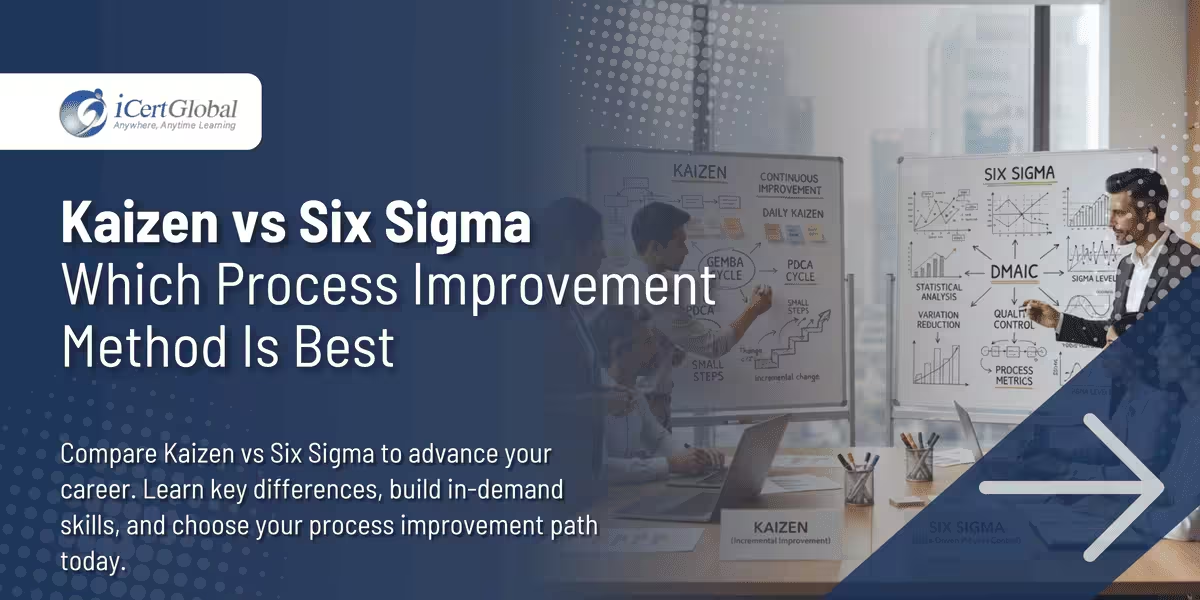
Compare Kaizen vs Six Sigma to advance your career. Learn key differences, build in-demand skills, and choose your
Advance your career by mastering quality management. Discover the key differences between Six Sigma and TQM to choose
.avif)
Master the DMAIC framework and boost your career. Learn how to achieve Six Sigma Green Belt Certification with
Our experts are ready to help you with any questions about courses, admissions, or career paths. Get personalized guidance from industry professionals.

Live online and classroom training in PMP, ITIL, Agile, Six Sigma and more, with exam support included.
Subscribe to our newsletter for the latest updates on certifications and training opportunities.
Search iCertGlobal for certifications, courses and articles.

"PMI®", "PMBOK®", "PMP®", "CAPM®" and "PMI-ACP®" are registered marks of the Project Management Institute, Inc. | "CSM", "CST" are Registered Trade Marks of The Scrum Alliance, USA. | COBIT® is a trademark of ISACA® registered in the United States and other countries.