





Lean Six Sigma Green Belt and Black Belt
Discover the true Lean Six Sigma certification cost for Green and Black Belts. Compare exam fees, career ROI,
Gain practical expertise in DMAIC methodology and process improvement through hands-on case studies, expert-led live training sessions, and 16 contact hours of classroom instruction in Chicago.
The Lean Six Sigma Green Belt Certification Training in Chicago, IL equips professionals with expertise to lead process improvement projects and drive operational excellence. Delivering 16 contact hours, this Six Sigma Green Belt course Chicago provides in-depth exploration of the DMAIC framework. The curriculum aligns Lean tools with Agile methods and PMI standards, enabling leaders to achieve measurable quality results. Through practical exercises and real world case studies, participants master statistical tools to eliminate waste and optimize business workflows. This comprehensive program prepares professionals to direct strategic quality initiatives and accelerate executive leadership careers across diverse modern corporate business environments.
Attend sessions during Lean Six Sigma Green Belt Certification Training in Chicago, IL led by certified Master Black Belts.
Complete a standardized curriculum through our Six Sigma Green Belt course Chicago aligned with IASSC quality bodies of knowledge.
Receive comprehensive Green Belt exam prep materials, lifetime toolkit access, and Minitab templates for your career.
Earn an elite qualification through LSSGB Training in Chicago validating your capability to manage high impact continuous improvement.
Benefit from continuous learning guidance throughout your professional journey to resolve questions and study confidently.
Earn 35 professional development units to satisfy continuing educational requirements for PMP and related credentials.
The need for process improvement is a fundamental aspect of organizational success, and obtaining Lean Six Sigma Green Belt certification provides a clear understanding of the methods and tools necessary for achieving this goal. In today's business environment, companies in Chicago, IL are constantly seeking ways to streamline operations and reduce waste. This certification demonstrates an individual's ability to use statistical methods to analyze and improve processes. A critical component of process improvement is identifying and addressing variability, which can be achieved through the use of control charts and statistical process control. By understanding how to apply these tools, Lean Six Sigma Green Belt certified professionals can effectively analyze and improve processes, leading to increased efficiency and productivity. The certification program provides a comprehensive understanding of these statistical methods, as well as other key tools such as the PDCA cycle and root cause analysis.
In practice, a Lean Six Sigma Green Belt certified professional will be able to analyze current processes and identify areas for improvement, using data-driven decision making to drive change. This expertise will enable individuals to make a tangible impact on their organization's performance, resulting in cost savings and improved customer satisfaction. The Lean Six Sigma Green Belt certification is a widely recognized and respected credential in the business world, and obtaining this certification demonstrates an individual's commitment to process improvement and quality management. Companies in Chicago, IL, as well as globally, require professionals who can apply data-driven methods to drive process improvement and efficiency. By earning this certification, individuals can demonstrate their expertise in these areas and enhance their professional credibility. Upon completion of the certification program, professionals will have a clear understanding of the DMAIC methodology and how to apply it to real-world problems.
They will also be able to use a variety of statistical tools and techniques, including hypothesis testing and regression analysis, to analyze and improve processes. This expertise will enable individuals to make a significant impact on their organization's performance and contribute to its ongoing success. In a business environment where quality and efficiency are paramount, the skills and knowledge gained through the Lean Six Sigma Green Belt certification program are highly valued. In Chicago, IL, companies are constantly seeking professionals who can apply data-driven methods to drive process improvement and efficiency. By earning this certification, individuals can enhance their career prospects and make a meaningful contribution to their organization's success.

Get a custom quote for your organization's training needs.
Through the Lean Six Sigma Green Belt certification program, individuals gain a comprehensive understanding of process improvement methods and tools, including statistical process control, control charts, and the PDCA cycle. These skills and knowledge are essential for professionals seeking to analyze and improve processes, and are highly valued in the business world.
By mastering these tools and techniques, individuals can effectively drive process improvement and efficiency in their organization. The certification program provides a detailed understanding of the tools and methods necessary for process improvement, including statistical analysis and data-driven decision making.
This expertise will enable individuals to identify areas for improvement and develop effective solutions, using a combination of statistical analysis and business acumen. Upon completion of the program, professionals will have a clear understanding of how to apply these skills and knowledge in real-world situations.
Note: The training location may be subject to change depending on the number of participants registered for the session and participant convenience. Confirmed venue details will be shared by email after enrollment.
Master five core phases Define, Measure, Analyze, Improve, and Control to resolve complex business inefficiencies systematically.
Utilize analytical frameworks including Fishbone diagrams, Pareto charts, and FMEA to uncover process vulnerabilities.
Acquire statistical monitoring skills during Lean Six Sigma Green Belt Certification Training in Chicago, IL for operational stability.
Apply proven methods like Value Stream Mapping, 5S, and Kanban to eliminate non-value activities across workflows.
Gain practical proficiency through LSSGB Training in Chicago using statistical analysis software for evidence-based decision making.
Measure operational metrics and capability indices including Cp and Cpk to ensure deliverables meet specifications.
Cultivate leadership skills necessary to direct multidisciplinary quality teams and maintain alignment.
You can enroll in the Lean Six Sigma Green Belt Certification Training in Chicago, IL to significantly boost your project management capabilities and lead high-impact process improvement initiatives across diverse industries. The training helps professionals develop the critical analytical skills required to streamline workflows, optimize quality, and reduce operational costs. Most importantly, it enables professionals to deliver measurable financial results and strategic project outcomes that align perfectly with organizational goals.
In a business context where process improvement is critical, the skills and knowledge gained through the Lean Six Sigma Green Belt certification program are highly relevant. In Chicago, IL, companies are constantly seeking professionals who can apply data-driven methods to drive process improvement and efficiency.
The certification program provides a comprehensive understanding of statistical methods, process improvement tools, and quality management principles, making it an essential credential for professionals seeking to make a meaningful contribution to their organization's success. The certification process involves a combination of classroom instruction and hands-on experience, providing a comprehensive understanding of process improvement methods and tools.
Individuals will learn how to apply statistical methods, such as hypothesis testing and regression analysis, to analyze and improve processes. The certification program also covers key quality management principles, including the DMAIC methodology and the PDCA cycle.


Our Lean Six Sigma Green Belt Certification Training in Chicago, IL prepares you to eliminate waste and optimize workflows.
Utilize quantitative tools and root cause analysis methodologies to mitigate risk, resolve quality defects, and deliver sustainable business solutions.
Securing recognized LSSGB certification Chicago credentials positions candidates for top management roles across competitive corporate job markets.
Generate substantial financial savings, enhance output, and improve customer satisfaction across organizational operations.
Enrollment in Lean Six Sigma Green Belt Certification Training in Chicago, IL requires no formal prerequisites, welcoming diverse professionals.
Eligibility Criteria:
Professional Background: This Six Sigma Green Belt course Chicago suits project managers, quality analysts, and continuous improvement practitioners.
Methodology Knowledge: Basic understanding of operational processes supports optimal classroom learning.
Data Aptitude: Comfort with foundational analytical concepts assists successful Green Belt exam prep studies effectively.
Upon completion of the Lean Six Sigma Green Belt certification program, professionals will have a clear understanding of how to apply statistical methods to analyze and improve processes. In a business environment where data-driven decision making is critical, this expertise is highly valued. Companies in Chicago, IL, and globally, require professionals who can apply statistical methods and process improvement tools to drive efficiency and cost savings.
The certification program provides a detailed understanding of statistical analysis, data-driven decision making, and process improvement methods, including the DMAIC methodology and statistical process control. These skills and knowledge are essential for professionals seeking to analyze and improve processes, and are highly valued in the business world. By mastering these tools and techniques, individuals can effectively drive process improvement and efficiency in their organization.
In a business context where process improvement is critical, the skills and knowledge gained through the Lean Six Sigma Green Belt certification program are highly relevant. The certification program provides a comprehensive understanding of process improvement methods and tools, and is a widely recognized and respected credential in the business world.
Build detailed process documentation before attempting improvement. In our Lean Six Sigma Green Belt course, you will learn to create value stream maps, detailed process flowcharts, and data collection plans that specify what to measure, how to measure it, who will collect the data, and how to ensure data integrity throughout the Measure phase. This is a crucial skill for every Lean Six Sigma Green Belt certified professional aiming to drive measurable process improvements.
Master the statistical foundation required for hypothesis testing. Learn to calculate and interpret measures of central tendency (mean, median, mode), measures of dispersion (range, variance, standard deviation), understand normal distributions, Z-scores, and probability concepts that underpin all advanced statistical analysis.
Validate your measurement system before trusting the data. You will learn to conduct Gage Repeatability & Reproducibility (GR&R) studies using ANOVA method, assess attribute agreement analysis, interpret %GRR and number of distinct categories, and determine whether your measurement system is adequate for process capability assessment and decision-making.
Quantify whether your process can meet customer specifications. Learn to calculate Cp, Cpk, Pp, Ppk indices, interpret capability metrics, understand short-term versus long-term capability, calculate defects per million opportunities (DPMO), determine sigma levels, and communicate capability gaps that justify improvement investments to leadership.
Master the statistical rigor that separates Green Belts from Yellow Belts. You will learn hypothesis testing theory, Type I and Type II errors, significance levels, p-values, power analysis, and how to select appropriate tests (1-sample t-test, 2-sample t-test, paired t-test, chi-square, ANOVA) based on data type and business questions.
Identify and quantify relationships between variables. Learn to create scatter plots, calculate correlation coefficients, distinguish correlation from causation, conduct simple linear regression, interpret R-squared values, assess residuals, and use regression equations for prediction and process optimization that withstands statistical scrutiny.
Move beyond obvious symptoms to identify true root causes. You will master advanced techniques including multi-vari studies, failure modes and effects analysis (FMEA), fault tree analysis, and systematic brainstorming methods that generate implementable solutions rather than theoretical improvements that never get executed.
Learn to optimize processes through controlled experimentation instead of trial-and-error guessing. Master DOE terminology, full factorial designs, fractional factorial designs, screening designs, analyze main effects and interactions, interpret Pareto charts of effects, and identify optimal factor settings that maximize quality while minimizing cost.
Evaluate improvement alternatives objectively. In our Lean Six Sigma Green Belt certification course, you will learn to conduct cost-benefit analysis, create solution selection matrices, design pilot studies, implement improvements on a controlled scale, collect validation data, and prepare for full-scale implementation with risk mitigation strategies. This ensures your Lean Six Sigma Green Belt certified status reflects practical, real-world capability.
Implement monitoring systems that sustain improvements after project closure. You will learn control chart theory, rational subgrouping, calculate control limits, distinguish common cause from special cause variation, select appropriate charts (X-bar/R, I-MR, p, c, u), and train operators to use control charts for real-time process monitoring.
Create comprehensive control systems. Learn to develop control plans that specify what to measure, measurement frequency, who is responsible, reaction plans for out-of-control conditions, and documentation standards. Understand process audit procedures, standard operating procedure (SOP) updates, and how to transfer ownership to process owners for long-term sustainability.
Close projects with documented results that earn recognition. You will learn to calculate hard savings, soft savings, cost avoidance, validate financial benefits with finance departments, create executive-level presentations, document lessons learned, and complete project closure reports that satisfy certification body requirements and position you for promotion.
Lean Six Sigma Green Belt certified professionals are equipped with the skills and knowledge necessary to analyze and improve processes, using data-driven decision making to drive change. In Chicago, IL, companies are constantly seeking professionals who can apply statistical methods and process improvement tools to drive efficiency and cost savings. By earning this certification, individuals can enhance their career prospects and make a meaningful contribution to their organization's success.
The certification program covers key quality management principles, including the PDCA cycle and root cause analysis, as well as statistical methods such as hypothesis testing and regression analysis. By mastering these skills and knowledge, individuals can effectively drive process improvement and efficiency in their organization. The certification program is designed to provide a comprehensive understanding of statistical methods and process improvement tools.
Upon completion of the certification program, professionals will be able to apply data-driven decision making to drive process improvement and efficiency in their organization. In a business environment where quality and efficiency are paramount, this expertise is highly valued. Companies in Chicago, IL, and globally, require professionals who can apply data-driven methods to drive process improvement and efficiency.
Great class, very informative.

Great PMP<sup>®</sup> Bootcamp. I had a great time taking this course. I took the course to prepare to sit for the CAPM<sup>®</sup> but may be able to sit for the PMP<sup>®</sup>. I learnt a lot was challenging. Great course. We need one more day. Content was very detailed.

it was a great class. Lots of energy. And I enjoyed.

Fantastic course to prepare for PMP<sup>®</sup> exam.

As a participant it was smooth sailing for me.

Trainer was excellent. Shared good resources and good experiences.

Good content and training.
I wanted to let you know that I took and passed the PMP exam. Thanks to iCertGlobal and especially my Cincinnati course instructor, who was an excellent teacher and helped me immensely.

Trainer was good. Trainer was very engaged and interacting. Very much satisfied with the training.

I was pleasantly surprised at the quality of this training. Yomi was awesome as a trainer and working to make sure that we understood the concepts. Controlling Cost and Controlling Risk are the most complicated, but Yomi spent time after class working through questions to help others understand. This class also helped to change my perception of the PMP being this MONSTER to something that I can I can successfully do.

Great class with a lot of information and tips to prepare for the exam

It was a great course, covered all the things that i ended up hitting road bumps on. I was the only one in the class, but the trainer was just as involved as if it had been a full class.

I was nervous about taking it online versus classroom; but I am actually glad I took it online. Instructor was very great and gave a good learning experience with his relevant project management experience.
The training was very intense but covered with course material. It was more than I expected.

I thought the class was very informative. The instructor did an excellent job breaking down each chapter to where it was easy to understand. I was also very impressed with his commitment to help us pass ever after the class is over.

Excellent training. Instructor was very knowledgeable and explained information in an understandable way
Quality Materials presented, Instructor very knowledgeable. Exceeded my expectations.
The training is a great introduction into the PMI mindset. Very informative and helpful

Explore our instructor-led Lean Six Sigma Green Belt training to learn about the course duration, cost, eligibility, and certification process. You get practical learning, exam-focused preparation, and expert guidance. Ready to get started? Compare Lean Six Sigma Green Belt certification training options and choose a classroom or live online format that fits your schedule.
Explore Our Lean Six Sigma Green Belt certification training is available in a city near you
Stay updated with the latest insights and trends in your field
Discover the true Lean Six Sigma certification cost for Green and Black Belts. Compare exam fees, career ROI,
Master the DMAIC process with a practical, step-by-step example. Learn how to solve process issues, pass your exam,
Learn how to identify and execute high-impact projects. Master Lean Six Sigma project selection to drive business results
Advance your career by mastering Six Sigma belt levels. Learn the differences between Yellow, Green, and Black Belts

Master the DMAIC methodology and pass your Six Sigma Green Belt Certification Exam. Learn proven study strategies to

Advance your career with Lean Six Sigma Green Belt skills. Explore the top 10 industries actively hiring certified

Master essential lean six sigma principles to pass your certification exam, eliminate process waste, and advance your career.
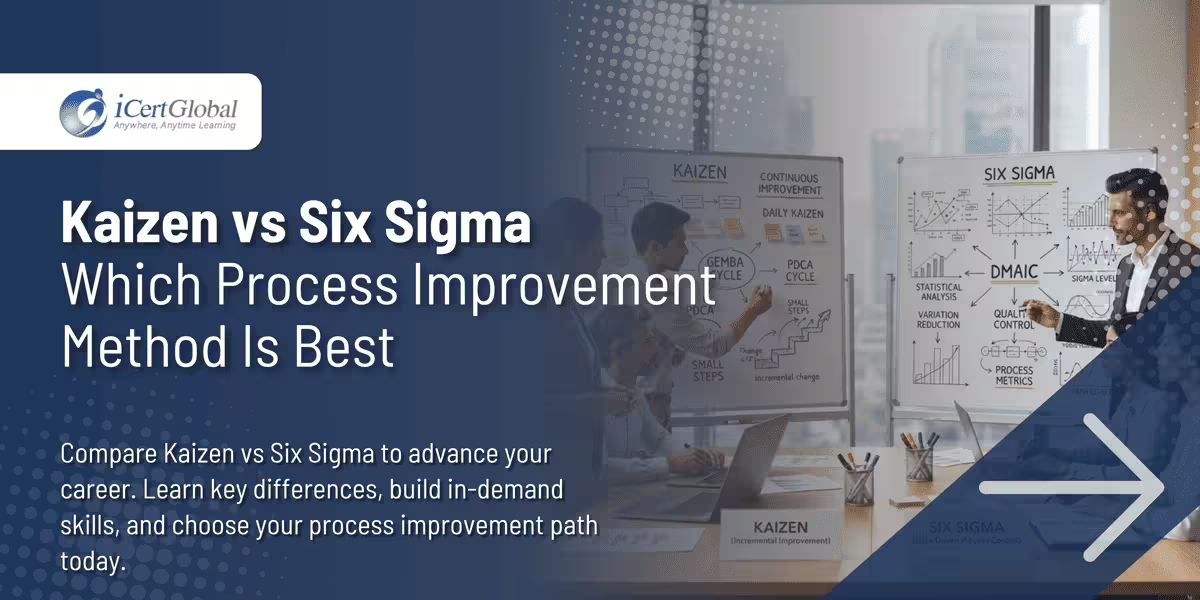
Compare Kaizen vs Six Sigma to advance your career. Learn key differences, build in-demand skills, and choose your
Advance your career by mastering quality management. Discover the key differences between Six Sigma and TQM to choose
.avif)
Master the DMAIC framework and boost your career. Learn how to achieve Six Sigma Green Belt Certification with
Our experts are ready to help you with any questions about courses, admissions, or career paths. Get personalized guidance from industry professionals.

Live online and classroom training in PMP, ITIL, Agile, Six Sigma and more, with exam support included.
Subscribe to our newsletter for the latest updates on certifications and training opportunities.
Search iCertGlobal for certifications, courses and articles.

"PMI®", "PMBOK®", "PMP®", "CAPM®" and "PMI-ACP®" are registered marks of the Project Management Institute, Inc. | "CSM", "CST" are Registered Trade Marks of The Scrum Alliance, USA. | COBIT® is a trademark of ISACA® registered in the United States and other countries.