



ITIL 4 Foundation vs Practitioner: Certification Path Explained
Compare ITIL 4 Foundation vs Practitioner. Discover which certification aligns with your career goals, boosts your salary, and
Stop being just a senior developer or a solution architect. Get the globally-recognized credential that validates your ability to design enterprise-level strategy and unlocks the C-suite salary bands.
You are likely stuck in the "implementation trap." You are the one fixing the code, patching the servers, and putting out fires caused by short-sighted decisions made three years ago. You understand the systems better than anyone, yet you are still reporting to managers who don't know a microservice from a monolith. Meanwhile, Enterprise Architecture professionals holding the TOGAF 9 Certification are the ones making the decisions, defining the roadmap, and commanding billing rates 30-50% higher than yours. They don't fix bugs; they design the future of the business. Your resume may be getting filtered out by HR systems at major IT consultancies and MNCs because it lacks the standard vocabulary associated with high-level strategy. You might have the experience, but without the right credential, your profile may be overlooked for Principal Architect and Chief Architect roles. This certification can help strengthen your professional profile and improve its alignment with senior-level opportunities. This isn't a theoretical history lesson on The Open Group. Our TOGAF 9 training course is built by practicing Enterprise Architects who have restructured chaotic IT landscapes in Santa Clarita, CA's tech parks and financial districts. They have dealt with legacy spaghetti code, resistant stakeholders, and budget constraints. They have built this program to teach you the Architecture Development Method (ADM) not as a dry academic exercise, but as a weapon to cut through corporate bureaucracy and enforce technical standards. Unlike "dump-and-run" bootcamps that hand you a PDF and wish you luck, we build architectural thinking. You will learn how to bridge the gap between business strategy and IT execution. The exam is just the hurdle - the real value is walking into a boardroom and explaining why a multi-million dollar migration is necessary, using the precise governance frameworks that executives respect. We have designed this program for working IT professionals who cannot afford to waste time. Weekday evening and weekend batches are fully interactive, with live Q&A sessions. Beyond the training, you get practical case studies, 24/7 expert support, and a direct path to passing the TOGAF 9 Combined exam—saving you the time and cost of taking Level 1 and Level 2 separately.
Don't risk your time with unaccredited providers. Our material is fully aligned with The Open Group standards for the TOGAF 9 Certification.
Learn from industry veterans who are TOGAF 9 Certified and actively consulting for Fortune 500 companies.
Aim for the certification without quitting your job. Choose from weekday-evening, weekend-only, or intensive corporate bootcamps.
We don't drag it out. Our curriculum covers both Foundation and Certified levels simultaneously to get you fully qualified faster.
Stop guessing. Access hundreds of exam-style questions for both the multiple-choice Level 1 and the complex scenario-based Level 2.
Industry experts are available around the clock to clarify complex ADM concepts and assist you at every turn.
As organizations navigate complex IT landscapes, they require frameworks to guide enterprise architecture implementation. The TOGAF 9 Certification Training Program teaches professionals the Adaptive, Integrated, and Enterprise Architectures methodologies to foster growth in their careers. By mastering these frameworks, individuals can scale their skills in alignment with shifting business requirements.
The TOGAF 9 standard establishes an enterprise architecture methodology that supports IT service management and governance, aligning it with service-oriented architecture (SOA) principles. Professionals understand that integrating business architecture with information systems planning and development is essential for organizational strategy alignment. To achieve this, expertise in SOA is crucial for architects to design and implement scalable, flexible, and adaptive systems.
In Santa Clarita, CA, professionals working in the enterprise architecture department can benefit from this training to enhance their knowledge of TOGAF 9 standard, thereby increasing their value to their employers. By developing skills in integration, architects can improve the quality of IT service delivery, which contributes significantly to organizational growth.

Get a custom quote for your organization's training needs.
As an Enterprise Architect, individuals play a crucial role in designing IT architectures that align with business strategy. TOGAF 9 Certification Training Program equips professionals with the skills to define and implement enterprise architecture, driving business change through strategic and incremental architecture planning. This enables organizations to adapt to new business models while maintaining a strong connection to existing technology investments.
The training program emphasizes the importance of architectural governance, ensuring that architecture development is aligned with business objectives and aligned to enterprise architecture principles. Professionals understand that effective architecture governance provides the foundation for integration and transformation across the organization. This typically includes an understanding of the IT service management (ITSM) framework and service-oriented architecture (SOA).
Professionals in Santa Clarita, CA, with a focus on enterprise architecture can leverage TOGAF 9 certification to expand their understanding of governance, integration, and transformation, enabling them to assume more significant roles and participate in critical business decisions.
Master the core engine of TOGAF. You will learn the cyclical process of creating and managing enterprise architectures, from Vision to Migration Planning.
Stop letting politics kill your projects. You will learn to identify stakeholder concerns and view the architecture through their specific viewpoints to secure buy-in.
Control the chaos. You will develop the structures and boards necessary to ensure projects actually conform to the architecture you designed.
Define the reality. You will learn to rigorously document the baseline architecture, define the target architecture, and identify exactly what needs to change to bridge the gap.
Stop reinventing the wheel. You will learn how to classify and reuse architecture assets, moving from generic industry standards to organization-specific solutions.
Link IT to value. You will learn to articulate business problems and requirements in a way that ensures the technical solution delivers actual ROI.
If you are involved in the design, planning, or oversight of IT infrastructure and strategy, this program is engineered to validate your expertise.
TOGAF 9 Certification Training Program enhances professional credibility among architects by validating their expertise in applying TOGAF 9 standard principles to real-world scenarios. This certification demonstrates their proficiency in enterprise architecture, IT service management, and ITIL frameworks, signifying their ability to contribute to strategic business planning and decision-making.
The training emphasizes the importance of adapting to changing business needs and market conditions, which enables architects to bridge the gap between business requirements and technology solutions. Professionals understand that building trust with stakeholders is essential in this context, emphasizing the need to communicate technical solutions effectively in business-friendly terms.
In Santa Clarita, CA, organizations can benefit from hiring professionals with TOGAF 9 certification to ensure that IT services are aligned with business strategy. This expertise enables businesses to establish a strong connection between technology and business goals, leading to increased efficiency, productivity, and competitiveness.
Major global consultancies and Global Capability Centers (GCCs) require Enterprise Architecture certification for senior roles.
Move from being a "technical resource" to a strategic advisor who speaks the language of business transformation.
As AI and cloud complexity grows, the need for structured Enterprise Architecture is exploding, not shrinking.
Unlike other restrictive certifications, The Open Group focuses on knowledge, not gatekeeping based on years of service.3 However, do not mistake "open eligibility" for "easy."
No Formal Prerequisites: There are no educational or experience requirements to take the TOGAF 9 certification exam.4
Recommended Experience: While not mandatory, we strongly recommend successful candidates have at least 3-5 years of experience in IT, modeling, or system design. The concepts are abstract and difficult to grasp without a reference point in reality.
Assessment: You must pass both Part 1 (Foundation) and Part 2 (Certified) exams to achieve the full TOGAF 9 Certified status.5
The TOGAF 9 Certification Training Program emphasizes the importance of understanding enterprise architecture principles, such as business capability and business architecture. This enables professionals to define and implement IT architectures that align with the organization's business objectives and contribute to strategic business planning.
The training explores the relationship between enterprise architecture and IT service management, illustrating how architects can use the TOGAF 9 standard to develop IT service management frameworks. This typically involves an understanding of service-oriented architecture (SOA) and the importance of architectural governance in ensuring alignment.
For professionals in Santa Clarita, CA, this training provides a valuable opportunity to enhance their skills in enterprise architecture, IT service management, and ITIL frameworks, ensuring that their knowledge stays relevant in an ever-changing business environment.
Learn how to set up the architecture capability. Master the inputs and outputs of the Preliminary phase and how to define the scope, stakeholders, and business goals in Phase A. This is where the TOGAF 9 Certification tests your ability to start correctly.
Dive into the business layer. Learn how to describe the baseline and target business architecture, analyze gaps, and define the roadmap from a business perspective.
Split into Data and Application architectures. Learn the intricacies of designing the data entity and application component blueprints that support the business vision.
Map the software to the hardware. Learn to define the technology portfolio and technical standards required to support the applications and data.
Shift from design to planning. Learn how to identify major implementation projects, group them into work packages, and build a realistic Migration Plan that delivers business value.
Master the art of oversight. Learn how to govern the implementation projects through architecture contracts and how to manage changes to the architecture once it is live.
Master the tools of the trade. Learn the specifics of Gap Analysis, Stakeholder Management, and Risk Management. Understand when to iterate the ADM and how to apply it at different levels of the enterprise.
Understand the deliverables. Learn the metamodel that describes the artifacts (catalogs, matrices, diagrams) you must produce during the ADM cycle.
Learn how to classify architecture assets. Master the Architecture Repository and the concept of the continuum, moving from Foundation Architectures to Organization-Specific Architectures.
Study the TRM (Technical Reference Model) and the III-RM (Integrated Information Infrastructure Reference Model). These are legacy concepts but are critical high-index topics for the TOGAF 9 exam.
Learn how to establish an architecture practice within a company. Covers the Architecture Board, compliance reviews, and the skills framework for architects.
A brutal review of Level 1 facts and Level 2 scenario logic. We dissect how The Open Group words their questions to trick you and how to select the "best" answer in the gradient scoring system of Part 2.
The TOGAF 9 Certification Training Program bridges the skill gap between business strategy and IT solution implementation by focusing on enterprise architecture, IT service management, and TOGAF 9 standard principles. This enables professionals to develop skills in defining and implementing IT architectures that align with business objectives.
The training program highlights the importance of integrating business architecture with information systems planning and development, illustrating how architects can use the TOGAF 9 standard to develop IT service management frameworks. This typically involves an understanding of service-oriented architecture (SOA) and the importance of architectural governance in ensuring alignment.
In Santa Clarita, CA, professionals working in the enterprise architecture department can enhance their knowledge of TOGAF 9 standard, enabling them to address skill gaps related to integration, transformation, and IT service management, ultimately benefiting their employers' growth and success.
Great class, very informative.

Great PMP<sup>®</sup> Bootcamp. I had a great time taking this course. I took the course to prepare to sit for the CAPM<sup>®</sup> but may be able to sit for the PMP<sup>®</sup>. I learnt a lot was challenging. Great course. We need one more day. Content was very detailed.

it was a great class. Lots of energy. And I enjoyed.

Fantastic course to prepare for PMP<sup>®</sup> exam.

As a participant it was smooth sailing for me.

Trainer was excellent. Shared good resources and good experiences.

Good content and training.
I wanted to let you know that I took and passed the PMP exam. Thanks to iCertGlobal and especially my Cincinnati course instructor, who was an excellent teacher and helped me immensely.

Trainer was good. Trainer was very engaged and interacting. Very much satisfied with the training.

I was pleasantly surprised at the quality of this training. Yomi was awesome as a trainer and working to make sure that we understood the concepts. Controlling Cost and Controlling Risk are the most complicated, but Yomi spent time after class working through questions to help others understand. This class also helped to change my perception of the PMP being this MONSTER to something that I can I can successfully do.

Great class with a lot of information and tips to prepare for the exam

It was a great course, covered all the things that i ended up hitting road bumps on. I was the only one in the class, but the trainer was just as involved as if it had been a full class.

I was nervous about taking it online versus classroom; but I am actually glad I took it online. Instructor was very great and gave a good learning experience with his relevant project management experience.
The training was very intense but covered with course material. It was more than I expected.

I thought the class was very informative. The instructor did an excellent job breaking down each chapter to where it was easy to understand. I was also very impressed with his commitment to help us pass ever after the class is over.

Excellent training. Instructor was very knowledgeable and explained information in an understandable way
Quality Materials presented, Instructor very knowledgeable. Exceeded my expectations.
The training is a great introduction into the PMI mindset. Very informative and helpful

Explore our instructor-led TOGAF 9 training to learn about the course duration, cost, eligibility, and certification process. You get practical learning, exam-focused preparation, and expert guidance. Ready to get started? Compare TOGAF 9 certification training options and choose a classroom or live online format that fits your schedule.
Explore Our TOGAF 9 certification training is available in a city near you
Stay updated with the latest insights and trends in your field
Compare ITIL 4 Foundation vs Practitioner. Discover which certification aligns with your career goals, boosts your salary, and
Explore the top 10 IT service management best practices for modern business, from ITIL 5 and AI automation
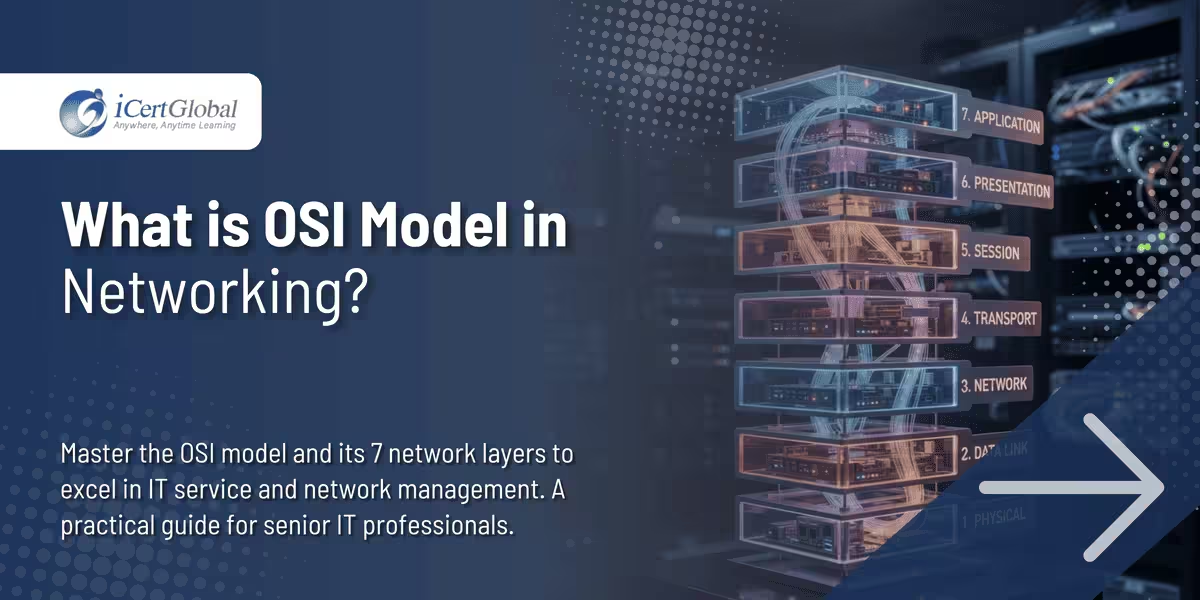
Master the OSI model and its 7 network layers to excel in IT service and network management. A
Learn the top benefits of ITIL certification and how it boosts your IT career and organizational value.
Learn how businesses keep their technology like computers and internet running well with ITSM and ITIL.
Learn what COBIT is and why it matters for managing technology in businesses.
Learn about the key responsibilities, skills, and career path of a Service Desk Manager.

Explore the top high-paying programming languages for 2026 and gain in-demand skills to boost your career, stay competitive,
Master frontend frameworks to accelerate your career. Compare React, Angular, Vue, Svelte, and Next.js to build modern web
Harness the power of Data Science in IT Process Management to streamline operations, improve decision-making, and maximize efficiency
Our experts are ready to help you with any questions about courses, admissions, or career paths. Get personalized guidance from industry professionals.
Request a Call Back

"PMI®", "PMBOK®", "PMP®", "CAPM®" and "PMI-ACP®" are registered marks of the Project Management Institute, Inc. | "CSM", "CST" are Registered Trade Marks of The Scrum Alliance, USA. | COBIT® is a trademark of ISACA® registered in the United States and other countries.

